Northwest Profiles
The Clay Whisperer
Clip: Season 39 Episode 5 | 7m 13sVideo has Closed Captions
Ceramic artist Chris Kelsey explores natural processes that shape both land and human experience.
Christopher Kelsey is a ceramic artist based in Spokane, Washington. His sculpture and pottery work explores themes of change, memory, and the natural processes that shape both land and human experience. In 2008, he co-founded Trackside Studio, a working studio and gallery shared with fellow clay artists.
Problems playing video? | Closed Captioning Feedback
Problems playing video? | Closed Captioning Feedback
Northwest Profiles is a local public television program presented by KSPS PBS
Funding for Northwest Profiles is provided by Idaho Central Credit Union, with additional funding from the Friends of KSPS.
Support provided by:

Northwest Profiles
The Clay Whisperer
Clip: Season 39 Episode 5 | 7m 13sVideo has Closed Captions
Christopher Kelsey is a ceramic artist based in Spokane, Washington. His sculpture and pottery work explores themes of change, memory, and the natural processes that shape both land and human experience. In 2008, he co-founded Trackside Studio, a working studio and gallery shared with fellow clay artists.
Problems playing video? | Closed Captioning Feedback
How to Watch Northwest Profiles
Northwest Profiles is available to stream on pbs.org and the free PBS App, available on iPhone, Apple TV, Android TV, Android smartphones, Amazon Fire TV, Amazon Fire Tablet, Roku, Samsung Smart TV, LG TV, and Vizio.
Providing Support for PBS.org
Learn Moreabout PBS online sponsorshipThe more you make, the better you'll get, you can't just sit around and plan.
You have to keep your hands in the mud and just keep trying stuff, that was the best advice I ever got.
was "do it again" I fell in love with just making shapes with clay, because you can make anything out of it for the most part.
>>Making objects with clay is a popular hobby and pastime for people who want to dip their toe into the world of ceramic art.
In the case of Chris Kelsey, it's more than a hobby.
He coalesced his passion for still photography by adding a passion for ceramics and in 2007, he teamed up with fellow ceramic artist Mark Moore and opened trackside studio ceramic art gallery in Spokane.
He subsequently brought in Gina Freuen, as a display artist early on.
All three artists bring years of experience in creating ceramic pieces of art and share with each other their expertise and love of the craft.
(Kelsey) So, Pottery is always there and I love throwing' there's so many avenues with, with ceramics I might be down too many avenues, but it keeps it interesting all the time.
>>As we watched Chris take some clay and place it on a wheel and sprinkle a bit of water over it, it was amazing how quickly he formed the shape of a pot as it turned around and around in a circle.
>>I just like the shape or the form and not know how I'm going to glaze it, or fire it.
So that's the gamble, I guess.
But it's also the fun, make something and then make decisions along the way, which most art really is that way anyway.
>>Meticulous planning and execution are required in creating each of his sculpture pieces.
Take these wall sculptures.
Lines flow from one slab of clay to another to create rough jagged patterns carved from the piece, that flow when displayed together.
And here... Chris carefully cuts out predetermined shapes from slabs of clay, these separate pieces consisting of flat and round surfaces, will eventually be fused together in the ceramic firing process.
>>Ceramic art is really a traditional art form.
Thousands of years ago, people were doing amazing artwork with this stuff.
And whereas we're still trying to figure out how they how they made it, how they glazed it, you know, we don't have all the answers yet of how they were masters at doing this.
Well, I have three firing methods that I use, thanks to friends that we all share and fire together.
The simplest one is the electric kiln here in the studio, the electric kiln is a real controlled atmosphere.
There's plenty of oxygen, the heat's even.
There's nothing swirling around in the kiln to change the pots.
So, you basically have a glaze, you know what it's going to look like, you put the glaze on the pot, fire it, and that's what's going to come out.
>>Two other types of firing methods are what is called atmospheric, whereby the kiln's atmosphere, which are vaporized materials like smoke or flames.. another is the addition of ingredients like soda in a soda kiln.
Both methods interact during the firing process to create unique surfaces all happening without having to apply a glaze beforehand.
>>Anytime you fire ceramics, silica molecules leave that material.
They're constantly leaving as the clay matures.
And so, when you introduce ash or soda to those kilns, it, it either traps the silica against the surface or integrates with it and forms a glass material on the pots and glazes them.
>>Constructed from donated materials, Chris cleared a spot on his property and went about drawing out plans to create a specialized kiln, based on a Japanese Anagama kiln.
>>I built a wood fired kiln, which is very ancient method of doing this.
it's a mysterious outcome, which is always, intriguing.
And lessons are learned, each firing of how to do it better.
the wood kiln.
I built is.
I call it the Kurorukamegama because it looks like a turtle crawling.
In Japanese it's a crawling turtle kiln.
I have dreamed about doing this for a long time.
And I just love the idea of having a real amagama kiln, all my art is about process for the most part, and building the kiln was also a huge process.
My kiln is a cross-draft kiln, meaning there's a firebox on one side.
And then you stack the ware and the flue is on the opposite side.
the flames just go in one way.
Part of the art of wood firing is how you load the kiln.
So, where you want the ash to build up on the pot and glaze it, that needs to face the firebox because it's all going towards that then out the back.
This is the front side where it totally four days of ash got here.
And, and glaze this pot.
Whereas the other side, since it had no glaze on it when it went in, it just got this little kiss on the back where the rest is, is not so much.
Most of my sculpture has multiple forms in it, and the way they're put together and the proximity between them, I want them to look like they're shifting or moving.
And some, some kind of connections between different parts of the sculpture to make you look around it more.
I like them to be to look off balance a little bit.
And then once if it gets a good surface on it, then it's really good.
A ceramic hand-built piece is a one-of-a-kind thing.
I just I love the process so much.
There's lots of ups and downs, but in the end, it's what I want to do.
I really can't imagine doing something else.
♪
Video has Closed Captions
Preview: S39 Ep5 | 30s | Geocaching, painter Josh Harnack, ceramics artist Chris Kelsey, and home cook Suwanee Lennon. (30s)
 New
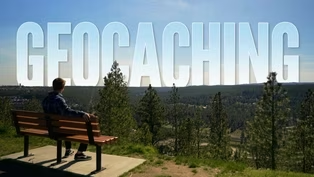
NewGeocaching: A New Way To Explore
Video has Closed Captions
Clip: S39 Ep5 | 6m 16s | Join us on a high-tech treasure hunt where we’ll learn about Geocaching, at home and abroad. (6m 16s)
 New
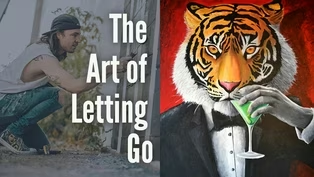
NewThe Art of Letting Go with Artist Josh Harnack
Video has Closed Captions
Clip: S39 Ep5 | 7m 10s | Artist Josh Harnack turns adversity into creativity, shaping a life of resilience and art. (7m 10s)
 New
NewVideo has Closed Captions
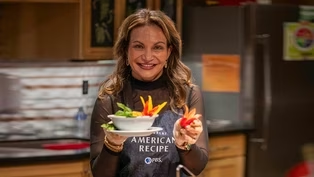
Clip: S39 Ep5 | 5m 29s | From Thailand to Spokane, Suwanee Lennon shares her story through food and community. (5m 29s)
Providing Support for PBS.org
Learn Moreabout PBS online sponsorship












Support for PBS provided by:
Northwest Profiles is a local public television program presented by KSPS PBS
Funding for Northwest Profiles is provided by Idaho Central Credit Union, with additional funding from the Friends of KSPS.