Northwest Profiles
Geocaching: A New Way To Explore
Clip: Season 39 Episode 5 | 6m 16sVideo has Closed Captions
Join us on a high-tech treasure hunt where we’ll learn about Geocaching, at home and abroad.
Geocaching started in the early 2000s, shortly after the U.S. government made GPS technology available for civilian use. Geocaching is often described as a high-tech treasure hunt, but what you’ll find might surprise you. Northwest Profiles Producer, Neil Vanos, explores the world of geocaching, and discovers the many treasures hidden in our own backyard.
Problems playing video? | Closed Captioning Feedback
Problems playing video? | Closed Captioning Feedback
Northwest Profiles is a local public television program presented by KSPS PBS
Funding for Northwest Profiles is provided by Idaho Central Credit Union, with additional funding from the Friends of KSPS.
Support provided by:

Northwest Profiles
Geocaching: A New Way To Explore
Clip: Season 39 Episode 5 | 6m 16sVideo has Closed Captions
Geocaching started in the early 2000s, shortly after the U.S. government made GPS technology available for civilian use. Geocaching is often described as a high-tech treasure hunt, but what you’ll find might surprise you. Northwest Profiles Producer, Neil Vanos, explores the world of geocaching, and discovers the many treasures hidden in our own backyard.
Problems playing video? | Closed Captioning Feedback
How to Watch Northwest Profiles
Northwest Profiles is available to stream on pbs.org and the free PBS App, available on iPhone, Apple TV, Android TV, Android smartphones, Amazon Fire TV, Amazon Fire Tablet, Roku, Samsung Smart TV, LG TV, and Vizio.
Providing Support for PBS.org
Learn Moreabout PBS online sponsorshipThere's treasure hidden around us, that anyone can go and find.
It's called geocaching and it's been around since the early 2000s.
My name is Neil Vanos.
I'm a video producer at KSPS PBS, located in Spokane, Washington.
Here, the great outdoors isn't something we take for granted.
It's woven into our everyday experience.
It's a part of who we are.
So I wanted to know, whos hiding all these caches, and how do I find them?
After doing some research online, I decided to dig a little deeper.
I emailed Jon Stanley.
He works as a senior data scientist for geocaching.com, has been geocaching since the very beginning, and has traveled all over the world.
People like to describe geocaching as a High-Tech Treasure Hunt.
There's an instinct, I think, that appeals to humans to to go look for something that's hidden.
It just seems to capture that that essence.
Okay, so here's the gist.
People hide containers called caches anywhere.
Parks.
Trails.
Downtowns.
Beaches.
Even on top of mountains.
Then they post the coordinates online.
When a player wants to find a cache, they download the geocaching app, use their phones GPS to locate the cache, and get outside to enjoy the adventure.
That's it.
Okay, well, we have crossed the desert and the mountain ridge and the river, and now we're on the final approach to a geocache here at Palisades.
Geocaches come in all sizes and designs.
It's in fact, it's only limited by people's creativity really.
It started off as five gallon buckets, but it didn't take long before people were finding pill containers.
You can just put a log in that.
So there are a few items in here.
This is the log book.
That's where people sign their names to say that they visited.
And then I'm going to take out this.
It's called a trackable, specifically a travel bug.
As you can see here.
And players can log these in and out of geocaches.
We want to put everything back the way we found it.
So naturally, I had to try it!
First thing, I had to suit up and get ready for the great outdoors.
That's better.
Next I opened the geocaching app and looked for a cache nearby.
I couldn't believe it.
There were caches all over the city.
I found one close by and was out the door.
It was time to find my first cache.
How hard could it be?
Where is this thing?
Maybe this is going to be harder than I thought.
I probably looked a bit confused at first, but after a few minutes I saw it.
Okay, let's take a look here.
My first find, signed a log book, left a sticker.
Then I wondered who else was geocaching.
I think the people who really get into the game are the ones who embrace the culture.
We have a lot of really passionate people, and the thing is, they're really good people.
I met up with Ashley Steinhart, an avid geocacher, to learn more about how geocachers help their community.
Well, today we're doing what we call a CITO: cache in, trash out, C I T O, and it's where we get together and pick up trash.
It's our way of giving back to the community.
So we have agreements with all the parks in Spokane and a lot of areas, also state parks where we get to place caches.
And it's a lot of that is that they understand that we are a positive benefit to the area.
We pick up after ourselves and other people.
Oh, why do I love geocaching?
For me, it is a frame for the adventures that I seek.
I like to get out in the woods and do stuff, and I don't often know where to go.
So for me, geocaching shows me the places that other people have found that are fantastic.
It's about getting out and finding things and seeing things that I wouldn't necessarily otherwise find.
They say that the Pacific Northwest is the birthplace of geocaching, and it's easy to see why.
But as geocaching grew more popular, it spread all over the world.
In 2025, there were over 3 million caches across 248 countries.
There are caches hidden in amazing places and a few that might surprise you.
Like Antarctica, the top of Mount Everest, at the bottom of the ocean, and even in the International Space Station.
So many people think that they're going to go out and find gold bouillon or something in a cache and, no, you're going to find broken kids toys, and soggy stuffed animals, and that sort of thing.
You will be disappointed if you go for the stuff.
It's about the experience.
It's taken me to so many places.
I've now been to 33 countries geocaching.
I've seen some amazing sites.
I didn't find gold.
I found something better.
A new way to see the place I call home, and an opportunity to see the world.
There's an adventure hiding around every corner.
You just have to look for it.
Video has Closed Captions
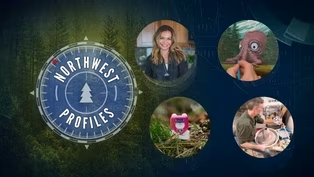
Preview: S39 Ep5 | 30s | Geocaching, painter Josh Harnack, ceramics artist Chris Kelsey, and home cook Suwanee Lennon. (30s)
 New
NewVideo has Closed Captions
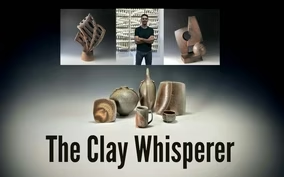
Clip: S39 Ep5 | 7m 13s | Ceramic artist Chris Kelsey explores natural processes that shape both land and human experience. (7m 13s)
 New
NewThe Art of Letting Go with Artist Josh Harnack
Video has Closed Captions
Clip: S39 Ep5 | 7m 10s | Artist Josh Harnack turns adversity into creativity, shaping a life of resilience and art. (7m 10s)
 New
NewVideo has Closed Captions
Clip: S39 Ep5 | 5m 29s | From Thailand to Spokane, Suwanee Lennon shares her story through food and community. (5m 29s)
Providing Support for PBS.org
Learn Moreabout PBS online sponsorship











Support for PBS provided by:
Northwest Profiles is a local public television program presented by KSPS PBS
Funding for Northwest Profiles is provided by Idaho Central Credit Union, with additional funding from the Friends of KSPS.