Northwest Profiles
April 2026
Season 39 Episode 5 | 29m 44sVideo has Closed Captions
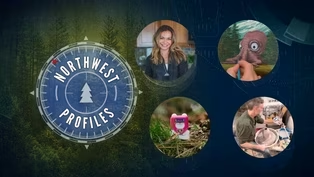
Geocaching, painter Josh Harnack, ceramics artist Chris Kelsey, and chef Suwanee Lennon.
Join us on a high-tech treasure hunt where we’ll learn about Geocaching, at home and abroad. See an award-winning artist from Edmonton, who brings the joy of laughter to his work. We’ll discover ceramics from a Spokane based artist, who’s taking the artform to a new level. And, we’ll meet Suwanee Lennon, a local home chef who represented Spokane on The Great American Recipe.
Problems playing video? | Closed Captioning Feedback
Problems playing video? | Closed Captioning Feedback
Northwest Profiles is a local public television program presented by KSPS PBS
Funding for Northwest Profiles is provided by Idaho Central Credit Union, with additional funding from the Friends of KSPS.
Support provided by:

Northwest Profiles
April 2026
Season 39 Episode 5 | 29m 44sVideo has Closed Captions
Join us on a high-tech treasure hunt where we’ll learn about Geocaching, at home and abroad. See an award-winning artist from Edmonton, who brings the joy of laughter to his work. We’ll discover ceramics from a Spokane based artist, who’s taking the artform to a new level. And, we’ll meet Suwanee Lennon, a local home chef who represented Spokane on The Great American Recipe.
Problems playing video? | Closed Captioning Feedback
How to Watch Northwest Profiles
Northwest Profiles is available to stream on pbs.org and the free PBS App, available on iPhone, Apple TV, Android TV, Android smartphones, Amazon Fire TV, Amazon Fire Tablet, Roku, Samsung Smart TV, LG TV, and Vizio.
Providing Support for PBS.org
Learn Moreabout PBS online sponsorshipHere we are, together again.
It's Northwest Profiles for April.
Good evening, and welcome to an all new edition of North West Profiles on KSPS PBS.
I'm Tom McArthur.
Our first course tonight.
You may recognize Suwanee Lennon from PBSs The Great American Recipe.
But her story begins far fro the studio lights across oceans, across cultures, in kitchens filled with memory.
Each dish tells a story.
Each flavor a piece of hom carried with her and re-imagined along the way.
Im Suwanee.
I'm a Thai food blogger and photographer in Spokane.
[Voiceover] We first met Suwanee in the summer of 2025, when she was a contestant on PBS “The Great American Recipe.” But her journey began lon before our cameras ever rolled.
I grew up in a small village in Thailand, in the northeast called Isan Region.
And it has about 300 people.
It's a leprosy village, meaning people that were infected by leprosy were sent to my village to live there.
I did not know anything else.
I was there as an infant until I was 13 years old.
So growing up in the leprosy village was something that was not abnormal or unusual for me.
[Voiceover] As a teenager, Suwanee was adopted by an American woman, and her life changed in ways she could have never imagined.
I moved from Thailand to the US when I was 13 years old, and that transition was extremely difficult, was a learning process.
And the one thing that I did not want to let go of was the language and the food.
And My American family were extremely supportive.
They would take me to the Asian markets and let me pick out ingredients.
And so, yeah, at 13 I was just experimenting putting this and that together.
But they never complained about the taste at that time.
You know, like if they didn't like it I didn't know it.
[Voiceover] What began as experimentation in the kitchen grew into something more, a passion that would eventually catch the attention of a national casting team.
So for The Great American Recipe, I was contacted by a casting agent and it just came out of nowhere.
It was a complete surprise for me.
And then, I just realized that going on a show like this, it wasn't just about me.
It was about telling the stories of the people that I grew up with.
The people with leprosy, in a small village of 300 people.
The people that don't have a voice, the people that were oppressed and suppressed and were so, outcast, weren't accepted by society.
And I wanted to tell that story, even if it's a small group of people.
I wanted to use my experience, my voice, to share with the world that these people do exist.
[Voiceover] And Suwanee was selected as one of eight home cooks to compete on season four of “The Great American Recipe.” Welcome back to “The Great American Recipe.” [Pen scratches] Cooking in my kitchen, I have so much fun.
It's relaxing.
It's like therapy for me.
And then cooking for a competition, we had limited time with “The Great American Recipe.” [Your time starts now!]
And within those 60 minutes, we had to get this dish together.
And on top of that, you know, talking to the judges, and cooking in a new kitchen, it takes some adjusting and adapting and it slows you down a bit, too.
So it's just a lot of pressure.
Alejandra: Welcome back, cooks.
It is time to announce the 3 home cooks who will be moving on to the big finale next week for the chance to be named this season's winner of "The Great American Recipe."
Tiffany: The final cook making it to next week's finale is... Coby!
[Cheering] [Voiceover] She narrowly missed a spot in the finale, but for Suwanee, the experience was never just about winning.
It was about sharing her story.
And even after the show, that story continues to bring people together.
Since the show ended I've been busy doing many different things.
Watch parties.
[Chef Suwanee, this is just one of many accomplishments,] [but its one to celebrate.]
[And we are so thankful youre celebrating here with the] [Feast family] [and with all your amazing community!]
[So.]
[”Great American Recipe”] [to chef Suwanee!]
[Cheering] Cooking classes.
So in an American grocery stor you usually have Italian basil.
Thai basil have purple stems.
They always have purple stems.
But even as her schedule fills, Suwanee remains grounded in where she came from, carrying forward the lessons she learned from her village.
So Feed My Village is a personal mission of mine to feed the elderly in my village.
It started when I was 13.
My Thai mom, before I left the village, brought me to say goodbye to each person in my village, and as we were saying goodbye to each one of them, elderly with leprosy handed me Thai baht, Thai bills.
And I didn't understand that until way later when I was looking back and I kind of reflecting on the story and realize it was such a big, giving moment on their parts that they had so little but they give me what they had.
And it stuck with me.
And I told myself, when I'm able, when the timing is right, I'm going to go back and I want to feed them, I want to give back to them.
[Voiceover] And in Spokane, she's found something similar, a community that reflects the same spirit of generosit and connection she grew up with.
It has been really a just a humbling experience to see people, Spokane being so supportive of me and just kind of rallying behind me, you know, with the watch parties at Feast and at the station, how people just showed up.
It was just incredible.
It is a beautiful community of people.
Reminds me of my village, Yeah, it's a small group of people, but it's also like a family.
We show up for people that we know and we want them to be successful.
And so I'm very thankful for our Spokane community.
Through food, Suwanee Lennon honors the past while shaping something new.
It's more than a meal.
It's a bridge between worlds, a way of bringing people together.
To experienc her journey for yourself, visit simplysuwanee.com and step into her kitchen.
I'll be right there.
Ceramic art has never bee more accessible, and more people than ever are discovering the joy of working with clay.
In Spokane one artist is not only embracing that movement but helping to push it forward.
Chris Kelsey has quickly found his place among a community of makers who are redefining what's possible - shaping, firing and experimenting in ways that challenge tradition.
I fell in love with just making shapes with clay, because you can make anything out of it for the most part.
>>Making objects with clay is a popular hobby and pastime for people who want to dip their toe into the world of ceramic art.
In the case of Chri Kelsey, it's more than a hobby.
He coalesced his passion for still photography by adding a passion for ceramics and in 2007, he teamed up with fellow ceramic artist Mark Moore an opened trackside studio ceramic art gallery in Spokane.
He subsequently brought in Gina Freuen, as a display artist early on.
All three artists bring years of experience in creating ceramic pieces of art and share with each other thei expertise and love of the craft.
(Kelsey) So, Pottery is always there and I love throwing' there's so many avenues with, with ceramics I might be down too many avenues, but it keeps it interesting all the time.
>>As we watched Chris take some clay and place it on a wheel and sprinkle a bit of water over it, it was amazing how quickly he formed the shape of a pot as it turned around and around in a circle.
>>I just like the shape or th form and not know how I'm going to glaze it, or fire it.
S that's the gamble, I guess.
But it's also the fun, make something and then make decisions along the way, which most art really is that way anyway.
>>Meticulous planning and execution are required in creating each of his sculpture pieces.
Take these wall sculptures.
Lines flow from one slab of clay to another to create rough jagged patterns carved from the piece, that flow when displayed together.
And here... Chris carefully cuts out predetermined shapes from slabs of clay, these separate pieces consisting of flat and round surfaces, will eventually be fused together in the ceramic firing process.
>>Ceramic art is really traditional art form.
Thousands of years ago, people were doing amazing artwork with this stuff.
And whereas we're still trying to figure out how they how they made it, how they glazed it, you know, we don't have all the answers yet of ho they were masters at doing this.
Well, I have three firing methods that I use, thanks to friends that we all share and fire together.
The simplest one is the electric kiln here in the studio, the electric kiln is a real controlled atmosphere.
There's plenty of oxygen, the heat's even.
There's nothing swirling around in the kiln to change the pots.
So, you basically have a glaze, you know what it's going to look like, you put the glaze on the pot, fire it, and that's what's going to come out.
>>Two other types of firing methods are what is called atmospheric, whereby the kiln' atmosphere, which are vaporized materials like smoke or flames.. another is the addition of ingredients like soda in a soda kiln.
Both methods interact during th firing process to create unique surfaces all happening without having to apply a glaze beforehand.
>>Anytime you fire ceramics, silica molecules leave that material.
They're constantly leaving as the clay matures.
And so, when you introduce ash or soda to those kilns, it, it either traps the silica agains the surface or integrates with it and forms a glass material on the pots and glazes them.
>>Constructed from donate materials, Chris cleared a spot on his property and went about drawing out plans to create a specialized kiln, based on a Japanese Anagama kiln.
>>I built a wood fired kiln which is very ancient method of doing this.
it's a mysterious outcome, which is always, intriguing.
And lessons are learned, each firing of how to do it better.
the wood kiln.
I built is.
I call it the Kurorukamegama because it looks like a turtle crawling.
In Japanese it's a crawling turtle kiln.
I have dreamed about doing this for a long time.
And I just love the idea of having a real amagama kiln, all my art is about process for the mos part, and building the kiln was also a huge process.
My kiln is a cross-draft kiln, meaning there's a firebox on one side.
And then you stac the ware and the flue is on the opposite side.
the flames just go in one way.
Part of the art of wood firing is how you load the kiln.
So, where you want the ash to build up on the pot and glaze it, that needs to face the firebox because it's all going towards that then out the back.
This is the front side where it totally four days of ash got here.
And, and glaze this pot.
Whereas the other side, since it had no glaze on it when it went in, it just got this little kiss on the back where the rest is, is not so much.
Most of my sculpture has multiple forms in it, and the way they're put together and the proximity between them, I want them to look like they're shifting or moving.
And some, some kind of connections between different parts of the sculpture to make you look around it more.
I like them to be to look off balance a little bit.
And then once if it gets a good surfac on it, then it's really good.
A ceramic hand-built piece is a one-of-a-kind thing.
I just I love the process so much.
There's lots of ups and downs, but in the end, it's what I want to do.
I really can't imagine doing something else.
For Chris, the secret to great ceramics is simple.
keep your hands in the mud.
Don't overthink it - Just start making.
Because the more you create, the better you become.
Next, we head outdoors t explore the world of geocaching.
A modern-day treasure hunt powered by GPS and curiosity.
The rewards aren't gold or silver, but something just as meaningful: discovery adventure and connection.
Producer Neil Vanos and our team set out to see what makes this global game so compelling.
There's treasure hidden around us, that anyone can go and find.
It's called geocaching and it's been around since the early 2000s.
My name is Neil Vanos.
I'm a video producer at KSPS PBS, located in Spokane, Washington.
Here, the great outdoors isn't something we take for granted.
It's woven into our everyday experience.
It's a part of who we are.
So I wanted to know, whos hiding all these caches, and how do I find them?
After doing some research online, I decided to dig a little deeper.
I emailed Jon Stanley.
He works as a senior data scientist for geocaching.com, has been geocaching since the very beginning, and has traveled all over the world.
People like to describe geocaching as a High-Tech Treasure Hunt.
There's an instinct I think, that appeals to humans to to go look for something that's hidden.
It just seems to capture that that essence.
Okay, so here's the gist.
People hide containers called caches anywhere.
Parks.
Trails.
Downtowns.
Beaches.
Even on top of mountains.
Then they post the coordinates online.
When a player wants to find a cache, they download the geocaching app, use their phones GPS to locate the cache, and get outside to enjoy the adventure.
That's it.
Okay, well, we have crossed the desert and the mountain ridge and the river, and now we're on the final approac to a geocache here at Palisades.
Geocaches come in all sizes and designs.
It's in fact, it's only limite by people's creativity really.
It started off as five gallon buckets, but it didn't take long before people were finding pill containers.
You can just put a log in that.
So there are a few items in here.
This is the log book.
That's where people sign thei names to say that they visited.
And then I'm going to take out this.
It's called a trackable, specifically a travel bug.
As you can see here.
And players can log these in and out of geocaches.
We want to put everything back the way we found it.
So naturally, I had to try it!
First thing, I had to suit up and get ready for the great outdoors.
That's better.
Next I opened the geocaching app and looked for a cache nearby.
I couldn't believe it.
There were caches all over the city.
I found one close by and was out the door.
It was time to find my first cache.
How hard could it be?
Where is this thing?
Maybe this is going to be harder than I thought.
I probably looked a bit confused at first, but after a few minutes I saw it.
Okay, let's take a look here.
My first find, signed a log book, left a sticker.
Then I wondered who else was geocaching.
I think the people who really get into the game are the ones who embrace the culture.
We have a lot of really passionate people, and the thing is, they're really good people.
I met up with Ashley Steinhart, an avid geocacher, to learn more about how geocachers help their community.
Well, toda we're doing what we call a CITO: cache in, trash out, C I T O, and it's where we get together and pick up trash.
It's our wa of giving back to the community.
So we have agreements with all the parks in Spokane and a lot of areas, also state parks where we get to place caches.
And it's a lot of that is that they understand that we are a positive benefit to the area.
We pick up after ourselves and other people.
Oh, why do I love geocaching?
For me, it is a fram for the adventures that I seek.
I like to get out in the woods and do stuff, and I don't often know where to go.
So for me, geocaching shows me the places that other people have found that are fantastic.
It's about getting out and finding things and seeing things that I wouldn't necessarily otherwise find.
They say that the Pacific Northwest is the birthplace of geocaching, and it's easy to see why.
But as geocaching grew more popular, it spread all over the world.
In 2025, there were over 3 million caches across 248 countries.
There are caches hidden in amazing places and a few that might surprise you.
Like Antarctica, the top of Mount Everest, at the bottom of the ocean, and even in the International Space Station.
So many people think that they're going to go out and find gold bouillon or something in a cache and, no, you're going to find broken kids toys, and soggy stuffed animals, and that sort of thing.
You will be disappointed if you go for the stuff.
It's about the experience.
It's taken me to so many places.
I've now been to 33 countries geocaching.
I've seen some amazing sites.
I didn't find gold.
I found something better.
A new way to see the plac I call home, and an opportunity to see the world.
There's an adventure hiding around every corner.
You just have to look for it.
Want to try geocaching for yourself?
Visit geocaching.com to learn how to get started, or connect with fellow enthusiasts through the Washington State Geocaching Association at wsgaonline.online.org.
Artists often find joy in their work.
But for Josh Harnack that joy becomes something more.
His art is infused with whimsy, humor, and a sense of play that feels almost effortless.
Even after facing significant health challenges as a young adult, Josh holds tightly to his creativity, choosing to nurture the same curiosit and wonder that first drew him to art.
I love doing arts.
Anything creativ where I can just express myself has always been like a big thing in my life.
my name is Josh.
I'm born and raised in Edmonton.
Lived there my whole life.
no artist in my family.
I'm a pioneer that way.
But painting wasn't my original pursuit.
I actually really wanted to be an actor, Josh has always been creative and while art was part of that, it was in junior high that he discovered drama and became convinced acting was his true calling.
Even so he continued taking art classes, especially ones where he had creative freedom.
there's an Art 31 class.
I could just do five projects, self led, whatever I wanted, And I love the teacher.
He said, have you thought about doing the Whyte Avenue Artwalk, I got a little six foot section, and I didn't have business cards or a tablecloth or anything.
I just had art propped up ended up selling a couple paintings and I thought, wow, this is really awesome.
So now I can take that money and buy more art supplies with it.
As graduation approached, Jos faced a life altering challenge.
He was diagnosed with cancer the first the longer I sat with it more I realized I don't know how much longer I'm going to have So mine is will spend my time doing whatever I want with it, rather than maybe just trying to make the most money or do something that's really safe.
in 2013, Josh moved to Vancouver to enroll in film school.
But during a visit hom that same year, he learned that his cancer had returned, this time in his stomach.
After 20 rounds of radiation, Josh was cancer free.
He returned to Vancouve to complete his final semester, and while continuing to pursue acting, he began experimenting with new artistic techniques.
This led to his first series of paintings inspired by the idea of an inner animal, a collection that even caught the attention of his dentist, who purchased the series for his office.
just eight months after returning to Vancouver, Josh's cancer returned, this time between his lungs.
So I had to do chemotherapy for that.
And that one totally kicked my butt.
Like they have a pamphlet of all the symptoms that you might get.
I got every single one of them.
After becoming cancer free a third time, Josh's passion for acting took a backseat as his identity as an artist began to take center stage.
And then I graduated and got an agent, and I auditioned and booked a couple small things.
in that process, I was just so broke living in Vancouver, So I was just on my social media being like, who wants to commission a painting for, like 40 bucks?
Josh decided to try something new.
After spotting a Craigslist ad asking for a ceiling mural.
and then that kind of snowballed into me doing more art, which snowballed into me wanting to change career paths and go back to school for practical art with graphic design.
I moved back to Edmonton, went to Northern Alberta Institute of Technology, And then at the same time, I got a job working for a marketing agency.
So I was a designer there going to school.
While attending school, Josh created a new and highly successful series of paintings, his take on the RCMP reimagined as the Royal Canadian Mammal Police.
Josh also develope skills in graphic communication, branding and advertising.
Tools that would carry over into his art.
He even began to explore writing.
I got an opportunity to design and publish books, And then I would get th manuscript design and do covers And my boss one day was like, hey, you're doing a lot of great art.
Why don't yo write your own book?
And I thought what a great opportunity to reflect on my life, all the little nudge that pushed me down this path and the reason why I'm creating and why I love it so much, and then tell them as kind of fun, teachable moments I love doing anything where I can express myself.
And I think a little bit is A.D.D., as soon as I do something for a little bit, I get bored with i and I want to do something new, something exciting, something challenging.
I've cast my net fairly wide, like going from paintings to a mural is exciting because it seems like the new novel thing then once I've done a few murals, I'm like, I kind of want to go back to the studio.
well, now I don't actuall want to work with my hands more.
So that's why I like the sculpture part comes in and then I just want to sit on my laptop.
why I love the design side too.
art for me, the variety that comes with it is like infinitely exciting because it's always changing and evolving.
And I think that's my favorite part of it This is the start of a big venture for Josh Harnack, aspiring artist in Edmonton.
I just saw 6000 paintings on Facebook Marketplace.
Welcome to this historic moment.
This is what I bought.
6000 of these.
Oh, my God, I transforming them into playful and imaginative new works.
playful stuff is my nature.
I really love kind of something more whimsical.
I really love to make people laugh, which is one of the reason why I wanted to do film and TV.
and I try to bring some of that into my artwork where what I'm creating sometimes is a little bit more spontaneous, I don't necessarily always know what I'm going to paint, but I start by painting a bit of a blob and then just let the shapes kind of start dictating.
So I'm kind of like in the journey in real time, While Josh enjoys bringing humor and spontaneity into his work, he also finds meaning i creating art for his community.
moving forward, I would really love to do more art that is not just for me in my own practice helping the community and using my skills as like in service of.
for somebody to trust me in honor of, like a police office who passed away in portraiture.
And then having to rise to that occasion make something really meaningful that will last in the community for the next maybe 20 or 30 years.
with support from the Edmonton Arts Council.
Josh recently had the opportunity to expand his skills during an artist residency in France.
I love doing residencies.
being an artist, you know, usually make a ton of money.
So if I can use art as a way of traveling and seeing the world and havin that impact me and my artwork, there's nothing better.
Explore more of Josh Harnack' work on his website: Harnack.ca, or follow him on Instagram, where he continues to share his imaginative and uplifting creations.
Northwest Profiles is so often a program about exploring, Rudyard Kipling writes in his poem The Explorer in 1898.
Something hidden.
Go and find it.
Go and look behind the ranges.
Something lost behind the ranges.
Lost and waiting for you.
Go.
Thank you for exploring the great Pacific Northwest with us here on Northwest Profiles.
Do you know of someone or somewhere we should explore in the future program?
Tell us online at ksps.org.
I'm Tom MacArthur.
See you again soon.
Bye for now.
Video has Closed Captions
Preview: S39 Ep5 | 30s | Geocaching, painter Josh Harnack, ceramics artist Chris Kelsey, and home cook Suwanee Lennon. (30s)
Providing Support for PBS.org
Learn Moreabout PBS online sponsorship












Support for PBS provided by:
Northwest Profiles is a local public television program presented by KSPS PBS
Funding for Northwest Profiles is provided by Idaho Central Credit Union, with additional funding from the Friends of KSPS.