Africa's Great Civilizations
Cities | Hour Four
Episode 4 | 52m 1sVideo has Closed Captions
Explores the great African cities and their wealth and industry.
Gates explores the power of Africa’s greatest ancient cities, including Kilwa, Great Zimbabwe and Benin City, whose wealth, art and industrious successes attracted new European interest and interaction along the continent’s east and west coasts.
From
Problems playing video? | Closed Captioning Feedback
Problems playing video? | Closed Captioning Feedback
Major corporate support for Africa's Great Civilizations is provided by Bank of America, Johnson & Johnson, and Ancestry. Major funding is also provided by The Andrew W. Mellon Foundation, the...
Africa's Great Civilizations
Cities | Hour Four
Episode 4 | 52m 1sVideo has Closed Captions
Gates explores the power of Africa’s greatest ancient cities, including Kilwa, Great Zimbabwe and Benin City, whose wealth, art and industrious successes attracted new European interest and interaction along the continent’s east and west coasts.
From
Problems playing video? | Closed Captioning Feedback
How to Watch Africa's Great Civilizations
Africa's Great Civilizations is available to stream on pbs.org and the free PBS App, available on iPhone, Apple TV, Android TV, Android smartphones, Amazon Fire TV, Amazon Fire Tablet, Roku, Samsung Smart TV, and Vizio.
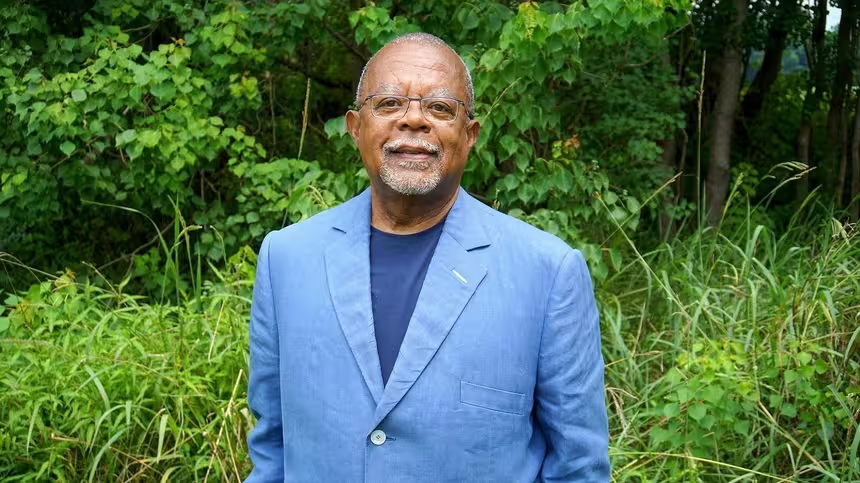
Explore Our Shared Histories
Stream more from Professor Henry Louis Gates, Jr. through iconic series like Making Black America, Finding Your Roots, and The Black Church. Discover the ancestry of diverse, influential people and delve into the rich history and culture of Black America.Providing Support for PBS.org
Learn Moreabout PBS online sponsorshipHost: Between the 11th and the 17th centuries, civilizations throughout the African continent experienced something of a golden age.
Africa, during Europe's Middle Ages, was dotted with powerful cities built on the trade of the riches of the continent's natural resources with the outside world.
Goods and ideas flowed in and out of Africa along its trade routes, resulting in sophisticated societies that were truly cosmopolitan.
With expansion and wealth came tensions that, inevitably, would lead to conflict.
This period remains defined by sublime artistry, astute political maneuvering, and daring commercial endeavors, which taken together would redefine not only how the world saw Africa but also how Africa would see itself.
[Thunder] Our story begins on the shores of East Africa, on the Swahili coast, once known as Azania.
For over 1,000 years, African merchants have gathered on this coast to exchange their wares with other merchants from Europe, from Persia, Arabia, even as far east as China... Creating a cosmopolitan society as well-connected as any in late medieval Europe.
The island of Zanzibar sits 45 miles off present-day Tanzania in the Indian Ocean.
Here in the Darajani Market, in the capital, Stone Town, the legacy of commerce that helped make the Swahili coast so prosperous endures.
[Speaking native language] Spices, still, but once also ivory and gold.
Between 800 and 1600 A.D., East Africa exported an estimated 500 tons of gold, at a value today of $25 billion.
Woman: Swahili culture was basically a result of deep African traditions that are soaked in the Indian Ocean with surrounding cultures and give birth to this extraordinary and fairly distinct culture.
Host: This fertile strip of East African coast extends 1,800 miles from modern-day Somalia down to Mozambique.
The majority of its inhabitants engaged in fishing and farming.
One metropolis, Rhapta, traded with merchants from Arabia.
And by the end of the first millennium, a series of other coastal cities had emerged.
Woman: The height of the Swahili age, 1000 to 1500, is where you get the physical coast looking the way we think of it.
The merchant elite had a level of wealth that is probably new at that time.
Host: A fascinating natural phenomenon that sailors along the coast had been using for centuries fueled the growth of these cities.
In the first century B.C., a Greek navigator named Hippalus noticed that between the months of November and march, the monsoon winds blow from India towards Africa.
That is southwest.
Then in April, miraculously, the winds would reverse, so, between the months of April and October, the winds blow from the Swahili coast back northeast towards India.
Working with the monsoon wind shifts dramatically reduced the time it took to cross the Indian Ocean... Connecting the east coast of Africa since ancient times with civilizations on the Arabian Gulf, in India, and even far-away China.
And using this principle, merchants have since the time of Christ been coming to the Swahili coast to exchange goods, ideas, and yes, even genes.
By harnessing these winds, traders could make the 3,000-mile journey from India to East Africa in as little as 25 days in wooden boats known as dhows.
Classic dhows are still built by hand at the Nungwi boat yard on the northern tip of Zanzibar.
Man: There are two types of construction style.
There's dhow, with big stomach, that can carry lot of things inside, can float in very shallow water, but not very good for long way journey.
So, other type of dhow is narrow at the end.
They call them taper-style dhow.
This can cut the movement of the waves and make easy to cross from the deep sea or rough sea.
Host: Dhows carry far more than just traded goods back and forth across the ocean.
Prosperity bred competition between cultures and religions.
[Speaking native language] Through this long history of trade and intermarriage, a cross-pollination of cultures and beliefs took place, and in fact, the most enduring contribution that the Arab immigrants and traders made was their religion--Islam.
As early as the ninth century A.D., Arabian traders brought Islam to the people of the Swahili coast.
Woman: It's not that they become Arabs but that they are Swahili people who are practitioners of the Islamic faith.
The Swahili did adopt Islam and they Africanize it, they Swahili-ize it.
[Indistinct chatter] Man: We do know that the Islam that emerges on the coast is a very distinctive type of Islam.
So, the way that they treat the dead, the way they mark burials, the way they construct ancestors.
The actual physical space of the mosque and the things that they put in the mosque, those are all very locally fashioned.
Host: Islam gave the Swahili elite added entry to the vast common market of the Indian Ocean.
Fourshey: The Swahili did see Islam in terms of its religious value but they also saw that it helped to improve the terms of trade, and that being part of this Islamic brotherhood allowed them access to certain networks.
[Horn honking] Host: Alongside this growth in trade, the people along the coast developed their own language, called Kiswahili, an African language with loan words from Arabic, a lingua franca that unified the cultures along the coast still further.
[Man speaking native language] Host: Islam also brought literacy in Arabic.
Man: Because of the necessity to read the Koran, you begin to have Koran classes where the alphabet was taught, and the Swahili used that alphabet to write poetry, to write history of their own towns, and this contributed to the advancement of the culture.
What we call Swahili culture is a peak of tradition rather than something new just mushrooming.
Traditions which will still be practiced today, which are actually, um, originally from a different religion, but in the indigenous tradition have been absorbed.
[Children speaking native language] Host: Civilization thrived along the Swahili coast, exemplified by the legendary city-state of Kilwa, located 200 miles south of Zanzibar.
Its authority at its height stretched the entire length of the Swahili coast.
In the year 1331, Ibn Battuta, the Muslim world's great explorer and chronicler, wrote that Kilwa was one of the most beautiful and well-constructed towns in the whole world, and these ruins testify to its past splendor.
Kilwa's fame was legendary and far-reaching.
In 1667, the English poet John Milton referred to Kilwa as one of the world's great kingdoms in his epic poem "Paradise Lost."
Its remarkable rise stemmed from its ideal location.
Man: Kilwa happens to be the edge where the monsoon winds that were bringing the vessels from India, Arabia, this is about the furthest south that they could directly come.
But if you lived further south of Kilwa, you were toast.
Exactly.
So, Kilwa ha ha!
Played the middle, and as you know, in commerce, the middleman is the one who reaps the profit.
Yeah.
Say, man, you know how long it took to get this gold here?
You got to pay.
Huh?
Yes, exactly.
And--and these guys would come here and say, no, no, you can't even get yourselves there.
Get south of Kilwa, you are going to die.
[Laughs] So, all those guys would come here and stop and wait for, uh-- wait for the wind to change.
Yes, exactly.
Host: Constructed in the 10th century and subsequently rebuilt, Kilwa's great mosque would become one of the largest of its kind in the whole of sub-Saharan Africa.
This is stunning.
Stunningly beautiful.
It is.
It is.
How long did it take to build?
Do we know?
In some sources it shows, like, 10 years to finish.
This part where we are now was built in the 14th century.
This was just at the time when Kilwa was at its apex of commercial strength.
And I just Marvel at the domes, as you see.
Yeah.
Extraordinary.
It's amazingly beautiful.
This is what they call the Friday mosque, which tends to be bigger, where all people would come here.
It's like Sunday church.
Exactly.
And it symbolizes the glory that was Kilwa.
Exactly.
Exactly.
Host: Kilwa's most ambitious ruler greatly extended the mosque in the 14th century along with a spectacular palace.
So, Bertram, who lived in this modest, little cottage by the sea?
[Laughs] [Laughs] This was the place where the great sultan Al-Hasan ibn Sulaiman lived.
This was his personal house.
This is where his close family would be, but it is also a place built in such a way that he would receive all those important people, because he would receive them here.
Host: Sultan Sulaiman was one of a long line of sultans who embellished Kilwa with magnificent buildings.
His palace, known as Husuni Kubwa, was built between 1315 and 1330.
It was exquisite, covering 5 acres and containing 70 rooms.
Fleisher: Husuni Kubwa is an incredible piece of architecture.
It was probably gleaming white, and as you pulled into the harbor, you would see this phenomenal palace.
And if you wanted to approach it, you'd walk up sort of winding your way up into this massive formal audience court.
There was a sense that the sultan was building into the structure a sense of drama, a sense of greatness that had never been done before in East Africa.
So, this was the public face of the palace where affairs of state and general hospitality would both be... Yeah.
Sultan Sulaiman is said to be the father of gifts.
What's that mean?
We are told that everyone who would come and be received here would not leave without a tiny, little something to tell the story.
A little gold nugget?
[Laughter] Of course.
A small, little leopard skin?
Yes, exactly.
Host: The medieval Moroccan scholar and traveler Ibn Battuta tells us that Sultan Sulaiman was renowned as a pious and humble man, known to share his food with beggars and even give them his clothes.
But the sultan was not above earthly pleasures.
Amidst the ruins of Husuni Kubwa rests one of the palace's most luxurious features-- a hexagonal swimming pool.
So, like a Jacuzzi.
Exactly.
With these steps on which you could sit.
Yes.
How much water would it hold?
Something like 80 cubic meters of water.
A lot of water.
Yes.
You can imagine how many people filling one bucket after another until you fill this pool.
Host: It's a lot of buckets.
Mapunda: Exactly.
And this was a place of recreation.
Yes.
Host: The sultan's court hosted a regular traffic of traders from across the Indian Ocean, and on the city streets, a cosmopolitan mix of people reflected both its modernity and its commercial significance.
Fleisher: If you're walking down the street at a place like Kilwa, you would see traders that had come from the interior meeting people with scarification, with piercings.
You'd see religious teachers from across the Indian Ocean.
You would see craftspeople working.
People with different amounts of wealth.
Some with the ability to build an earthen house, some with the ability to build a stone house, some with the ability to build a stone palace.
What unites all of them is a sort of sense of urban dwelling.
Host: Sultan Sulaiman's prosperity, and that of Kilwa, was built on a monopoly on the trade in gold and ivory from the African interior.
And those very precious resources originated 400 miles inland to the south, on the Zimbabwe plateau.
One African kingdom dominated the flow of gold from the west, and the rulers on the Swahili coast became its international brokers.
This extraordinary African kingdom was extremely well placed to profit from the great resources it controlled.
That way, to the west, people mined the gold.
And that way, to the northeast, people bought the gold.
And sandwiched in between sat Great Zimbabwe.
Location, location, location.
Great Zimbabwe lies close to the most extensive gold workings in the ancient world.
At its peak, as much as a ton of gold a year was extracted from this region.
Incredibly, half the gold coins in medieval Europe were struck from African gold.
But it wasn't just gold that made the rulers of Great Zimbabwe wealthy.
You didn't have to mine the gold to become wealthy.
Trade could be a gold mine, too.
Great Zimbabwe was known far and wide as Africa's El Dorado, a place shrouded in mystery and wrapped in tales laden with gold.
The original site, which became the king's palace, began on the rocky precipice around 1200 A.D.
From here, his kingdom unfolded before him, as far as the eye could see.
Over the following century, the city spread into the valley below.
The city of Great Zimbabwe filled this entire valley.
Thousands of adobe buildings, clustered around larger stone enclosures, housed more than 15,000 people.
Who were the people who created this great civilization that prospered and flourished here for more than 200 years?
Its builders almost certainly were Shona speakers, ancestors of many of today's Zimbabweans, and heirs to an older civilization that stretched back to 900 A.D.
Man: Coming into the city from the countryside, we first go through areas of fields.
Women would be the farmers doing most of the farming.
And then as you come into the city, you'd be walking in among hundreds and hundreds of houses, and as you wend your way past all these houses, you might eventually see the great buildings themselves, and the most notable is the great enclosure.
Host: The great enclosure sat at the heart of a city that covered nearly 1,800 acres.
Its ruler controlled a kingdom that spanned much of present-day Zimbabwe and surrounding countries.
This is the largest pre-colonial structure in the whole of sub-Saharan Africa.
It was a statement of majesty and power, wealth but also architectural genius.
Few people know this site as well as its former director-- Dr.
Edward Matenga.
My God, this is astonishingly beautiful, is it not?
Absolutely.
And it's the pride of all Africans.
The king and his family, would they have lived here, or what would've happened here on a day-to-day basis?
Ordinarily, the king would have lived on top of the hill, on the summit.
The king's great wife lived in this enclosure.
Number-one wife.
Yes.
Mm-hmm.
So, the queen had her palace and the king had his.
Absolutely.
Why did they need the wall, do you think?
Prestige.
The person who is living in this enclosure is very important.
So, a wall is the signature of power, of authority, of dignity.
Yes.
Host: The great enclosure is comprised of over one million stone blocks, but absolutely nothing binds these walls together.
Mire: Those high walls are connected together without any mortar.
It showed an indigenous, distinct architectural development in southern Africa.
Host: The massive outer wall is over 800 feet long... Rising in places to the height of a 4-story building.
And ingeniously, it combines with an inner wall to form an intimidating passageway.
I love these curved walls.
The theory is that because of social stratification, these passages would force people to move in single file.
Uh-huh.
To protect the people who live here.
Oh, yeah.
Absolutely.
Host: The combined effect of this monumental architecture remains a marvel to behold, one of the world's great wonders.
Ehret: The kings have the wealth to hire skilled masons, and we can see as the years go on at Great Zimbabwe, the masons get more and more skilled.
The latest buildings are the most magnificent, the most wonderfully put together.
And the living areas of the royal family would've mostly have been more within those particular areas.
They wouldn't have been right out with the hoi polloi of the society.
This would've been a place of having to get access to be able to even to go in there.
Host: Life in the stone enclosures was a world apart from the everyday reality of those living in the crowded streets beyond.
This valley would've been bustling with the king's enterprising subjects and filled with the smog from thousands of cooking fires.
Herds of livestock grazed in the valley.
Archaeologists have discovered so many bones of cattle in this valley that it could be nicknamed the valley of the dry bones.
And that shouldn't surprise us, really, because cattle sustained this society.
[Cow moos] Surprisingly, however, archaeological finds suggest that only the ruling elite ate the beef from the cattle.
Livestock served as a sign of status.
Ehret: These institutions were organized around ownership of great herds of cattle, and the chiefs who grew into Pedi kings were people who controlled enormous herds of cattle.
They could lend these cattle out, and so, they built up a system of subordinate chiefs within small kingdoms.
Host: Cattle became the banking system for the wealth accrued from brokering the trade in gold with the merchants on the Swahili coast.
In addition to gold, the Zimbabwe plateau was also rich in another natural commodity coveted by those traders from the coast.
There's one very important product along the Limpopo River.
It was a great area of elephant herds.
And Swahili merchants coming south discovered that they could get ivory there.
Host: As late as the 16th century, about 40 tons of ivory were being exported every year from the Swahili coast.
Similar amounts were exported during the heyday of Great Zimbabwe, and on every load transported across the kingdom, Great Zimbabwe's rulers took a 50% cut.
Ehret: The hunters went out to do the killing of the elephant.
One tusk had to go to the chief or the king.
They kept the other tusk.
And then it starts happening with the gold.
So, with half of the gold profits and half of the ivory profits going to the king, that gives the king all kinds of power.
Now it becomes a tool of state-building.
Host: Great Zimbabwe's enormous significance can be gleaned not just from the goods it exported but from those it imported into Africa as well.
Shards of Ming dynasty porcelain from far-away China have been discovered here, suggesting that great Zimbabweans liked to dine in style.
Matenga: During the Ming Dynasty, they were getting blue and white porcelain.
Really?
Yeah.
Which was used for making plates.
If you had said this when I was growing up, no one would have believed it.
The myth of Africa was that all these Africans are running around, not being very bright, waiting for some European to discover them.
Ha ha ha!
But you're saying that's total rubbish.
The so-called myth of a dark continent does not hold water.
If you look at 1,000 years of exchange between this part of the continent with the Indian Ocean, across, and then, of course, beyond to the middle east, India and China.
In other words, the world was multicultural over 1,000 years ago.
Absolutely.
Absolutely.
Host: By the 1420s, Great Zimbabwe was in decline.
A new trade route allowed Swahili merchants to circumvent the old routes, diverting gold before it ever reached Great Zimbabwe, leading to its decline and Kilwa's as well.
But these towering ruins bear witness to the civilization that dwelled here so regally for centuries.
Man: It tells us that Africans were building cities in the 13th century and 14th century and 15th century, contrary to this notion that Africa is, to some people, it's a place where there are animals and you have a couple of villages.
But it shows that there was substantial technological and architectural development and that all these exploits were the work of Africans.
Matenga: There has been debate about what is a civilization.
Civilization has been rather sort of wrongly defined as the ability to write, leave text.
I believe in its own way, this place is a text.
It is a text.
It is a text because a text is about communicating messages.
Mm-hmm.
So, this is a medium through which you can communicate messages.
This is a sublime manifestation of the human spirit.
Absolutely.
Host: At the same time that Great Zimbabwe and the Swahili coast were flourishing in East Africa, civilizations in West Africa were igniting an artistic revolution.
Today, Benin City is part of Nigeria, completely rebuilt after it was burned and looted by Britain's invading army in 1897.
But at its peak, it was at the center of a kingdom that controlled over 20,000 square miles.
And at its heart sat the royal palace of the Oba, the king.
The sublime art that Benin's artists created reveals an urban society that was both complex and sophisticated.
These treasures of classic world art are known today as the Benin bronzes.
When I look at that, I see a brother with dreadlocks wearing a turtleneck.
Ha ha!
What do you see, art historian?
That's a great commentary on it.
It's an idealized portrait of one of the kings of Benin, and the dreadlocks, as you are calling them, are actually strings of coral.
What was the function of the head of the Oba?
Well, these were placed on a royal altar in the middle of the palace.
Each king, once he died, had an altar made for him.
They would've been made by a patron who would've been a later king honoring his predecessor.
Mm.
The man chiefly responsible for initiating this artistic tradition was a 15th-century Oba known as Ewuare the Great.
According to oral tradition, Ewuare seized power from his brother after years of civil war.
Woman: Ewuare the Great is one of these remarkable figures in human history who is seen to have done a lot for the kingdom.
There are many traditions that are credited back to his reign.
I think one of the most important is that he rebuilds the city and a palace in it.
Host: From the year 900, the Edo people had begun to carve a home out of the West African rainforest.
The people remained within small village chiefdoms, but over time, a centralized city-state emerged that by the 15th century was about to undergo a remarkable transformation.
When Ewuare became Oba in 1440, he ordered an extraordinary engineering project-- to rebuild the city as a stronghold from which he could expand his kingdom.
Man: Benin had a very elaborate system of earthworks that went not just around the city itself, as you might expect, but all throughout the countryside, too.
I think it's the longest earthworks system in the entire world.
Host: Estimated to be longer than the Great Wall of China, the walls encompassed over 500 surrounding villages and have been called the world's largest ancient monument.
Their purpose was not only to keep out enemies but to keep out the forest as well.
Boundaries are very important in many indigenous west African societies.
In Benin, there's a sense in which the space of human settlement was maintained through constant work to keep the forest at bay.
Host: But for Ewuare the Great, the city's walls served still another purpose.
Thornton: What's interesting about all of those earthworks around Benin is that their purpose is to keep people from moving anywhere except through designated areas.
You couldn't go anywhere in Benin without passing through a gate, and there would be a guard there and he would inquire about your business and so on, so, everything was channeled through this very elaborate bureaucracy.
Host: Benin City became a military fortress.
Residents unhappy with Ewuare's restructuring of Benin society were prevented from fleeing.
Obedience and control, Ewuare believed, encouraged stability and strength.
But he also knew other ways to inspire his subjects' loyalty.
Akyeampong: One of the things that is notably significant was that within the palace he builds quarters for craftsmen, and that is also connected to his patronage of the arts and the flourish of the arts.
Host: Those craftsmen were known as servants of the Oba.
In return for his patronage and protection, they produced elaborately detailed metal plaques that decorated the interior of the Oba's palace.
Akyeampong: From that period, we see militarism become important and the annexation of territory, and these then are reflected in the plaques that are made.
Preston Blier: They're incredibly detailed in terms of the portrayal of various figures in rich kinds of regalia, engaged in various activities.
You can see the Oba or king.
In a number of them, you see various of his ministers and servants and priests.
There are a number of portrayals of situations of war where they're going to war or coming back after a military victory.
Host: Ewuare, the first of 5 great warrior kings, could mobilize 20,000 soldiers in a single day.
During the 15th and 16th centuries, Ewuare and his successors waged a series of wars against neighboring states and they commemorated their victories in a most unusual fashion.
Suzanne, who is this gentleman?
One of the theories about this work is it represents not an individual from Benin but rather a defeated enemy of some sort.
I think one of the striking things in many African art contexts is there's often as much emphasis given to honoring somebody of importance whom one defeated as there is in portraying important individuals in one's own society.
So, if you show your enemy as brave and strong and regal, and you defeated him, then you are brave and strong and regal.
Exactly, and that's in part the point.
You're saying, "Who's the man?
Me, because I defeated him."
Exactly.
Would he have been beheaded?
Most likely.
That was one of the main means of execution, so, that idea of an honorific portrait head and a trophy head, they sometimes merge.
But does it look like the defeated king?
No.
The idea of an exact representation is something that for the most part was not done in Africa.
There's much greater sense on timelessness and monumentality, which comes when one is creating an idealized portrait.
Host: Although they're called bronzes, these heads are in fact cast from brass.
The intricate skill involved in memorializing their kings, and their conquered opponents, speaks to a society that was both sublimely self-confident and extremely proud.
Where does this piece stand in the canon of late 15th-century art throughout the world?
This is an extraordinary work, both in the effect of its presence and its technology.
And at this time, the casting is really just very, very thin and very precise.
As a work of art, it really stands right up there among the real canon of art history.
Host: Remarkably, these bronzes capture a moment that would alter the course of African history-- the arrival of the Portuguese.
To the people of Benin, the Portuguese initially represented a new market, just another group with which to trade.
What's coming from Europe?
By this time, the metal is coming from Europe and there is an exchange of individuals, ideas, and materials.
So, was it a relationship of equality?
Each was offering different elements to the relationship.
For the Portuguese, this was a center for exchange.
For the Edo of Benin City, they used the Portuguese as soldiers, and so, in a certain sense, it was an equal exchange.
So, the king was hiring Portuguese soldiers as mercenaries.
Yes.
They were hired as mercenaries.
It helped them to expand the domain of the Empire of Benin.
Host: The Portuguese, however, had expansionist ambitions of their own.
Back on the east coast of Africa, by the end of the 15th century, the Swahili stone cities were still thriving.
Kilwa, now home to as many as 12,000 inhabitants, had long minted its own gold coins.
Little did they realize that their dominance was about to be fatally challenged by Portuguese fortune hunters.
Topan: The Portuguese came with an agenda of their own and they were very much there to take and to subdue.
Laviolette: The Portuguese were essentially pirates in many ways.
I mean, they are-- they were a pirate culture into a very thriving, existing system.
They wanted to co-opt existing trade routes and make them their own.
They wanted to seize ports.
They wanted to tax ports.
They disrupted a world in which they had no part.
They inserted themselves in that.
They were looking for economic toeholds in different places and to disrupt and to exploit.
Host: The Portuguese believed that Kilwa was the key to the gold trade and eagerly desired to conquer the city to control that lucrative trade.
Bold in ambition, ruthless in method, the Portuguese thought it would be easy to defeat the sultan and then take control of this sophisticated market economy.
In 1505, a fleet of 11 heavily-armed Portuguese ships carrying 500 men docked at Kilwa.
Their captain was Francisco Almeida, a proud and experienced man, recently appointed the Portuguese viceroy of India.
When the sultan refused to surrender, Almeida's response was swift.
Almeida and his men resorted to force.
They bombarded the city with cannon.
The coral buildings were no match for all that Portuguese firepower.
Weakened by infighting and local rivalries, Kilwa was hard pressed to defend itself.
The Portuguese attack delivered the final blow to this once-great city.
As a consequence, Almeida and his men secured a vital strategic stronghold on the Swahili coast.
But they made a fundamental mistake.
Arrogantly, they interfered with a trading economy that had evolved over centuries.
Mapunda: From that moment, East Africa is falling in the hands of the Europeans.
Mm-hmm.
Their interest is not to actually promote trade.
Had they been smart, actually, what they would have done, just to take control politically, and then let the business go on.
And take their cut.
[Laughs] Exactly.
But they didn't want to do it.
Leave the political parts, they were not interested, but just the commerce.
Now, they did not know that this commerce has been there going on for a long time and it was a system.
Host: Following the sacking of Kilwa, the Portuguese continue to upset trade on the Swahili coast in their aggressive pursuit of profits.
Laviolette: The effect of the Portuguese on the Indian Ocean trading system is undeniable.
They came in to disrupt and to exploit, and it's the whole Indian Ocean system that they ended up disrupting.
So, it's the beginning of the decline of a system.
Host: But it was more than gold and the spice trade that the Portuguese had been seeking.
Their navigators carried a letter written by the king of Portugal himself, addressed to an individual who had fascinated Europeans for centuries.
Their search would lead them to the ancient Christian kingdom of Ethiopia.
Ethiopia was replete with biblical myth-- a line of kings descended from Solomon and the Queen of Sheba.
The home, legendarily, of the Ark of the Covenant itself.
But what the Portuguese were seeking was a superhero, a wealthy African king whose supernatural powers would turn out to be a fantasy of the European imagination.
A legendary Ethiopian king became a powerful symbol of the glories of Africa.
The embodiment of the riches, romance, and mystery that Europe imagined the continent to hold.
His name was Prester John.
The legend of Prester John arose during the crusades of the 12th century.
The idea of a mighty Christian ally located in the east captured Christendom's fancy.
He was, it was said, rich and powerful, descended from one of the 3 magi and immortal.
The fountain of youth was located in his kingdom, which explained why he was still around all these centuries later.
This greatest of kings, Prester John, had thus far eluded his European pursuers.
European monarchs believed that if they could locate this great king and forge military alliances with him, they might be able to reverse the progress of the Muslim forces that had conquered the holy land.
Europe's quest for Prester John had a certain appeal for the Ethiopians.
Woman: The location of Prester John kept on moving.
Was he in Asia?
Was he--who knew where he was?
And the Ethiopians came to Europe and when they heard this myth, they said, "Yeah, that's us.
We are those people.
Our king is the Prester John."
So, they corralled this European myth for their own uses, as it were.
Host: The Ethiopians had their own reasons for claiming Prester John as their own.
In 1306, Ethiopia dispatched an embassy to the King of Spain, requesting aid against their Muslim neighbors.
100 years later, a group of Ethiopian monks constituted an official delegation to the papacy.
Belcher: We often think of Europeans discovering Africa, but of course, in this case, the Ethiopians were discovering Europe.
The Ethiopians went to Europe in order to make religious connections, but of course, the political was very much a part of it as well because Ethiopia was surrounded by Islam, and they were anxious to protect themselves.
Host: Ethiopia had lived in a state of uneasy tension with its Islamic neighbors for centuries.
But in the first half of the 14th century, Christian Ethiopia became aggressively expansionist, seizing the land of neighboring Muslim sultanates.
But then those neighbors fought back.
Man: By the end of the 14th century, a strong Islamic state emerged in the eastern highlands of Ethiopia.
That was the Sultanate of Adal.
Mm-hmm.
So, the Sultanate of Adal and the Christian kingdom were in continuous conflict.
The main reason was control of the trade route that goes to southwestern parts of Ethiopia.
It's all about the money.
Yeah.
So, the Islamic monarchy is expanding.
Expanding.
At the beginning of the 16th century.
Yeah.
Host: It seemed that Ethiopians had found the Christian ally they'd been looking for.
The king sent letters to Portugal and he was expecting... Reinforcements.
Yeah, the Portuguese came to assist the Christian king, but by the time that the Portuguese came, he was already dead and he was succeeded by his son Gelawdewos, and then in that same year, the Portuguese arrived at the... At Massawa.
At Massawa.
Host: The commander of the Portuguese musketeers was Christopher da Gama.
He joined forces with the Ethiopians under their leader Gelawdewos.
In the year 1543, the Ethiopians, assisted by Portuguese reinforcements, inflicted a sharp defeat on the attacking army from the Sultanate of Adal.
They had managed to save the Christian kingdom.
[People singing in native language] Host: But this new alliance with the Portuguese would have profound and devastating consequences for Ethiopia.
At its root lay a fundamental misunderstanding.
Woman: Gelawdewos believed that he was receiving military aid out of Christian friendship.
On the other side, in Portugal, they believed the military assistance was given in exchange for a vow of obedience to the pope.
So, something very, very important had been lost in translation there.
[People chanting in native language] Host: With the Portuguese mercenaries came a different kind of army-- the Jesuits.
They were roman Catholics in search of converts.
Windmuller-Luna: The Ethiopian Orthodox Christian Church is one of the oldest Christian churches in the world, and the Catholics admired that, but they also believed that it was full of errors and that it had become heretical.
Belcher: They sent these priests to Ethiopia in order to convert them, and this is one of the more bizarre of all historical moments when Christians go to convert Christians to Christianity.
Host: By 1606, Ethiopia had a new emperor--Susenyos.
Seeking to counter the power of the Ethiopian Orthodox Church, Susenyos developed an interest in Catholicism.
What happened is that there was a Jesuit who loved Ethiopia.
He said to the emperor, look, the church is wonderful.
Christianity is wonderful.
You really don't have to change anything.
This is really about politics.
If you say that you are, you know, agreeing to be a part of the pope's kingdom, that just helps us all to fight Islam.
Host: Susenyos converted.
Determined to gain total control of his kingdom, he outlawed the Ethiopian Orthodox Church, which was supported by powerful and rival nobles.
The people of Ethiopia didn't take kindly to the outlawing of their faith, a faith, after all, that they had practiced for over 1,000 years.
Ordinary people, the nobility, the clergy of the Ethiopian Orthodox Church all refused to convert to Roman Catholicism.
And what followed was a catastrophe for Ethiopia.
In the wake of Susenyos' conversion, Ethiopia plunged into a civil war that lasted 5 years.
In the fighting between the forces of Susenyos and those who resisted conversion, the death toll was enormous.
On the last day of fighting alone, 8,000 people were killed.
By 1632, Susenyos was a broken man.
He had little choice but to abdicate in favor of his son Fasilides.
Windmuller-Luna: Fasilides was adamantly pro-Orthodox, and the very first thing he did was to turn the kingdom's faith back into Ethiopian Orthodox.
The second thing he did was to expel the Jesuits from the court, and very soon after, he expelled them from the country.
Belcher: This failed attempt of the Jesuits in Ethiopia turned out to be a great blessing to the Ethiopians, and that's because they had an early experience of exactly what colonialism would be.
The Ethiopians decided that this was not for them and they were never colonized again.
Host: Susenyos' ploy, however, had opened up deep rifts in Ethiopian society.
Fasilides faced a huge challenge.
But he was a man who understood the power of symbolism, and so, he turned to architecture.
He believed that by building a great, new capital city, he could provide a unifying focal point for a nation that had spent years riven by religious division and anarchy.
Oral tradition states that a buffalo led Fasilides to a spot north of Lake Tana, where a hermit told him he should build a city.
4 years after Fasilides ascended the throne, he commenced work on a permanent stone capital for his ancient country, perched high on a volcanic ridge at Gondar.
Windmuller-Luna: Prior to the establishment of Gondar, the capitals of Ethiopia were roving.
They moved from place to place seasonally.
But in Gondar, you had settlement at the same place for hundreds of years, going all the way into the 18th century.
So, given this stability in terms of place, the empire's power was consolidated.
Host: At the heart of the city sat Fasilides' castle.
The castle enclosure, known as Fasil Ghebbi, covered 70,000 square meters and was surrounded by an imposing wall more than half a mile long.
Its design was a bold statement of imperial intent.
Windmuller-Luna: The Gondarine style is characterized by large towers topped by these egg-shaped domes and grand staircases on the outside.
You also have these sort of crenellations at the top.
Gives it a bit of a fortified look.
Host: Within 20 years, Gondar had expanded to become the largest city in the Ethiopian Empire.
With a population just over 25,000, and a remarkable 44 churches, Gondar became a flourishing center for the arts.
Windmuller-Luna: Under the Gondarine kings, there was a cultural explosion.
You had a royal court centered in a city where there were workshops of painters as well as monks producing illuminated manuscripts, and it really allowed art to flourish.
Host: Coming out of a time of bitter division within the country, Gondar was Fasilides' reassertion of the supremacy of the emperor, as well as a vision of optimism and confidence for the future of the Ethiopian Empire.
Fasilides had redeemed the catastrophic error of his father's plan.
And even today, his legacy lives on.
Fasilides' Bath in Gondar is filled with water once a year for the Timkat festival, when Ethiopians gather to celebrate Jesus' baptism.
[All cheering] Belcher: This is what people don't know about Africa, is that there were these amazing cities that were effervescent.
People were writing, people were creating things, people were doing innovations in law, in trade, and Gondar was a great example of that.
Host: The rise of these sophisticated and ambitious civilizations on the Swahili coast, in Great Zimbabwe, at Benin City, and at Gondar was an indication of Africa's continuing engagement with Europe, the Middle East, and Asia, absorbing foreign influences and transforming them into something uniquely African.
This period of ingenuity, creativity, and daring commercial ambition would fuel the world's curiosity about Africa for centuries to come.
But the wheel was about to turn once more.
Kingdoms in West Africa would undergo profound changes as they were drawn ever more deeply into the political economies of the Atlantic world.
These links would generate great wealth and power but also disruption, tearing 12 million people from its shores.
[Thunder] While a revolution based on faith would lay the foundations of one of the largest and most culturally vibrant empires in the history of Africa.
"Africa's Great Civilizations" is available on Blu-ray and DVD.
To order visit shoppbs.org or call 1-800-Play-PBS.
This series is also available for download from iTunes.











Support for PBS provided by:
Major corporate support for Africa's Great Civilizations is provided by Bank of America, Johnson & Johnson, and Ancestry. Major funding is also provided by The Andrew W. Mellon Foundation, the...