
Retired admiral on U.S. strategy behind naval blockade
Clip: 4/20/2026 | 4m 2sVideo has Closed Captions
Retired admiral breaks down U.S. strategy behind naval blockade
To discuss the U.S. shooting and disabling of an Iranian cargo ship to enforce its naval blockade, Geoff Bennett spoke with retired Adm. Gary Roughead. He was Chief of Naval Operations from 2007 to 2011 and is now a Distinguished Military Fellow at the Hoover Institution at Stanford University.
Problems playing video? | Closed Captioning Feedback
Problems playing video? | Closed Captioning Feedback
Major corporate funding for the PBS News Hour is provided by BDO, BNSF, Consumer Cellular, American Cruise Lines, and Raymond James. Funding for the PBS NewsHour Weekend is provided by...
Retired admiral on U.S. strategy behind naval blockade
Clip: 4/20/2026 | 4m 2sVideo has Closed Captions
To discuss the U.S. shooting and disabling of an Iranian cargo ship to enforce its naval blockade, Geoff Bennett spoke with retired Adm. Gary Roughead. He was Chief of Naval Operations from 2007 to 2011 and is now a Distinguished Military Fellow at the Hoover Institution at Stanford University.
Problems playing video? | Closed Captioning Feedback
How to Watch PBS News Hour
PBS News Hour is available to stream on pbs.org and the free PBS App, available on iPhone, Apple TV, Android TV, Android smartphones, Amazon Fire TV, Amazon Fire Tablet, Roku, Samsung Smart TV, and Vizio.
Providing Support for PBS.org
Learn Moreabout PBS online sponsorshipGEOFF BENNETT: For more now on the U.S.
enforcement of the Strait of Hormuz blockade, we turn to retired Admiral Gary Roughead.
He was chief of Naval operations from 2007 to 2011.
He's now a distinguished military fellow at the Hoover Institution at Stanford University.
Thank you for being with us.
And I want to start with this, your reaction when you learned the U.S.
Navy fired on and seized an Iranian-flagged cargo ship near the Strait of Hormuz as part of the American enforcement there?
ADM.
GARY ROUGHEAD (RET.
), Former Chief of U.S.
Naval Operations: I was not surprised.
The blockade had been put in place, and as ships were moving in and out, if there was not enforcement of the blockade, it would be viewed as a paper tiger.
So, stopping a ship and boarding it was not unusual to me, given the circumstances.
GEOFF BENNETT: Where does firing on a vessel rank in the U.S.
toolkit for enforcing a blockade like this?
ADM.
GARY ROUGHEAD (RET.
): I would say it's ranked pretty high.
Normally -- and you heard in some of the videos that were released by CENTCOM that there were verbal warnings to the ship to stop.
Whether or not there were some shots fired across the bow to signal intent to use hostile force, I don't know.
I have not seen anything on that.
But disabling fire is quite high up the ladder.
But the fact remains that the blockade was enforced, the Marines boarded it, and my understanding now is that they're searching the containers that are on that ship.
GEOFF BENNETT: How operationally challenging is it to enforce a blockade in a body of water like that, given the size and the different entry points into it?
ADM.
GARY ROUGHEAD (RET.
): Right now, I'd say it's not very hard.
I mean, the intelligence that we have, the ability to be able to track ships, knowing where they're coming from, where they're bound, and the limited number of ships, because what we're doing is we're stopping either ships that have called at an Iranian port or are bound to an Iranian port.
So that number is fairly slow.
The sea lanes that they're -- fairly low.
The sea lanes that they're traveling on are well established, and in my mind it would not be a problem to be able to begin tracking that ship using aircraft, then passing that information to the ships that are in the region for an intercept to take place.
The volume is not high, the intelligence is good, so not that challenging.
GEOFF BENNETT: If the U.S.
wanted to keep the Strait of Hormuz open by force, what would that require operationally?
ADM.
GARY ROUGHEAD (RET.
): To keep it open by force under the current circumstances would require many more ships than are in place now.
It would require continuous air coverage of the strait, because not only are you defending against drones and missiles, but you also have to defend against small craft.
To move a large volume of ships in and out means that you would also have to start protecting those ships at some distance from the strait proper.
Ships that would be entering into the Gulf, you would have to pick them up and provide escort, and those that are leaving ports in the -- from the Arab Gulf states, you would most likely have to be able to provide protection for them moving through.
So until there's a cease-fire, a well-established cease-fire, an accepted cease-fire by countries that are engaged in commerce in the Gulf, it would require quite a bit of assets.
GEOFF BENNETT: And the U.S.
does not currently have those assets in place right now?
ADM.
GARY ROUGHEAD (RET.
): No, they're not.
GEOFF BENNETT: All right, that is retired Admiral Gary Roughead.
Thanks again for your insights and perspectives this evening.
ADM.
GARY ROUGHEAD (RET.
): Thank you.
Have a good evening.
 New
NewCities turn streetlights red to protect nocturnal ecosystems
Video has Closed Captions
Cities turn streetlights red to protect nocturnal ecosystems (5m 51s)
 New
NewKilling of 8 children spotlights domestic gun violence
Video has Closed Captions
Killing of 8 children in Louisiana renews focus on domestic violence involving guns (6m 6s)
 New
NewMideast experts on U.S. and Iran priorities in negotiations
Video has Closed Captions
Middle East experts analyze U.S. and Iran priorities in potential negotiations (8m 26s)
 New
NewNews Wrap: Kash Patel files lawsuit against The Atlantic
Video has Closed Captions
News Wrap: Patel sues The Atlantic over story alleging excessive drinking and absences (6m 10s)
 New
NewNext round of U.S.-Iran talks in doubt as tensions rise
Video has Closed Captions
Next round of U.S.-Iran talks in doubt as tensions rise ahead of ceasefire deadline (8m 12s)
 New
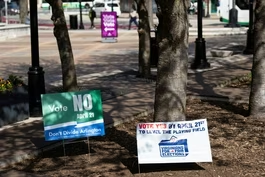
NewRedistricting fight reaches Virginia as voters weigh new map
Video has Closed Captions
Redistricting battle reaches Virginia as voters weigh new congressional map (5m 52s)
 New
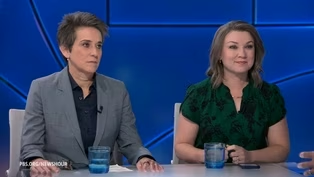
NewTamara Keith and Amy Walter on partisan redistricting
Video has Closed Captions
Tamara Keith and Amy Walter on partisan redistricting and the midterms (7m 46s)
Providing Support for PBS.org
Learn Moreabout PBS online sponsorship
- News and Public Affairs

FRONTLINE is investigative journalism that questions, explains and changes our world.

- News and Public Affairs

Today's top journalists discuss Washington's current political events and public affairs.












Support for PBS provided by:
Major corporate funding for the PBS News Hour is provided by BDO, BNSF, Consumer Cellular, American Cruise Lines, and Raymond James. Funding for the PBS NewsHour Weekend is provided by...