
Killing of 8 children spotlights domestic gun violence
Clip: 4/20/2026 | 6m 6sVideo has Closed Captions
Killing of 8 children in Louisiana renews focus on domestic violence involving guns
Another deadly shooting has torn apart another American community. In Shreveport, Louisiana, a man shot and killed eight children and left two other adults gravely wounded. The killer was reportedly the father of seven of the eight children he shot. William Brangham discussed the tragedy and the broader issue of gun violence with April Zeoli.
Problems playing video? | Closed Captioning Feedback
Problems playing video? | Closed Captioning Feedback
Major corporate funding for the PBS News Hour is provided by BDO, BNSF, Consumer Cellular, American Cruise Lines, and Raymond James. Funding for the PBS NewsHour Weekend is provided by...
Killing of 8 children spotlights domestic gun violence
Clip: 4/20/2026 | 6m 6sVideo has Closed Captions
Another deadly shooting has torn apart another American community. In Shreveport, Louisiana, a man shot and killed eight children and left two other adults gravely wounded. The killer was reportedly the father of seven of the eight children he shot. William Brangham discussed the tragedy and the broader issue of gun violence with April Zeoli.
Problems playing video? | Closed Captioning Feedback
How to Watch PBS News Hour
PBS News Hour is available to stream on pbs.org and the free PBS App, available on iPhone, Apple TV, Android TV, Android smartphones, Amazon Fire TV, Amazon Fire Tablet, Roku, Samsung Smart TV, and Vizio.
Providing Support for PBS.org
Learn Moreabout PBS online sponsorshipGEOFF BENNETT: Another deadly shooting has torn apart another American community.
Yesterday morning, in Shreveport, Louisiana, a man shot and killed eight children and gravely wounded two adults.
He was killed during a confrontation with police after fleeing the scene.
William Brangham has more.
WILLIAM BRANGHAM: Geoff, police said the children ranged in age from 3 to 11 years old.
The killer was reportedly the father to seven of the eight children that he killed.
The two adult victims were the suspect's wife and another woman.
This was the deadliest shooting in America in over two years and it sent shockwaves throughout Shreveport.
City officials today said the shooting underscores a broader problem.
GRAYSON BOUCHER, Shreveport, Louisiana, City Councilmember: I would like to also remind everyone that, in the city of Shreveport, we have a true epidemic of domestic violence.
And that is something that should be a top priority of the city's administration, the city council and law enforcement.
WILLIAM BRANGHAM: For more on this tragedy and the broader issue of gun violence, we are joined again by April Zeoli.
She's the director of the Michigan Firearm Law Implementation Program at the University of Michigan.
April, thank you so much for being here again.
Your research studies the intersection of domestic violence and firearms.
So, given that people might just be taking on board what this tragedy is all about, what was your initial reaction to this?
APRIL ZEOLI, University of Michigan: My initial reaction was, unfortunately, that this has happened again.
We know from research that there are often opportunities to intervene and to stop this kind of violence from happening.
But the opportunities were missed and we're left with a tragedy.
WILLIAM BRANGHAM: And what does the research show us about that, the overlap between domestic violence and firearm ownership?
APRIL ZEOLI: It shows that when a violent male intimate partner has access to a gun, the chance that he will kill the female partner goes up five times.
It is much greater.
We also know that there is more likely to be other victims as well.
So, in this case, we saw an intimate partner, another adult, and eight children.
This comports with what we know about domestic violence shootings, unfortunately.
WILLIAM BRANGHAM: And this also seems to fly in the face of the way guns are marketed and sold, as a defensive weapon, that you bring a gun into your home to defend yourself, not that that gun then becomes a tool used against you.
APRIL ZEOLI: Correct.
The reason guns are pitched and sold as defensive weapons and people want them as defensive weapons are exactly the reasons that they are so deadly.
Guns are incredibly lethal and they're a range weapon.
So you can injure somebody from far away.
You can't do that with a knife.
You can't do that with a blunt instrument.
And that gives firearms more lethality.
And if you're hit by a bullet, you're much more likely to die than if, say, you were stabbed.
So, in an already violent situation, firearms just make the problem worse.
WILLIAM BRANGHAM: And you touched on this before, but when we think about children in America being shot, we tend to think of school shootings.
How does the data on school shootings compare to violence in the home, shootings in the home?
APRIL ZEOLI: School shootings are tragedies, and we should do everything we can to prevent them.
But if we're concerned about children dying, then we have to look at domestic violence and events that happen in the home.
Because kids are much safer at schools than they are in the home.
When they're dying in mass shootings, these are domestic violence events.
WILLIAM BRANGHAM: We heard public officials in Shreveport today repeatedly saying to the general public that, if you see something, say something.
They're basically saying, if you know that someone is troubled and may have access to a gun, that they have to speak up.
I mean, is that the message to people, that that's the best way to prevent this?
Do we have other ways of intervening that are useful?
APRIL ZEOLI: Oh, there are many ways to intervene.
In this particular case, it's been reported that the wife of the shooter was leaving.
They were getting divorced.
And just that one fact raises the risk of homicide and severe violence.
Separation is the most deadly time when it comes to domestic violence.
So this is a time for people to gather resources, for courts and domestic violence agencies to come into play and help somebody's safety plan.
Safety plans can really help.
Restraining orders can sometimes help.
There are other things people can do.
If no action is taken, if firearms aren't removed, if they're still available, if somebody who says that they're suicidal doesn't get any attention, then we're really not going to solve this problem.
WILLIAM BRANGHAM: That is April Zeoli of the University of Michigan.
Thank you so much for taking the time to talk with us.
APRIL ZEOLI: Thank you.
 New
NewCities turn streetlights red to protect nocturnal ecosystems
Video has Closed Captions
Cities turn streetlights red to protect nocturnal ecosystems (5m 51s)
 New
NewMideast experts on U.S. and Iran priorities in negotiations
Video has Closed Captions
Middle East experts analyze U.S. and Iran priorities in potential negotiations (8m 26s)
 New
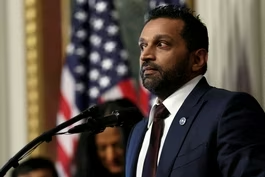
NewNews Wrap: Kash Patel files lawsuit against The Atlantic
Video has Closed Captions
News Wrap: Patel sues The Atlantic over story alleging excessive drinking and absences (6m 10s)
 New
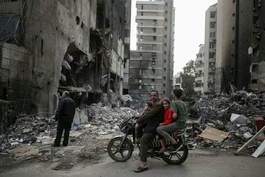
NewNext round of U.S.-Iran talks in doubt as tensions rise
Video has Closed Captions
Next round of U.S.-Iran talks in doubt as tensions rise ahead of ceasefire deadline (8m 12s)
 New
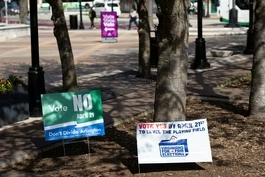
NewRedistricting fight reaches Virginia as voters weigh new map
Video has Closed Captions
Redistricting battle reaches Virginia as voters weigh new congressional map (5m 52s)
 New
NewRetired admiral on U.S. strategy behind naval blockade
Video has Closed Captions
Retired admiral breaks down U.S. strategy behind naval blockade (4m 2s)
 New
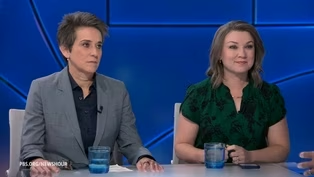
NewTamara Keith and Amy Walter on partisan redistricting
Video has Closed Captions
Tamara Keith and Amy Walter on partisan redistricting and the midterms (7m 46s)
Providing Support for PBS.org
Learn Moreabout PBS online sponsorship
- News and Public Affairs

FRONTLINE is investigative journalism that questions, explains and changes our world.

- News and Public Affairs

Today's top journalists discuss Washington's current political events and public affairs.












Support for PBS provided by:
Major corporate funding for the PBS News Hour is provided by BDO, BNSF, Consumer Cellular, American Cruise Lines, and Raymond James. Funding for the PBS NewsHour Weekend is provided by...