Oregon Field Guide
Shark Superhighway, How to Make a True American Flag, Bend Pet Parade
Season 37 Episode 11 | 25m 19sVideo has Closed Captions
Washington’s shark mystery. The American flag’s colorful roots. A century-old pet parade.
Beneath the quiet waters of Willapa Bay in southwest Washington is a mysterious shark superhighway. Portland dyer Elan Hagens makes a “true” American flag rich with our nation’s deep history. A parade of pets has been a beloved Bend event since 1924.
Problems playing video? | Closed Captioning Feedback
Problems playing video? | Closed Captioning Feedback
Oregon Field Guide is a local public television program presented by OPB
Oregon Field Guide
Shark Superhighway, How to Make a True American Flag, Bend Pet Parade
Season 37 Episode 11 | 25m 19sVideo has Closed Captions
Beneath the quiet waters of Willapa Bay in southwest Washington is a mysterious shark superhighway. Portland dyer Elan Hagens makes a “true” American flag rich with our nation’s deep history. A parade of pets has been a beloved Bend event since 1924.
Problems playing video? | Closed Captioning Feedback
Where to Watch Oregon Field Guide
Oregon Field Guide is available to stream on pbs.org and the PBS app.
Providing Support for PBS.org
Learn Moreabout PBS online sponsorshipMajor support for Oregon Field Guide is provided by... [ ♪♪♪ ] WOMAN: Come on!
There he is, there he is, there he is.
[ exclaims ] Get him out of there, buddy!
Good boy!
[ laughing ] WOMAN: Whoo, high five!
Yeah!
AARON: Tonight on Oregon Field Guide: WOMAN: Put your hand in the vat slowly.
A Portland artist traces the colorful roots of the American flag.
It was important for me when making the flag that the dye for the red and the dye for the blue were grown from plants in North America.
[ sewing machine whirring ] Then, does a parade get any cuter than this?
All right, everybody, welcome to the 2025 Bend Parks and Rec Pet Parade!
But first, an underwater mystery.
JES: I think like a lot of people when I was young, I was totally afraid of sharks, but as an adult, that fear gradually shifted to fascination.
I'm here in Willapa Bay, and every summer this huge estuary turns into a shark superhighway.
The sharks move from the ocean out into the wider bay and scientists are here trying to figure out why.
JES: Catching one of the Pacific Northwest's top predators takes time, a little luck... All right, coming down.
...and big chunks of meat.
Let's get some stuff in the water.
We're in.
All right.
Good luck down there.
So we're going to leave these two buoys sitting for about 30 minutes, and then we'll go check them.
These scientists from Oregon State University's Big Fish Lab are studying broadnose sevengill sharks, one of about 15 shark species native to Oregon and Washington.
Understanding sevengills is understanding the entire ecosystem.
They are apex predators, and so understanding them is like understanding how all the other animals in the ecosystem are existing.
Yet very little is known about sevengills, or any of the other shark species, here in Willapa Bay.
We just know that they're here, period.
Period.
Period.
We know they're here, we know they're eating stuff.
We know they're here, we know they're eating stuff.
This one looks sharky to me.
And what they're eating today is the bait.
Got it?
Yep.
So we have a sevengill.
We have two sevengills!
Whoo!
[ laughs ] They're so chill right now.
Oh, my gosh, she's huge.
Two on one line-- it shows just how plentiful the sharks are in Willapa Bay.
Sharks in general are really hard to find.
There's typically not very many of them.
She's a chonk!
But here in Willapa Bay, we find a ton of sharks, just an absolute bonkers amount of sharks.
This was what haunts me at night.
Why are there so many sharks here?
I would say the biggest ones are around 300 pounds.
I would put her, this one, around that weight.
Shark coming down.
Can you shove it back-- There you go.
Thanks, lady.
They take good care of the shark once she's onboard.
A wand pushes water over the gills so she can breathe.
And the cloth keeps her calm.
Sevengills are very, very unique.
They're one of two species in the world that have seven gill slits.
And it's thought that they have seven gill slits because they're such an ancient species.
So these are actually one of-- if not the-- oldest shark species alive.
Similar sharks have been swimming in our oceans for more than 200 million years.
The crew tags, measures, and draws blood, all in a span of five to ten minutes.
With female sevengills like this one, they have another kind of opportunity.
WOMAN: One of our specialties in the Big Fish Lab is learning more about shark moms.
We are trying to advance our understanding of shark reproductive ecology.
So basically what shark moms do, where they go, how often they give birth.
Traditionally, trying to figure these things out involved killing and dissecting female sharks.
But here, ultrasound is the tool of choice.
So the ultrasound works exactly the same as it works for humans.
We literally even use gel.
There's some circles on there.
A lot of the females we capture generally in Oregon and Washington tend to have eggs or are already pregnant.
Unfertilized eggs, so she's not pregnant, but she seems to be ready to become pregnant at some point.
Ready, shark-- Shark coming down.
Thanks, lady.
These sevengill sharks come to Willapa Bay every March.
Over the past few summers, the crew has tagged more than 300 here.
They've learned the sharks can cover a lot of ground in the off-season.
We had one shark that was tagged here in Willapa Bay that swam all the way down to San Diego and was caught by a fisherman.
And then we had another tag that was put on a sevengill and ended up swimming up to Alaska.
MAN: All right, Huckster, jump on, buddy.
The next day, lead scientist Taylor Chapple and his son Huck join the crew, hoping to get some more sevengills on the boat.
It's your workout.
Understanding what sharks are doing helps us understand how to keep the system together.
So if we want to be able to fish-- to catch salmon, to catch crab-- we need to understand how the predators are playing in those systems.
And that's what the work that we do with sharks is really helping to tell us.
The fishing starts off decidedly slower.
It's not looking good for the home team.
They get a feeding frenzy, but not the kind they were hoping for.
But then on another line, another visitor: a Pacific spiny dogfish, another species of shark native to the Pacific Northwest.
And eventually they get a hookup.
All right, watch the spines.
Spiny dogfish are named that for a reason.
Yep, they've got a venom in them.
So if they get stabbed, it doesn't feel good.
The Pacific Northwest has its own distinct population of these sharks.
That's what I'm really interested in, because that population of Pacific spiny dogfish appears to be falling, and we're trying to figure out why.
Despite their small size, dogfish are among the longest-lived sharks-- about the same lifespan as a human.
And another ultrasound reveals this female is old enough to have eggs.
I'm going to do one more pass.
Then we'll be done with this.
What I do know is that they do reach maturity, for females particularly, at about 30 years old, which suggests to me that that animal's probably older than I am.
So you see how there is like little white and brown layers in here.
Those can be used to age the dogfish, kind of like, you know, rings in a tree.
Catching Pacific spiny dogfish is expected here in Willapa Bay.
It's like a shark superhighway.
We find sevengills, we find tope sharks, smooth-hounds, we find dogfish.
There's a number of species of rays that we'll find in here as well.
So it really is an incredibly diverse ecosystem.
I'd almost say to the extent that we don't actually know all of what's in here yet.
When it comes to the sevengills, that question of "why here?"
still haunts Jess.
They're actually much more social than we think they are.
And so it's possible that they could be coming up here for some sort of sevengill hangout, in addition to, you know, a buffet of food that they've got available.
Willapa is an incredibly productive bay.
There's shark food everywhere.
And what the sevengills are eating is one mystery Jess and the team have been able to solve.
Up.
Up!
[ winch clicking ] And they've learned this by looking inside the sharks.
Or more accurately, bringing what's inside into the light.
JESS: All right, you're on head.
TAYLOR: I'm on head.
You're on stomach.
JESS: All right.
It's called a non-lethal lavage.
It doesn't harm the shark, but it does take their lunch.
On the boat, they call it puking the shark.
JESS: All right, going in.
Almost immediately, Jess gets a whiff of something familiar.
I think there's definitely seal.
I can smell the seal.
It's just like a weird side effect of this job that I've developed.
[ laughs ] A weird skill that I have that many people don't is that I can predict what's inside the shark based on the shark's "breath."
You got your chunks.
Hold on.
So these are the stomach contents that we just collected from a broadnose sevengill shark.
And it looks like we have a bunch of harbor seal.
And we can tell it's harbor seal from the fur, so we know it's a mammal, and the spotting pattern that we have on the fur.
So that's pretty distinct for harbor sea.
We also see a flipper of a harbor seal, as well as what appears to be a nail.
Willapa Bay is full of salmon and sturgeon, yet nearly two-thirds of what they've found in the stomachs of sevengills here has been seal, and this has big implications for local food chain.
Harbor seals and other marine mammals like sea lions eat a lot of salmon.
And so it's potential that the sevengills eating the harbor seal could be really good for the salmon in the sense that they're keeping marine mammal populations down and allowing salmon populations to rebound.
Okay, everybody ready?
We're going to release the shark.
I meet a lot of people who have no idea that there are sharks in these waters, and it's not a bad thing to have sharks here.
In fact, it's a really good thing.
You know, if you want to have a healthy ecosystem, you need to have sharks in the area.
And the sheer number of sharks that call these waters home show just how pristine Willapa Bay is.
And as they go out into the broader Pacific Northwest, we hope that we can help understand how these sharks are interacting with fisheries to maintain those healthy ecosystems.
That's why this research is really important to me, because it's filling in these gaps that I don't think we even knew that we had.
I think it's just really valuable to remember sharks when we're thinking about healthy oceans.
[ ♪♪♪ ] [ indistinct chattering, laughing ] These days, nearly everything is colored with artificial dyes, including Old Glory here.
But the original American flag was dyed with indigo, which came from plants like the ones you see around me.
Well, we've got it here in Oregon, as well as an expert guide to walk us through the process.
[ birds chirping ] WOMAN: As a natural dyer, one thing I've always really wanted to make is a true American flag.
It was important for me when making the flag that the dye for the red and the dye for the blue were grown from plants in North America.
[ fire truck horn blowing, people chattering ] Because we do love our country and I love what my ancestors have, like, stewarded and worked so hard for.
I think that would be a lot of fun and something just really wonderful to create.
[ bird calling ] Today we're going to be planting indigo, and that's a fun day, because all of your seeding from the winter months is going to be put in the ground.
When we think of indigo, we think of the color blue, but indigo is more than just a color.
We're going to dye this whole entire thing.
Put your hand in the vat slow.
It does take a skill set to grow and extract the blue pigment out.
Keep your hand and hold this.
I love to educate people about that tradition.
That looks good.
[ chuckles ] We've got all these beautiful varieties of indigo.
But wherever we're at, wherever you're located, it's nice to find the indigo that's going to work well with your climate.
Here in Oregon we have a climate where it can get cool.
We have a heavy influence of moisture that's very similar to Japan, and so we love to use Japanese indigo.
[ ♪♪♪ ] Here in America, the beginning of our knowledge of indigo came from Africa.
West Africans have been cultivating indigo hundreds of years before the trans-Atlantic slave trade.
When they were kidnapped, they brought all that knowledge of growing indigo with them.
And a lot of people don't know that our American flag, the blue color was actually made and stewarded and the color extracted from a lot of indentured workers in slavery.
It's kind of-- It's a very interesting thing when we start thinking about that beautiful blue.
That's ours!
[ laughs ] Let's bring this one... ELAN: I love being part of this crew here, just, like, helping out with production.
Anybody who pretty much works here is able to be part of this farm.
All right!
We're doing it!
Having access to land is just wonderful.
I come from a background where my mom did not have a car and a vehicle for me to be able to escape out into nature.
But I was lucky enough to have neighbors who, like, showed me how to garden, and a lot of the skills that I've learned have been purely because women have seen that joy in me.
And to, like, have them support me was just amazing, honestly.
And that's what-- That's what built me.
Coming to the farm, brother!
We all come together and learn and teach and just share, share, share, share.
All right, should we harvest some of this?
This is where the pigment is.
The pigments are in the leaves.
The best thing about indigo is that this is not going to kill the plant.
We're going to get multiple harvests off this exact same crop.
When I was younger, we did not have social media.
But now we are able to see people who look like us in different spots.
It does take some bravery when you have never seen yourself out there.
And social media has just, like, busted that open wide for me.
I'll be slow and dramatic.
I'm putting the leaves that we just harvested in a vessel, and then we're going to allow this to sit here and kind of just, like, get a little rotten, as I call it, to have the color kind of extract out of here.
Extracting indigo takes lots of knowledge.
In America, we've lost this knowledge of tending to the indigo plant.
Both Kara and I figured out indigo trial and error.
This looks good and ready to go.
Mm-hmm.
Yeah.
KARA: All of that pigment right now is floating in the water.
And we need to add the flocculant, which is the calcium hydroxide, to attach to it to sink.
ELAN: It's doing its thing.
KARA: Yeah, it's starting to fall.
And then what's at the bottom is the blue.
ELAN: Pure pigment.
This is the real blue, and this is, as we said, what the blue in our American flag was.
Isn't that beautiful?
That's nice.
ELAN: Once we have the pigment extracted, we then put that pigment into a vat.
And that vat will be used to dye many items.
[ people chattering indistinctly ] So I did this mushroom one during our lunch break and so... IndigoFest really touches on the community piece of indigo dyeing where people can get together who have the same common love for natural dyes.
I have the opportunity to go back later with some pigment and add some design.
As a Black woman from Oregon, there are those areas where you're gonna go into and you're like, "Man, everybody in the field that I really like and I love does not look like me."
And that's hard... Smells like a good vat to me.
Smells like a good indigo is what it smells like.
Put your face in there.
...and so there are those hurdles.
But I am so lucky that I have been, like, encouraged by my family and my peers that we can be in all these spaces together.
It's just a human thing.
I'm gonna drop it in and you're going to massage this.
Let's take it out and take a look at that and see if we're getting... Ooh, that's nice.
What's gonna happen is this is gonna be fully blue, and then you're going to see if that's the shade of blue that you want, because if you want to go darker, you're going to do this again.
I'll do the same thing again.
Yeah.
[ both chuckling ] When they open up their pieces of fabric that we have learned to dye, to watch that unfold and, like, the stars that come in the eyes... Oh, yeah!
...this is why I do it.
Beautiful!
Thank you, Elan!
Of course!
I have just a strong love.
And that strong love is just, like, my guiding light.
It truly is my guiding light.
So this is my flag, what I would call, like, my true American flag.
This is a wool-cotton blend from Pendleton.
And locally grown indigo.
This is the red dye that made my flag.
American-grown madder root.
Cutting my first piece and it was a little bit crooked, and I was like, "Oh, let me fix it."
It got even more crooked, and then I was like, "Oh, my gosh, they're not lining up perfect.
I'm not going to have a perfect American flag.
All these edges are gonna be so frayed and awful and I'm going to have to redo them."
And then I started just laying them on top of each other, just organically.
And I started liking that.
It just started coming together and making sense that it needed to be this way.
Because it is hand-crafted.
And our country, we're tattered right now.
[ whirring, then a soft pop ] Oh, hear that?
A string broke.
This piece is showing me what it wants to be.
And it looks a little ragtag.
And I'm okay with that.
I'm okay with not being perfect.
[ whirring ] Don't stress yourself out, right?
Just do a ragtag, uh, flag.
[ laughs ] Looks like it's coming together.
[ ♪♪♪ ] Making this American flag is definitely showing my passion.
My love for indigo, my love for farming, my love for sharing, like, the Black indigo story and imagining, like, what my ancestors must have done.
It's all, like, wrapped up into this.
I have to show people who think different than me, who were raised different than me, that this is mine as well.
That's it.
[ ♪♪♪ ] [ dog panting, people chattering indistinctly ] This next one goes out to the pet lovers out there.
Right, Shay?
Good girl.
[ people chattering indistinctly ] The Bend Pet Parade is actually an offshoot of pet parades being a marketing gimmick.
[ ♪♪♪ ] So in 1924 is when we first see it show up in the newspaper.
And in 1932 is when we see it become attached to 4th of July.
And the parade is just our, you know, absolute open celebration of love of pets.
Having our pets with us on those adventures has become part of, you know, modern Bend's lifestyle.
ANNOUNCER: We will start as close to 9:30 as we can once we get the A-okay from our traffic control team.
Onion, Onion the cat.
This is Onion.
We're fighting for Onion's rights.
I think he would enjoy the right to-- at least to have the option to be in the parade.
All right, everybody, welcome to the 2025 Bend Parks and Rec Pet Parade in partnership with the city of Bend!
We're so thankful you're here!
[ ♪♪♪ ] You can now find more Oregon Field Guide stories and episodes online.
And to be part of the conversation about the outdoors and environment here in the Northwest, join us on Facebook, Instagram, and YouTube.
[ birds chirping ] [ people chattering indistinctly ] Major support for Oregon Field Guide is provided by... Additional support provided by... and the following... and contributing members of OPB and viewers like you.
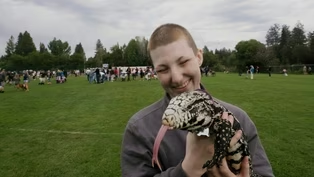
Video has Closed Captions
Clip: S37 Ep11 | 1m 57s | A parade of pets has been a beloved Bend event since 1924. (1m 57s)
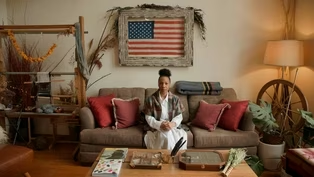
How to make a true American flag
Video has Closed Captions
Clip: S37 Ep11 | 9m 35s | Portland dyer Elan Hagens makes an American flag rich with our nation’s deep history. (9m 35s)
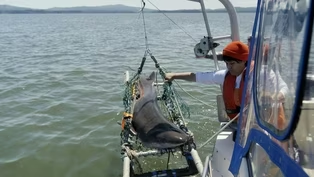
Shark Superhighway: Secrets of the Pacific Northwest’s Overlooked Apex Predator
Video has Closed Captions
Clip: S37 Ep11 | 10m 39s | Beneath the quiet waters of Willapa Bay in southwest Washington is a shark superhighway. (10m 39s)
Providing Support for PBS.org
Learn Moreabout PBS online sponsorship












Support for PBS provided by:
Oregon Field Guide is a local public television program presented by OPB