
Our House: The Wisconsin Capitol
Special | 26m 46sVideo has Closed Captions
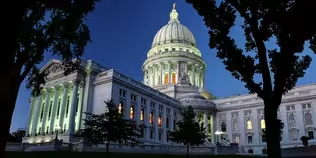
Michael Bridgeman hosts a portrait of the Wisconsin State Capitol.
Michael Bridgeman hosts a portrait of Wisconsin's architectural crown jewel: the Wisconsin State Capitol. As the state celebrates the 100th anniversary of the building's completion, this program highlights the many reasons it has become "the people's house."
Problems playing video? | Closed Captioning Feedback
Problems playing video? | Closed Captioning Feedback
PBS Wisconsin Documentaries is a local public television program presented by PBS Wisconsin
Funding provided by Ron and Colleen Weyers, Francis A. and Georgia F. Ariens Fund within the Brillion Area Family of Funds, the Conney Family in loving memory of Mildred Conney,...
Our House: The Wisconsin Capitol
Special | 26m 46sVideo has Closed Captions
Michael Bridgeman hosts a portrait of Wisconsin's architectural crown jewel: the Wisconsin State Capitol. As the state celebrates the 100th anniversary of the building's completion, this program highlights the many reasons it has become "the people's house."
Problems playing video? | Closed Captioning Feedback
Where to Watch PBS Wisconsin Documentaries
PBS Wisconsin Documentaries is available to stream on pbs.org and the PBS app.
- It's a masterpiece of design and engineering.
- They wanted it to be a symbol of self-rule.
- A very high-minded, idealized notion of democracy.
- Designed by an American master.
- This was the crowning gem in his life's work.
- And filled with priceless artwork.
- It's Wisconsin's most valuable work of art.
There's nothing like it.
- It's a state capitol that was created for all of us.
- I always think of it as the most public building in Wisconsin.
- It's always open 365 days out of the year.
- After a catastrophe ruined its predecessor.
- An hour after the fire starts, it's lighting up the sky.
- The Capitol would face its own disaster.
- There were actually parts of the mosaics that leaned forward.
- The whole thing was at risk of crumbling down.
- And it would take a massive 12-year effort to save the building.
- The restoration of this building was important because this is a masterpiece.
- This National Historic Landmark is one of the most admired capitols in the country.
I'm going to discover its remarkable history, explore its grand spaces, and uncover a few of its hidden secrets.
- This is the story of Our House: The Wisconsin Capitol - Our House: The Wisconsin Capitol is funded in part by Ron and Colleen Weyers, Francis A. and Georgia F. Ariens Fund within the Brillion Area Family of Funds, the Conney Family, in loving memory of Mildred Conney, Edvest College Savings Plan, helping families save since 1997, the Eleanor and Thomas Wildrick Family, Roger and Lynn Van Vreede, American Transmission Company, National Guardian Life Insurance Company, and Friends of Wisconsin Public Television.
♪ ♪ - The Wisconsin State Capitol was conceived just after the turn of the century in an era of American optimism.
States were building ever more grand capitols to express their success, pride, and democratic ideals.
If Europe's palaces were made for monarchs, America was building them for its people.
When it came time for Wisconsin to build such a palace, it would be one for the ages.
Since its completion in 1917, the Wisconsin Capitol has contained the state's four branches of government.
Its symmetrical form creates a unique balance between the spaces of the Governor, Senate, Assembly, and Supreme Court.
- Everything is equal in that building.
Every aspect of government is weighted equally.
No one wing is more important than the other wing.
- This uniformity is made possible because the Capitol is arranged in a shape known as a St.
Andrew's Cross.
- St.
Andrew's Cross is essentially an X. Here at our capitol, it lines up with the points of the compass and also the streets that are coming towards the Capitol.
- The Capitol's layout creates many access points.
And all of these entrances feed into a central circular area called the Rotunda.
- This is the Capitol's premier public space.
The Rotunda is immense in scale.
Natural light pours in from skylights in the wings and the dome's 19-foot high cathedral windows.
The space is intended to draw our eyes upward.
Fitting for a building designed to inspire us.
- The Rotunda is a big part of why the Capitol attracts hundreds of thousands of visitors each year.
- We call our Rotunda the "living room" for a reason.
That's because it's always open 365 days out of the year.
It is one of the most public features of the state of Wisconsin.
- The Capitol is and always was meant to be a public building.
From the time it was built, it was referred to casually as, quote, "the people's house," which was a phrase that originated a hundred years earlier with the White House in the early 19th century.
It fit the idea of how the building should be used.
[traffic sounds] - The people's house seems perfectly placed in the heart of Madison.
But the Capitol and the city would not exist except for one man.
Frontier judge and land speculator James Duane Doty traveled to this area in the spring of 1836.
To him, it was wild and unsettled.
But he envisioned a city here and drafted a plat, or map, of its layout.
Wisconsin became a U.S.
territory that summer, and a convention was called to form a constitution.
One important order of business was choosing a capital city among the twenty sites proposed.
Doty, one of the delegates, had a plan.
- Doty presented his map to fellow delegates, promising them lots in exchange for votes.
When it came time to vote for a site to be the capital, 16 of the 39 men owned property in Madison, a city that didn't even exist.
- And that was enough to tip the scales and Madison was chosen.
Now whether that should be called bribery or just good politicking is for the beholder to decide.
- Madison's first capitol building was constructed on the square Doty had earmarked.
By the time Wisconsin achieved statehood in 1848, this cold and leaky capitol had earned the uncomplimentary nickname "Doty's washbowl".
Its replacement was completed in 1869.
Over the next four decades, the second state capitol would receive numerous expansions and updates, especially to its fire prevention technology.
- By the turn of the century, the second Madison capitol was considered to be a state of the art fireproof building.
- But in the early morning of February 27, 1904, a newly-varnished ceiling caught fire and the system catastrophically failed.
- An hour after the fire starts, it's lighting up the sky in Madison and people are streaming out of their houses to come try to help.
- By the time the fire was out, the Wisconsin Capitol was in ruins.
No had died, but it was a devastating loss for the state.
Governor Robert "Fighting Bob" La Follette would cheerlessly write to a friend, "I have no doubt the citizens of Wisconsin will insist on having an entirely new building put up in its stead.
Nevertheless, I shall regret to see it go."
- At this point in the early 20th century, Wisconsin had a high self-esteem and booming economy.
- It's right at the height of the Gilded Age.
Wisconsin has become a tremendous success, and they wanted this capitol to be a symbol of that success.
- And other states, like Minnesota, were building grandiose new capitols.
- Wisconsin was not going to be left behind in the design of the building that it was going to have to mark its place as one of the premier state capitols in the country.
- The stage was set for Wisconsin to make its own statement.
A committee appointed by Governor La Follette, called the Capitol Commission, would oversee this ambitious endeavor.
- The Capitol Commission requested proposals from architectural firms all across the country.
They wanted a grand and monumental building.
And they would find the perfect architect to achieve that vision in George Post.
- By the turn of the century, George Browne Post of New York was a leading figure in American architecture.
- He was known in Manhattan for designing and having built really tall office buildings and sometimes referred to as the father of the later skyscraper.
- Post had recently completed the New York Stock Exchange and, in his late sixties, was actively seeking a large public project to seal his legacy.
- He always wanted to build a capitol, and this was it.
This was the crowning gem in his life's work.
- But building it would be a challenge.
The Capitol's huge cost of over $7 million, would have to be spread out over a decade.
The construction project would proceed in five stages over 11 years.
- Post carefully selected materials that would maximize beauty and visual appeal.
Marble, granite, and limestone, quarried from dozens of sites around the world, were used to create a spectacular display of color and patterns.
And each major chamber was distinguished by marble and granite found nowhere else in the Capitol, to ensure each of these spaces would have a character all its own.
As sections of the Capitol were built, they were put to use.
When the west wing was finished in 1909, the legislature began meeting there.
In 1915, two years before the Capitol was completed, guides began giving tours to the public.
- Welcome to the Wisconsin State Capitol.
My name is Jason, and we're going to take the stairs.
You can follow me up this way.
It's a tradition that has continued for over a century.
- Well, I really like sharing the stories.
So, I used to do theater back in high school, and I also am a historian by trade.
Being able to share the history and being able to share that information with people in a story format is my favorite thing.
If they try to speak over their thirty minutes, the justices will interrupt and say, "Excuse me!
[banging table to imitate a gavel] Your time is over.
Please sit down!"
Thirty minutes to change the laws of the state.
- Each year, 50,000 students from schools around the state make a field trip to the Capitol.
- This is my students' favorite thing to do each year.
I think that the information that's given on the tours here is excellent.
- The first electronic voting system installed in this room was the original electronic voting system in the world.
It was here in Wisconsin before anywhere else.
- A Capitol tour is packed with state history and interesting facts, but it's often the little details that are most memorable.
- We have a fossilized starfish in the staircase.
No matter how many tours I give, that's always the most memorable piece that people come back for.
- This should be a priority for all kids to visit to see how our state government runs and how we should be so proud of this capitol that was built for us.
- For citizens young and old, the Wisconsin Capitol was designed to instill a sense of awe and importance.
Public buildings constructed at this time in America followed grandiose classical examples from Greece, Rome, and the Renaissance.
- Why did this lavish classical style become the norm for government buildings?
A clue can be found here at the western approach to the Capitol.
It's a statue called "Forward," and it's from the Columbian Exposition in 1893.
Now, that might seem unrelated to our Capitol.
But actually, it has everything to do with it.
- The Chicago World's Fair of 1893, also known as the Columbian Exposition, featured a temporary metropolis conceived by America's top artists and architects, including George Post.
- You have a gathering of major architects who are coming together to create what was known as the White City, the classical core of the Columbian Exposition.
So, they're using architecture based on classical elements.
- The Chicago World's Fair would transform this approach to designing public buildings into a national movement.
- It's almost as if there is a standard vocabulary that has been set for these architects of things that people are expecting to see in a state capitol.
- George Post would bring the Columbian Exposition's architectural sensibilities to Madison.
He would also bring its artists.
- The creators of the Capitol wanted it to serve, in part, as an art museum.
A place where people could come see beautiful art and architecture and be uplifted by it.
- For the Capitol's most prominent work, Post turned to renowned American sculptor Daniel Chester French.
- Most people know him for the sculpture of Abraham Lincoln in the Lincoln Memorial.
He was a major, major figure in the art world at the period.
- French's sculpture "Wisconsin" symbolizes the state motto "Forward," a name she is often mistakenly called.
Wisconsin stands over 15 feet tall and weighs more than three tons.
In 1914, she was hoisted on top of the Capitol dome, which was a public spectacle.
- Wisconsin was placed with such fanfare, I mean there literally was a parade.
There were speeches and celebration and it was quite a big deal.
♪ ♪ - One of the most remarkable works of art in the Capitol is here in the highest visible point called the oculus.
It was painted by one of America's most highly-regarded muralists, Edwin Blashfield.
And it's a powerful demonstration of his mastery of scale.
- I think that one was difficult because you had to understand that it was going to be 200 feet away from you when everybody reads it.
- The mural is called "The Resources of Wisconsin."
Blashfield created it in New York City in a studio big enough to hold the painting.
Like the artwork of a Roman basilica or European cathedral, the art at the Capitol has a story to tell about the people who made the building and what they thought about their state and its government.
- The artists were attempting to convey, on Post's direction, clearly, and probably that of the Capitol Commission as well, a very high-minded, idealized notion of democracy.
- The themes of the artwork are sort of the grand themes of liberty, justice, government, democracy, abundance.
- Most of the Capitol's works of art were made by men.
But there are three striking exceptions.
- This statue, called "The West," has been here since the Capitol's beginning.
It was sculpted by an artistic prodigy from Madison named Vinnie Ream Hoxie.
She created it at a time when her fame was at its peak.
- At age 17, Vinnie Ream Hoxie became the first and only sculptor for whom Abraham Lincoln ever posed.
When she received a Congressional art commission the following year, Ream Hoxie was the first woman and youngest person ever to win such an award.
In a similar entryway nearby stands "The Genius of Wisconsin."
Oshkosh native Helen Farnsworth Mears designed it when she was a 21-year-old artist-in-residence at the Columbian Exposition.
"Forward" was also sculpted for the Columbian Exposition by Jean Pond Miner from Menasha.
Miner symbolized the state with a female figure on the prow of a ship clasping the American flag to her hip.
The combination of world-class art, monumental classical architecture, and exquisite materials came together perfectly in the Wisconsin Capitol.
By its official completion in 1917, the state had a building that reflected its confidence and optimism.
- But in the years to come, as occupants came and went and the needs of the building changed, the Capitol fell into decline.
- Respect for the building and its inherent grandiose-ness just sort of diminished as people became used to working in the space.
- Between 1920 and 1980, the Capitol as it had been envisioned was nearly destroyed.
- In 1987, it was determined that a wholesale restoration of the building was needed and a commission was formed.
The state would commit over a hundred million dollars to the eleven-year project.
The project would proceed section by section throughout the entire building.
- This is tube lights that are above the Supreme Court chambers.
The light is picked up the entire length of the tube.
They also put, like, a dropped ceiling diffuser plastic pieces so that the light in the chamber is nice and even.
When I started, there were fluorescent strip lights, like shop lights, about three feet off of this glass.
And so, for us to change it, we had to put boards down across the top of the stained glass and just hope you didn't put your foot through the historic antique glass.
- At times, the restoration team had to play detective, scouring through old photographs to uncover the building's original decorative finishes that had been painted over.
- We did a lot of research.
Postcards, pictures of the eras.
You know, pictures of the governors to see what was on the wall behind them.
Artwork throughout the Capitol was also carefully restored.
A massive 200-foot-tall scaffold was built to give the restoration team a rare close-up of the building's most precious art.
And in the case of its four mosaics, what they discovered was alarming.
- The whole thing was at risk of crumbling down.
- The mosaics each consist of about a hundred thousand pieces of glass glued onto a canvas, which was then attached to the walls of the Rotunda.
But over the decades, a problem developed.
- The canvas on which the glass was adhered was beginning to delaminate from the wall.
- There were actually parts of the mosaics that leaned forward, because they are not only concave, but they lean towards the Rotunda.
- The restoration team looked to experts around the world for help with this unique problem.
In the end, the solution was a permanent one-- using a powerful glue.
- The state's commitment to the Capitol resulted in a 21st century office building that shined as brightly as it had in 1917.
- On a warm July evening in 2017, the community gathered on the grounds of the Capitol to hear the Wisconsin Chamber Orchestra.
It's part of a weekly summer concert series, but this night was special.
It was a celebration of the building's 100th anniversary.
Some of the restoration team were on hand.
- We did an incredibly thorough, authentic, well-documented process of restoration.
If you're a citizen of Wisconsin I think you should just be impressed of how wonderful it looks.
- The restoration of this building was important because this is a masterpiece.
It was a complete masterpiece designed by a master of the style.
- This is one of a kind and there's no reason it can't last for another hundred years if given proper care.
So, yeah, love it.
Love it to death.
[laughs] - This is the seat of our government.
The symbol of our state.
It tells our story.
And we come to this place for many reasons-- as a community, as visitors, as citizens.
But even through our most passionate disagreements, we share this great capitol.
This is our legacy.
This is our house.
- It has a vitality that few buildings really do.
The building asks us as citizens of the state to be our best and to make a solid contribution to our state, however we best can.
- There is no other place like it.
It's just that special feeling you get when you're in it.
- This is a building for the ages that has come to us from people who thought highly of the state and its government and its institutions and wanted to create this monument to the state of Wisconsin.
And those ideals are still relevant today.
♪ ♪ ♪ ♪ - Our House: The Wisconsin Capitol is funded in part by Ron and Colleen Weyers, Francis A. and Georgia F. Ariens Fund within the Brillion Area Family of Funds, the Conney Family, in loving memory of Mildred Conney, Edvest College Savings Plan, helping families save since 1997, the Eleanor and Thomas Wildrick Family, Roger and Lynn Van Vreede, American Transmission Company, National Guardian Life Insurance Company, and Friends of Wisconsin Public Television.
Our House: The Wisconsin Capitol
PREVIEW|Michael Bridgeman hosts a portrait of the Wisconsin State Capitol. (30s)
Providing Support for PBS.org
Learn Moreabout PBS online sponsorship










Support for PBS provided by:
PBS Wisconsin Documentaries is a local public television program presented by PBS Wisconsin
Funding provided by Ron and Colleen Weyers, Francis A. and Georgia F. Ariens Fund within the Brillion Area Family of Funds, the Conney Family in loving memory of Mildred Conney,...