
Nature Destroying Nature, Miss Kentucky, Lavender in the Bluegrass, Navy Week
Season 32 Episode 3 | 27m 10sVideo has Closed Captions
Saving tornado-damaged plants; the Miss Kentucky pageant; Woodstock Lavender Co.; U.S. Navy week.
Scientists work to save tornado-damaged plants in a nature preserve; the Miss Kentucky Pageant and the Miss Kentucky Scholarship Organization work to empower Kentucky women; Woodstock Lavender Co. in Pulaski County successfully grows lavender in the state's climate and turns it into a variety of products; and sailors spend a week teaching Kentuckians about the importance of the U.S. Navy.
Problems playing video? | Closed Captioning Feedback
Problems playing video? | Closed Captioning Feedback
Kentucky Life is a local public television program presented by KET
You give every Kentuckian the opportunity to explore new ideas and new worlds through KET. Visit the Kentucky Life website.
Nature Destroying Nature, Miss Kentucky, Lavender in the Bluegrass, Navy Week
Season 32 Episode 3 | 27m 10sVideo has Closed Captions
Scientists work to save tornado-damaged plants in a nature preserve; the Miss Kentucky Pageant and the Miss Kentucky Scholarship Organization work to empower Kentucky women; Woodstock Lavender Co. in Pulaski County successfully grows lavender in the state's climate and turns it into a variety of products; and sailors spend a week teaching Kentuckians about the importance of the U.S. Navy.
Problems playing video? | Closed Captioning Feedback
Where to Watch Kentucky Life
Kentucky Life is available to stream on pbs.org and the PBS app.
Providing Support for PBS.org
Learn Moreabout PBS online sponsorshipProduction of Kentucky Life is made possible in part by the KET Millennium Fund.
Coming up on Kentucky Life, we'll look at the damage inflicted on native plants by a devastating 2025 tornado and efforts underway to save them.
We'll go behind the scenes of the Miss Kentucky pageant to learn what goes into crowning our state's representative who hopes to become the next Miss America.
We'll learn more about what it takes to grow lavender in Kentucky.
And we'll take you to Navy Week in Lexington, an event meant to strengthen the bond between the community and the Maritime Branch of the Armed Services.
All that's next on Kentucky Life.
[music playing] Hey folks, and welcome to Kentucky Life.
I'm your host, Chip Polston.
It's good to see you again.
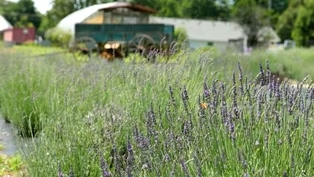
Welcome to the Woodstock Lavender Company in Somerset.
Three generations of the Colyer family have worked this land going all the way back to the Great Depression.
A mother-daughter duo have now established the acreage as a working lavender farm, which also supports fellow local growers and businesses, making a difference in the community.
The lavender is in bloom, and we'll learn more about it in just a moment.
But first, back in 2025, an EF4 tornado cut a 60-mile-long path of destruction between London and Somerset.
News accounts at the time covered the destruction to homes and businesses, but what you may not have heard about was the destruction to nature.
For 20 years, researchers in the area had been restoring native wetlands.
And in one night, those wetlands became the scene of unbelievable destruction.
Buildings can be repaired, but what about endangered native plants?
We went to the scene to learn more.
When you see this wooded area near Pulaski County, it looks as beautiful and pristine as other forests in the Commonwealth.
But then, it comes into view.
A defined and massive scar on the landscape.
[thunder rumbling] This is actual video of what caused it.
On the night of May 16, 2025, a large and deadly EF4 tornado, at times up to a mile wide, plowed through the area.
The tornado was on the ground for almost an hour and a half, killing 18 people and injuring 108 others along a 60-mile path of destruction.
Damage to the communities of London and Somerset was significant.
Homes and businesses are logically the immediate concern in the aftermath of such a catastrophe, but the destruction to nature is also significant.
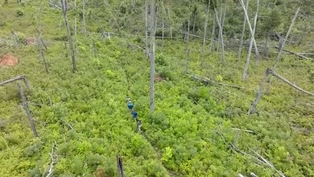
The Francis Johnson Palk State Nature Preserve was absolutely decimated by the storm.
Note how many of the trees weren't blown over or snapped in two.
They were twisted apart.
Take us back to May 16, 2025, the day before the tornado came through.
What did this area look like?
A lot different than it looks like now.
This was a mature forest.
We had done a tremendous amount of work over the last few years to really open up that mid-story.
We used prescribed fire a lot.
We really had it looking good.
It was on the trajectory that we wanted, but it was all woods back then.
And then, after the evening of May 16th, is this pretty good indication of what the whole area looked like at that time?
Once the tornado hit, obviously, because of the impact of the community here, we weren't able to come down for a week or two.
We didn't want to be in the way of some of the response that was going on in the community, getting people back into their homes.
When I first saw it, honestly, I drove right past it because I was used to seeing the entrance look one way and wasn't prepared for what I saw, to the point that I drove past the site.
I wasn't prepared for it.
It just looked different.
The whole landscape looks different out here.
[music playing] A big push behind the work here was to help preserve this rare and endangered plant, the white fringeless orchid.
That is on the federal endangered and threatened species list.
It lives in these little wetland seep areas.
We've been managing the property for over a decade for them, and that's what we're going to continue to do now is, “See?
Okay, we've got a change in the landscape here.
What do we need to do to make sure that that population continues to thrive?” It's not easy getting to the plants.
You have to maneuver a path that's been cut through the destruction and then work your way through mud, thickets, and swampy underbrush.
It's here where you find a very specific area where the orchids bloom.
We're in the headwater seep, and it's quite a treat.
All of the orchids are in full bloom right now.
These wetlands occur at the headwaters of these watersheds, and they're really close to the uplands.
You can see how the wetlands and uplands kind of integrate.
These headwater seeps have a thin fragipan layer in the soil, so that's just a kind of a clay layer that helps hold water.
The orchids bloom for just a few weeks each year.
In this small patch, there was another rare variety, the orange bog-crested orchid.
Littlefield and her colleagues first found the orchids here in 2006.
They'd worked hard to keep them in existence, but feared all was lost after the tornado.
Post-tornado, I think within a week, me and two other folks hiked back into this area, into the seeps, to see what level of damage had occurred and to see how many trees had piled onto the wetlands.
It was hard getting back here.
It took a lot longer than it did before.
We had to climb over hundreds and hundreds of trees up and down.
It was crazy.
In addition to helping the orchids survive, Couch and his staff are using this devastated landscape as a teaching and learning tool.
Obviously, this tornado had a huge path, over 100 miles that it was on the ground.
It impacted a lot of land that wasn't owned by nature preserves or by the state of Kentucky, so we want to leverage what we're doing here to be able to teach other landowners that have had the same impact how do they manage their woods.
This is a great opportunity to see how a woodland responds.
Again, it's just saplings right now.
And if you don't do some targeted management through prescribed fire and invasive species control, it's going to stay as a thicket for a long time.
But if you do the work, you could actually get this to recover over the next possibly 10, 20 years to get another growth of oak saplings and hickories and pines that are going to come into this area.
So, if I'm understanding you correctly, you're trying to pull a lot of the biomass out of here.
Then once you do that, it's a controlled burn to take everything down to kind of a starting point.
And then at that point, you start to reintroduce native species.
Is that kind of a good synopsis?
Right.
What we're hoping is that a lot of the native species are already in the seed bank.
They're going to start growing up on their own.
We may do some targeted tree planting in some places.
But again, we're just kind of going to go through this one step at a time and see how nature responds to each of our actions.
Do you think it'll ever look like it did on the day before the tornado struck, or is this going to be an area that's forever going to be impacted?
It won't go back to the way it looked in my lifetime, and that may be a good thing.
Because, again, we have been actively managing this site for the last over 10 years.
We were trying to get it back to what we thought it should look like already.
We hope that in the next decade or two, it'll be what we want it to be, but it likely won't go back to what it was.
So, we're seeing it as an opportunity to really get in and say, “Okay, how do we take a site that went through this massive devastation and manage it back to a natural community again?” So, it's pretty exciting for us.
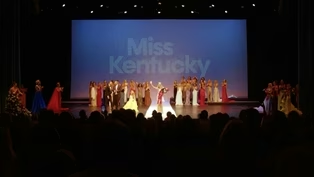
[music playing] [birds chirping] Every year, young women from across the Bluegrass compete in the Miss Kentucky competition.
Now, although it may seem just like a beauty contest, it's much more than that.
The Miss Kentucky Scholarship Organization is a nonprofit foundation devoted to empowering the women of Kentucky to achieve their personal and professional goals.
We traveled to Bowling Green for this year's Miss Kentucky competition to get a behind-the-scenes look.
[music playing] [music playing] Miss America has been around for over 100 years.
The state of Kentucky has been involved with the Miss America opportunity for 91 years.
I do still think it's a misconception that we're all about just beauty and appearances, but really, it's so much more than that.
We really have made such a shift to being a scholarship organization and one that also promotes service as well.
Our organization started in 1935, so we're going on 91 years of Miss Kentucky history, and each Miss Kentucky brought something different to the table and contributed to that legacy in their own way.
So, there's multiple phases of competition within the Miss America opportunity.
Each one's weighted a little differently.
And then, once they complete the preliminary competition, we will get a composite score, and the top 12 semifinalists will move on to finals competition Saturday evening to compete for the title.
[music playing] This week, of course, ends with the culmination of crowning a new Miss Kentucky and Miss Kentucky's Teen, which is my favorite part.
I think it's a real celebration of all the work that we put in year-round into making this week a success.
And this year's scholarship recipient is.
Miss Kentucky walks away with the opportunity for $20,000 to apply to scholastic, whether she's going to get her master's or her doctorate or PhD or even finish her undergrad.
And Miss Kentucky is a representative of the entire commonwealth, so she's someone who is mature and responsible, but she is that girl next door as well.
So, she's looking for improving scholastic opportunities, depending on what that looks like for her and her future endeavors.
She's a connector.
She is an influencer, and she meets people where they're at and leads them to where they need to go.
We're not looking for someone within a box.
We're looking for someone who's authentic, who can connect and truly believes in themselves.
You see these horror stories of people slashing dresses or cutting off heels, and that just does not happen.
If you spend some time with these girls, you really do see the sisterhood.
We talk a lot about sisterhood is one of the points of Miss America.
These girls truly exemplify that and you'll see that on the stage too when they talk.
They talk about just all the memories that they have, and that's why I love the Miss Kentucky Week.
It gives them that opportunity to form those friendships and really gather together and cheer each other on.
She's leaving here with 35 other sisters.
Who else is going to leave here with 35 sisters?
[cheers and applause] I think that's one of the most unique things about the Miss Kentucky organization is it truly is a sisterhood.
You see years where girls come back time after time.
If you walk away not having gained friends, were you even really participating?
You should be able to walk away with two or three really great friends.
I mean, half my bridesmaids were people I competed with at Miss Kentucky or Miss America, and that's so important because this is a unique opportunity that's unlike anything else.
The Miss Kentucky stage is the place that you will find the most accomplished, driven, and service-oriented women in our state.
If you're interested in being part of Miss Kentucky and being part of Miss America, this is where you start right here.
[cheering] Your Miss Kentucky 2026 is Reagan Earlywine.
I'm Reagan Earlywine.
I'm from Paris, Kentucky, and I'm Miss Kentucky 2026.
I was in complete shock.
I don't think that moment registered, and it still hasn't registered for me.
There she is, your new Miss Kentucky, Reagan Earlywine.
And you can just see the pure shock on my face because it was a shocking moment.
I started competing in pageants whenever I was nine years old but got involved with the Miss Kentucky organization at 12 years old.
So, whenever I was 12 and I started competing for Miss Kentucky's Outstanding Teen, I was chronically shy.
I would be way too shy to even speak in front of the panel of judges.
But by competing in Miss Kentucky, I got confidence when I needed it the most, and I was given a voice when I was still trying to find my own.
So, Miss America truly has shaped me into a well-rounded woman.
I was a dental student at the University of Louisville School of Dentistry, but I will be taking a year off to do my duties as Miss Kentucky.
Miss Kentucky serves as the official spokesperson for the Kentucky Department of Agriculture, where she will work to try to travel to all 120 counties within the Commonwealth, going into classrooms, going into different events throughout the state through her year.
Miss Kentucky is a full-time job.
A lot of people aren't aware of that.
During my year of service, I completed over 400 appearances and traveled over 45,000 miles across Kentucky.
And I really wanted to be someone that could represent all Kentuckians of all different types of backgrounds, and it was just such a joy to connect with so many different types of people across our state during that year.
So, when I talk to young ladies who are competing in the system or who want to compete, I encourage them that this should not just be one thing all of your life.
This journey is there to help you grow as an individual, and it's not just about the crown.
If you're only looking at that one title, you're missing the opportunity of all that can be.
I want young ladies to think about the totality of what they're gaining and not just winning something.
Because if you look at it with just winning the thing, you will miss so much that should be a part of the journey of competing for Miss Kentucky and Miss America.
I live by the quote, a dream deferred is not a dream denied.
And it's easy, as pageant girls, to get down on yourself and ask why they didn't pick you that year, but there is always something greater in store.
And even though it may not be your year this year, it doesn't mean that next year couldn't be your year.
I think a lot of people get caught up in the glitz and glamour of pageantry and don't really realize that we are actually people underneath this shiny hat, because the Miss America organization, like I said before, has shaped me into who I am.
We empower women through education, leadership, and service, and it's opportunities that you can't get anywhere else.
[music playing] [music playing] [music playing] [music playing] We're having a great time here today at the Woodstock Lavender Company.
This is Allison Horseman.
Allison, thanks so much for letting us be here today.
Absolutely, thanks for coming.
Your family's history here, you all have been here a long time.
Tell me about that.
Yeah.
So, I'm actually the fourth generation, so my kids are the fifth generation to live on this farm.
It was definitely not something that I had planned.
But through a series of events brought us back to the farm, and we couldn't be happier to be having our hands in agriculture in some way, just like my ancestors did, but we're just sort of forging our own path and doing our own thing with the lavender.
So why lavender?
Of all things in the world, why was it lavender that you all decided to do here?
Well, I was looking for something to do that I could be a part of agriculture, a part of the farming community without being a traditional farmer, and Mom actually saw the idea to grow lavender in a cookbook, and we decided to just go for it.
We didn't know anything about it 13 years ago.
We definitely learned a lot since then.
We just knew it was pretty.
We knew it was an herb, and we thought it was easy to grow.
We did not know it was not so easy to grow in Kentucky, but we learned a lot along the way.
So, that was my next question.
How tough is it to grow lavender here in Kentucky?
It's very tough to grow lavender in Kentucky.
[laughs] We have the complete opposite climate of the Mediterranean, which is where lavender thrives.
So, our soil is too good.
We have much too high humidity, and typically a lot of lavender dies because of root rot.
We just get too much rain.
So, to that point, if somebody wanted to grow this at home, what advice would you give them?
We tell them to focus on drainage.
They absolutely should have very good drainage.
We should have some rock and some sand and maybe some soil mixed in together.
And then we tell them to only water the plant until it's established.
And then, at that point, we get enough rain that it will take care of itself.
And then, how do you harvest it?
What does the actual harvest look like?
We actually have sickles, and we use sickles to hand-harvest each bundle that's left at the end of the season.
Then, we rubber-band it.
We hang it up in the top of the horse barn.
We let it dry out, and then we de-bud it and use it in all of our products.
So, when you talk about products, some uses of lavender, what would those be?
So, lavender is wonderful for helping people sleep, for reducing some anxiety, and it's one of the safest herbs and essential oils that you can use.
And so, that's really what a lot of people just find it so comforting, and real lavender smells really sweet.
And so, a lot of people use it just for stress relief, anxiety, headache relief, small cuts and burns, bruises.
It helps with healing for all of that.
Well, it's a remarkable place that you all have built up here, the fourth generation, and that really is something in and of itself.
Allison, thanks so much for letting us be here today.
Absolutely.
Thank you so much for coming.
[music playing] For most citizens of Lexington, situated in the center of Kentucky and far away from the ocean, sailors from our nation's Navy walking around town is an unexpected sight.
But that's exactly what townspeople saw during Navy Week, an event designed to introduce Lexingtonians to the history, the sailors, and the importance of the United States Navy, both to the country and the Commonwealth.
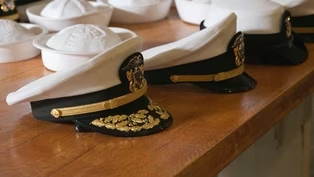
[music playing] [music playing] In spring of 2026, the United States Navy visited Lexington with an outreach program titled Navy Week, a program that brought sailors and Navy leaders to introduce townspeople throughout the city to the history and purpose of our nation's naval branch of service.
Kentucky is a landlocked state.
You don't touch an ocean.
You don't get to see big gray Navy ships and sharp sailors every day, but it's Kentucky's Navy.
And the Navy belongs as much to the people of Lexington and Louisville as much as it does to the people of San Diego and Norfolk, Virginia, where our fleets are based.
Rear Admiral Mike Brown explains how the Navy guarantees freedom of the seas, allowing global trade to flow, something important to the people of the Commonwealth.
The United States Navy underpins America's economic prosperity and way of life by guaranteeing freedom of the seas.
Kentucky is an exporting powerhouse.
$50 billion worth of goods left the state last year to be sold overseas, representing 17% of the state's economy and supporting more than 120,000 jobs directly.
So, the United States Navy helps Kentucky prosper.
Kentucky has had a connection with the names on Navy vessels that go as far back as the Civil War, when the USS Louisville, one of the nation's first ironclad warships, was built to serve on the Mississippi and Tennessee rivers.
This warship would participate in the Battle of Fort Henry, providing firepower that helped bring down this Confederate stronghold and assisting Ulysses S. Grant to one of his first major victories.
In World War I, the battleship USS Kentucky was put into service.
It was the first of two ships that would carry the name of the Commonwealth for the Navy.
Kentuckians themselves are part of the Navy's history.
During World War II, Lieutenant Commander Dudley of Owensboro would lead the crew of the submarine USS Wahoo.
One of my absolute heroes of the United States Navy was a submarine commander named Dudley Morton, and his nickname was Mush Morton.
His submarine, the USS Wahoo, sank more Japanese ships than any other single platform in the entire Second World War.
A graduate of the United States Naval Academy, Commander Morton would watch through the periscope as the Wahoo sank 19 enemy ships.
Sadly, the Wahoo, with Morton and the crew, was sunk while leaving the Sea of Japan.
[applause] One special set of guests during Navy Week were sailors from another submarine.
This, the missile submarine USS Kentucky.
They were joined by their commander, Robert Perris, himself born in the Bluegrass.
The USS Kentucky is an Ohio-class ballistic missile submarine, and we are a part of the strategic deterrence triad that the United States has.
Our role is one of us to go out and support that mission set via our operational commanders and provide the strategic deterrence that the nation asks us to carry out on a day-to-day basis.
It's one of the three operational legs of that deterrent aspect.
This submarine, known as a boomer for the 20 missiles it's capable of carrying, is the second Navy ship named for the Commonwealth.
[beating retreat] The USS Kentucky was christened in July 1991 by Carolyn Pennebaker Hopkins, wife of Representative Larry Hopkins.
Carolyn Hopkins christened the boat, not with the traditional bottle of champagne, but with a bottle of Kentucky bourbon.
The bourbon bottle was held in a special metal container that held the broken glass while allowing the bourbon to pour through holes in the bottom onto the vessel.
Appropriately nicknamed the thoroughbred of the fleet for its speed, this submarine's commander and crew carry on traditions that connect them with their namesake.
Our chant at the end of all of our all-hands meeting, it starts with me yelling, “Go big blue,” and the crew responding with, “Giddy up.” On their visit, the crew, along with fellow sailors, enjoyed other Kentucky traditions, sharing the memories and pictures with the people of Lexington.
These images from Navy Week display the pride these sailors have in both the history of the Navy and now the future they themselves train and prepare for, a pride that is recognized and reflected by their leaders.
I think that pride comes from not just wearing the cloth of the country, which is a big part of it too, and that sense of doing something bigger than yourself.
But the other sense of pride is every one of our sailors are experts in what they do.
The sailors are what makes the submarine go.
There's a lot of technology, but none of it will go anywhere, or work as designed, if those sailors, 18, 19, 20-year-olds, aren't trained and aren't executing as we ask them to.
And they do it fantastically, day in and day out.
No task asked of them is too small to meet that objective, and everybody has a role that's fundamental and vital to our success when asked to go underway and conduct our operations.
[music playing] We've had a great time here today at the Woodstock Lavender Company in Somerset.
The smell from the breeze going through the plants here is fantastic, and we really hope you've liked learning more about the operation.
Now, if you've enjoyed our show, be sure to like the Kentucky Life Facebook page and subscribe to the KET YouTube channel for more of what we like to call Kentucky Life Extras, where you'll have access to lots of other great videos.
Until next time I'll leave you with this moment.
I'm Chip Polston, cherishing this Kentucky life.
[music playing] [music playing] [wings flapping] [music playing] [ducks quacking] [music playing]
Video has Closed Captions
Clip: S32 Ep3 | 2m 50s | We visit Woodstock Lavender Co. to learn how lavender is grown and used in Kentucky. (2m 50s)
Video has Closed Captions
Clip: S32 Ep3 | 6m 58s | Meet this year’s Miss Kentucky contestants as they compete for the crown in Bowling Green. (6m 58s)
Video has Closed Captions
Clip: S32 Ep3 | 7m 3s | Scientists are fighting to save fragile plants in a nature preserve decimated by an EF4 tornado. (7m 3s)
Video has Closed Captions
Clip: S32 Ep3 | 6m 28s | Navy Week comes to Lexington with sailors from the USS Kentucky sharing Navy and state traditions. (6m 28s)
Providing Support for PBS.org
Learn Moreabout PBS online sponsorship











Support for PBS provided by:
Kentucky Life is a local public television program presented by KET
You give every Kentuckian the opportunity to explore new ideas and new worlds through KET. Visit the Kentucky Life website.