
July 9, 2026 - Full Show
7/9/2026 | 26m 47sVideo has Closed Captions
Watch the July 9, 2026, full episode of "Chicago Tonight."
A federal judge finds Chicago’s U.S. attorney violated a court order. And what happens to all the storm water after heavy rainfall like we saw last weekend.
Problems playing video? | Closed Captioning Feedback
Problems playing video? | Closed Captioning Feedback
Chicago Tonight is a local public television program presented by WTTW
WTTW video streaming support provided by members and sponsors.
July 9, 2026 - Full Show
7/9/2026 | 26m 47sVideo has Closed Captions
A federal judge finds Chicago’s U.S. attorney violated a court order. And what happens to all the storm water after heavy rainfall like we saw last weekend.
Problems playing video? | Closed Captioning Feedback
Where to Watch Chicago Tonight
Chicago Tonight is available to stream on pbs.org and the PBS app.

WTTW News Explains
In this Emmy Award-winning series, WTTW News tackles your questions — big and small — about life in the Chicago area. Our video animations guide you through local government, city history, public utilities and everything in between.Providing Support for PBS.org
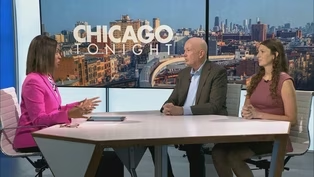
Learn Moreabout PBS online sponsorship>> Hello and thanks for joining us on Chicago Brandis Friedman.
Here's what we're looking at.
2 local reservoirs are nearly full of storm water.
So what happens if we get more rain?
We hear about the area's deep tunnel reservoirs and how they work.
>> We who believe in freedom cannot rest.
And those of us in this struggle have not rested.
>> And the long awaited groundbreaking for memorial that honors survivors of police torture.
>> First off tonight, embattled Chicago U.S.
Attorney Andrew Boutros is back in court and on the hot seat.
Magistrate Judge Laura McNally says Boutros violated a court order when he openly discussed a gang murder case.
While it remained under seal.
Boutros spoke about the case at a news conference last week and says he believed at that time that the case either was being unsealed or had already been unsealed.
The U.S.
attorney had asked the judge to strike today's hearing saying he was acting in, quote, good faith and no harm had been done to a defendant or law or law enforcement.
Mcnally denied that request ordering Boutros to appear in order to, quote, remind leadership, including you that unsealing orders must be scrupulously followed.
However, the judge did make clear that there would be no further investigations, sanctions or consequences for Boutros related to this.
more details on the case that Boutros was discussing on our website.
Republican state lawmakers are calling for accountability and stronger ethics reforms after 2 state lawmakers were accused of misconduct yesterday a federal grand jury indicted Democratic State representative Carol Ammons accusing her of orchestrating a scheme to receive illegal cash, kickbacks from local nonprofits.
She helps secure state grant funding for and last week, Democratic State Representative Kerry Benton resigned after an ethics investigation reportedly about allegations of harassment.
Republicans are now calling for the report detailing Benton's conduct to be released to the public and for Illinois House Speaker Emanuel Chris Welch to formally ask Emmons to resign.
Immigrant rights activists are sounding the alarm over recent uptick in ICE activity in Chicago and around the country.
Advocates say operation Midway Blitz.
That's the federal immigration enforcement that Royal Chicago area neighborhood last fall is far from over.
Today.
Months later.
We are standing here again.
>> Because we are seeing a surge in ice activity here back of the yards and surrounding neighborhoods and across Chicagoland area.
The spy claims that operation Midway Blitz has ended.
It is not over.
Our communities continue to feel the impact.
>> Ice arrests surged at the end of June with over 10,000 reported across the 5 day period in Chicago.
21 people were detained by ICE last week and 17 people have been detained this week, according to the Little Village based community group in Chicago.
Some Chicago teens received a history lesson today from Tony Award-winning Broadway musical Sox about the fight for women's rights to vote.
And one of the South's is Chicago.
Civil rights crusader and journalist Ida B Wells today, teens from the Girls leadership, nonprofit Girls Inc, heard from both the actress who plays Wells.
In the limited time Chicago production as well as well as great granddaughter, who is also a journalist in the former building of the Chicago be, which is the newspaper where Wells was an editor.
Students learned about how pioneering it was for black women at the time to fight for the right to vote.
>> How black women during that movement were sidelined were told to stand back.
We're told that can combine them.
You can't really be included.
And what also don't learn in school.
This how prevalent black women were during the suffragist movement and that might not seem significant today.
But if you really think about the fact that she was born into slavery.
>> And then she, you know, fast forward, you know, 40 years later, she's fighting for the right to vote, have voice and our democracy.
>> Subsys in Chicago at the CIBC Theater until July 19th.
Up next, we explain the Chicago area's overtaxed storm water reservoir system right after this.
>> Chicago tonight is made possible in part by the Alexander and John Nichols family.
The Pope Brothers Foundation.
And the support of these donors.
>> The Chicago region is drying out this week after being pounded by heavy rainfall over the weekend.
And it's probably needed more than 7 billion gallons of water flowed into Fort Reservoir in south suburban Cook County, putting it at nearly capacity and in south Western Cook County, the Mccook reservoir captured more than 3 billion gallons.
They're both part of the region's tunnel in Reservoir plan also known as TARP or tunnel.
And they add a critical backstop for storm water management in Cook County.
Here to help us understand how it all works.
Are John Murray, executive director of the Metropolitan Water Reclamation District and Tessa Marino relation watershed policy manager at Friends of the Chicago River.
Thanks to both for joining John, give us a sense of how much water these was a bars hold, what 7 billion gallons of water look like?
>> Well, 7 billion 7 billion gallons of water looks like about a well.
I'm gonna go with 13 billion gallons since 13 billion gallons that we collected and that's nearly 20,000 Olympic size.
Swimming pools is what that looks just 20,000.
Just just them Is this capacity enough to like what we have do we have enough capacity to keep up with what you know, this historically heavy rains that we've been seeing due to climate change.
What the current time we are driving down the reservoir years and where getting about 6 to 700 million gallons a day out of the reservoir system in that storage becomes immediately available for the next storm that comes in.
But we are going to be at a level.
We're going to have water in the system for for a number weeks will be the water.
So that means if we should get more water over the next few weeks.
There is there is storage is becoming available as we speak as we continue to the water in the reservoir.
So that depend on how much water, whether or not we're in near capacity situation where we're still near capacity situation.
But we're starting to to pump down reservoirs in.
So as each day goes by without any rain will get closer and closer to empting the reservoirs.
In the meantime, as we do water, they'll be space available.
To take on water, OK?
So we're getting there.
okay.
Why didn't explain for us if you would, you know how and why streets and basements still flood, despite, you know, having these reservoirs.
>> So we've seen incredible rain events that happened over the past couple of years.
If we recall in July of 2023, there's a very large storm event draft an incredible amount of water in a very short period of time.
And what happens is that that waters unable to make its way through the local sewer system and to make its way to to our system.
And so that is easy.
Even if we have capacity in our system that occurs.
When when the system, when the water can't get out of system.
then there's the potential for basement backups to the water and the rain is coming down and filling up the sewage system faster than it can make it to to you.
Correct?
>> Correct.
Tessa Wyatt Storm Water management.
Important for the health of local waterways.
Rivers.
>> Right.
It's storm water management is pertinent to the health and the water quality of the Chicago Calumet River System because we actually have a combined sewer system here in the Chicago region, meaning the water that's entering into the deep tunnel system that we're talking about is not just rain water, but also wastewater from people's homes, businesses.
So that the water from you're seeing from your toilets and when the system becomes overwhelmed during heavy storms like we're talking about, there is also a chance will enter into the river system.
So that means raw sewage entering into our precious waterways.
What what happens when raw sewage inter's when it when that happens?
So first of all, it is hazardous for humans that recreate on the water show.
People who kayak canoe, fishing, you're at a higher risk receiving any impacts from pathogens that could be in the water.
If you come into contact without water after a are combined.
Sewer overflow has occurred.
It's also really impactful for our aquatic habitats.
So we have seen there was a combined sewer overflow and the Bubbly Creek area just a few weeks ago.
And we did unfortunately see a large fish die off.
Fish risen to the surface of the water.
There as a result of the combined sewer overflow, you said was a large die off with how much come from attrition.
There are least 100 floating to the top of the river.
So it I and of course, the the Chicago County members system, we're seeing a lot more fish.
Then we have years past because we are getting better with the help of the river system by the these combined sewer overflows could really set us back.
John, what happens if a reservoir does fill up and then there's more rain on the way.
>> So what will happen is if there's that capacity in our system is that the water likely they'll be more of an increase of the sewer overflow into area waterways.
If I could just add a little bit the TARP system, the do tunnel systems just simply been amazing is tested.
Mentioned we look at the number fish species that are now on area waterways system.
We've gone from 7 or 8 in the 70's to well over 70 now, that's a testament to the success of the of the of tunnel system.
And we've also had hundreds of millions of dollars in flood reduction benefits.
Also.
So it's we it works in tandem.
We tried to prevent sewer overflows as much as we can.
>> Yeah.
So it does important work.
It gets.
It gets tricky, of course, I guess I'd like to know a little more if you can about that.
The impact of climate change.
If we're if we're getting more and more rain and more and more storms were pushing, the were pushing the ability of of the type system.
>> We're pushing the believe all of our systems through climate change.
And so what we what we've seen this year from January.
First until now from our mccook TARP system, that's the at the is the water at the Stickney plant.
And that plan central Chicago and communities in that area this year, just from that her pumping that we've done that collection that we've done over 34 billion gallons of water so far this year compared to last year at the scene time period.
It's about it's about double from what we had last year.
So it's considerable in that storm that we talked 2023 that direct indicator.
The climate change is is there is a real thing that that's that's not going away.
appears the only beginning more severe, right?
Because I think we heard from from someone earlier this week, I think the Chicago Department of Water Management that over the weekend at the 4th, we got as much rain that weekend alone.
>> As we would typically get in the month of July.
That's correct.
In.
That's as much >> From I think we have more rain in June that we normally get in June July.
>> Tessa, how does flood risk change with the seasons?
when I think about flood risk for the Chicago River system, I'm thinking about the combined sewer overflows and that really is more likely to occur occur in the summertime.
When there's larger but heavy rain storms and more intense rainstorms.
But combined sewer overflows are a risk to all our all year around there.
He was one earlier this winter and the beginning of January.
So there was some snow miles happening at the same time that there was some inclement rain water going through.
And so we did see a combined sewer overflow them to It always could be an issue.
It's great tell Tessa are.
What more can you tell us about the overflow action friends Chicago River initiated overflow action days around 10 years ago.
And this is a way for all of Chicago region, community members to get involved in reducing the risk of combined sewer overflows.
So when we know that there's heavy rain in the forecast and now I'm the viewer, do use a one who really triggers those alerts for us because a loop it into whether or not the the TARP system of that capacity.
We'll send out an alert and it'll advise people to use less water use if they can in their home.
So maybe delay taking a shower for go.
Your chores like dishwashing in laundry for a little bit.
Maybe flush your toilet a little bit less because I can really help reduce the amount of water into the system since again.
It is a combined sewer system here.
John, how how does the in Derby or do you do you manage concerns about the odors that residents might experience near Reservoir?
>> So were We have a reservoir for this little kid and Thorton.
And there we first put the reservoir and service and a 2015.
There are a number of issues with voters.
And so some readers a couple years after that.
And then we still had different issues.
So we had public.
We we worked with municipalities in that area and we developed.
to projects that are going to be in service by the end of this year and that we hope we know will help address border issue in the in the area.
We've also made some operational challenges.
One of the greatest challenge is for the district is none of this.
If a structure exists anywhere else in the world.
And so we're learning how to deal with some of these some of these issues.
Also, we also take the order issue very seriously.
That's a that's quality of life.
In fact.
So where were we try to scare the residents who live near their appreciative of your efforts to to address that?
We're able to.
>> John Murray, Tessa Murray, no relation.
Thanks to you both for joining us.
We appreciate it.
Thank you.
Thank you.
Up next, honoring survivors of police violence.
This week.
Chicago made good on an 11 year-old promised to survivors of police torture from 1971.
To 1992 former police commander Jon Burge and officers under his command tortured more than 100 black men, women and children on Chicago's South side to coerce confessions in 2015 city Council approved a reparations package that included a permanent memorial acknowledging and remembering the experiences of the survivors.
Yesterday, construction finally began on that long-awaited memorial in Washington Park.
It is the first state sponsored monument in the U.S.
to commemorate law enforcement violence.
Joining us to talk more about the groundbreaking and what's next.
Are Anthony Homes survivor reparations recipient and vice president of the Chicago Torture, Justice Memorials Foundation Joey Mobile, co-founder and president of the Chicago Torture, Justice Memorials Foundation.
And Aislinn Pulley executive director of the Chicago Torture Justice Center.
Welcome back to the 3 of you.
Thank you for joining us.
Congratulations on getting to this point.
Thank you.
So I want to start with you all and find out, you know, sort of what the last 11 years.
You know, what it's been like and how you're feeling.
Now.
The construction has finally gotten started on and want to start with you first place.
This relief.
>> There met in that it would help us.
Kobe a lot changes.
Putin and proved too to help us.
So own son.
Him only did a bit of edge of the sea and helped us stuff so.
The south and mostly says will help those in need.
You come to his word from June 10th last year them, he stepped out and that's why like, that's what we have now.
speak on that.
>> Joey, remember when this reparations package was passed back in 2015, interviewing you then and learning about all of this?
How do you feel now that construction is finally started?
Well, its quarry us, it's truly a joyous occasion.
We are thrilled and excited and it's been too long coming.
>> You know, reparations legislation got passed and immediately went into implementing the reparations legislation.
And we did work with the Emanuel Administration to do so.
But they would not have any full and fair conversations truly about this memorial.
And it's been truly frustrating to try to get this memorial built while we have done the hard work of talking with the survivors and family members getting their input, doing sure.
Reds coming up with the design.
We really haven't had partners in the city who are willing to work with us.
There were members of the Lightfoot administration who did support us.
But unfortunately, we just not get the rhythm to build it.
So we are so grateful to Mayor Johnson and his administration for working with us to make this dream a reality.
We're also so grateful to Alderwoman Taylor.
She's the only person who Alderwoman on the South side who allow us build within her ward.
And it was very important when we talk to survivors and family members, they all said they wanted the memorial on the south side of Chicago because that's where they lived.
And that's where they were tortured.
And that's where they thought it was fitting to be built.
So it meant so much to us to have Alderman Taylor come through and have a minus.
Go through a could be built and her part.
Anthony, you're one of the first survivors of the birds.
Torture testified during his trial which was not about torture.
Actually, it was about something related after decades of people not believing you and the other survivors and your experiences.
Why do you think physical memorial is important to include tomorrow?
To me?
Is that true?
>> Express.
Everything that took place with those at the state that that the city did to us corrupt offices.
And the part about it then about a want to leave us zip.
And to and through all of it.
We've got we've got pushed them push the way and then fine.
Lawyers and stuff.
they get they get to represent built.
Move from now went to the u N and that was thanks is doing now.
No clearly.
And then they 10 and they helped us because of the amount of you know, Dan, want to help us period because we still encroached on August, the who but that's not the point.
The point what they did to is wrong.
And that's the point.
You know, 5 losom you're going jail for, but don't put me in the And you know, but that's not the point.
The point is that.
All of us.
The ones, those single cases and stuff that was true.
a joy is that they just locked us because the other one has locked up.
Through it all.
Thanks to them know y'all helping us.
the the the steps out and that really give us more hope.
You know, to continue on we do we help.
>> Aislinn one of the other things that was or that was included in this reparations package was, of course, the center that you're and now the Chicago Torture Justice Center that counseling center for survivors and families which opened in 2017.
How's that center been helping with ongoing trauma that survivors experience and their families?
It's been really incredible.
What we've seen is, you know, where the first in the only center in the country that's dedicated to treating survivors of domestic torture.
>> And we've learned so much from survivors like Anthony and from attorneys like Joey and from organizers who have taught us about the perseverance through the pain and what we're realizing is that there there's a slew of walking wounded people who have experienced and gone through the criminal legal system just like Anthony has.
And just like the mothers who have been fighting for their loved ones to be released, have.
And so there's a slew of the population who has been ignored for decades and perhaps for centuries and whose pain and trauma have been.
Rendered really invisible.
And so now we're at the precipice of really forging a new part of the field of psychiatry and psychology that connects not just a wellness and healing in the abstract, but in within the reality and within the confines of understanding what it means when a society hurts and harms.
As we mentioned, you know, in our lead, there's the narrative that only men were torture, but there are women as well.
Yes, absolutely verify No, absolutely.
There.
We don't know of as many women and to be honest with you.
>> Because the Chicago Police Department and the Cook County State's attorney's ever office number fully didn't investigation.
We may not know of every single survivor who was impacted by berge and the men under his command.
absolutely know that there were black women who were tortured and interrogated by Berge and his henchmen in area 2, 3 police headquarters.
So we have always said it's been men and women and children.
And that is very important.
Part of the story.
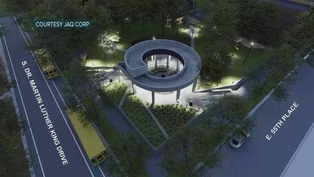
I'm joined the design of the memorial, its title breath for Brett Form Breath.
Excuse me, breath Foreman, Freedom.
>> Tell us more about the inspiration on what people will see this memorial when it's completed.
>> Well, the original, the original concept for the design was by patrician to go in.
And John Lee.
And they had sort of based it on.
We on the the feedback that we had solicited from survivors and their family members.
And so there's a spiral and it has to do with those upper teens to score curls as well as sort of the inverse of the PennDOT to com, which is the way you know, the system, the way prisons used to surveil everyone.
So it's sort of the inverse of that.
But then we really worked with John, whose architect and he also spoke with survivors as well, including Stanley Howard and how Stanley Howard described how he was like into the vortex of the criminal legal system and then spit out.
So there will be certain pathways that come from it.
So literally, as you can see, it's a concrete structure.
We have a timeline that tells the story of the races pattern and practice of torture as well as the decades long struggle for justice by organizers, by attorneys by independent journalism that culminated in the historic passage of the reparations legislation and then beyond that, you know where Trump where the survivors and family members were often denied and dismissed.
We've we we will have their voices there.
There are sayings etched into the ground near the memorial.
So it an expression of that them?
And, you know, the reverse of what's been happening to sounds like it'll be a very moving memorial when the time comes.
I expected to open in early 2027.
>> Unfortunately, we're out of time.
I want to thank the 3 of you and and congrats to all the joy mobile into support.
Thanks.
Thank you.
Thank you.
>> And we're back to wrap things up right after this.
>> Reflecting the people and perspectives that make up can This story is part of Chicago tonight.
Black Voice.
>> And that's our show for this Thursday night.
If you're making weekend plans, but need some inspiration.
Check out our website for our Chicago Summer Festival guide.
You can find it at Www dot com slash festivals and join us tomorrow night at 5.37, for the week in review.
Now for all of us here at Chicago Brandis Friedman, thank you for watching.
Stay healthy and safe.
>> Closed captioning is made possible by Clifford and Clifford Law offices, Chicago, personal injury and wrongful death for that contributes to
 New
NewDeep Tunnel Reservoirs Nearly Full. Here's How They Work
Video has Closed Captions
The Chicago region’s Tunnel and Reservoir Plan (TARP) can hold billions of gallons of water. (9m 43s)
 New
NewPolice Torture Survivors Hold Groundbreaking Ceremony for Chicago Memorial
Video has Closed Captions
The Chicago City Council in 2015 approved a reparations package that included a permanent memorial. (9m 29s)
Providing Support for PBS.org
Learn Moreabout PBS online sponsorship New Episode
- News and Public Affairs

Top journalists deliver compelling original analysis of the hour's headlines.

- News and Public Affairs

FRONTLINE is investigative journalism that questions, explains and changes our world.



 New Episode
 New Episode


 New Episode
Support for PBS provided by:
Chicago Tonight is a local public television program presented by WTTW
WTTW video streaming support provided by members and sponsors.