
Deep Tunnel Reservoirs Nearly Full. Here's How They Work
Clip: 7/9/2026 | 9m 43sVideo has Closed Captions
The Chicago region’s Tunnel and Reservoir Plan (TARP) can hold billions of gallons of water.
The Chicago region’s Tunnel and Reservoir Plan (TARP), aka the Deep Tunnel system, can hold billions of gallons of water during extreme weather events. Following a 48-hour period of near biblical rain between July 2 and July 4, TARP’s reservoirs were all but maxed out, reaching unprecedented levels.
Problems playing video? | Closed Captioning Feedback
Problems playing video? | Closed Captioning Feedback
Chicago Tonight is a local public television program presented by WTTW
WTTW video streaming support provided by members and sponsors.
Deep Tunnel Reservoirs Nearly Full. Here's How They Work
Clip: 7/9/2026 | 9m 43sVideo has Closed Captions
The Chicago region’s Tunnel and Reservoir Plan (TARP), aka the Deep Tunnel system, can hold billions of gallons of water during extreme weather events. Following a 48-hour period of near biblical rain between July 2 and July 4, TARP’s reservoirs were all but maxed out, reaching unprecedented levels.
Problems playing video? | Closed Captioning Feedback
Where to Watch Chicago Tonight
Chicago Tonight is available to stream on pbs.org and the PBS app.

WTTW News Explains
In this Emmy Award-winning series, WTTW News tackles your questions — big and small — about life in the Chicago area. Our video animations guide you through local government, city history, public utilities and everything in between.Providing Support for PBS.org
Learn Moreabout PBS online sponsorship>> The Chicago region is drying out this week after being pounded by heavy rainfall over the weekend.
And it's probably needed more than 7 billion gallons of water flowed into Fort Reservoir in south suburban Cook County, putting it at nearly capacity and in south Western Cook County, the Mccook reservoir captured more than 3 billion gallons.
They're both part of the region's tunnel in Reservoir plan also known as TARP or tunnel.
And they add a critical backstop for storm water management in Cook County.
Here to help us understand how it all works.
Are John Murray, executive director of the Metropolitan Water Reclamation District and Tessa Marino relation watershed policy manager at Friends of the Chicago River.
Thanks to both for joining John, give us a sense of how much water these was a bars hold, what 7 billion gallons of water look like?
>> Well, 7 billion 7 billion gallons of water looks like about a well.
I'm gonna go with 13 billion gallons since 13 billion gallons that we collected and that's nearly 20,000 Olympic size.
Swimming pools is what that looks just 20,000.
Just just them Is this capacity enough to like what we have do we have enough capacity to keep up with what you know, this historically heavy rains that we've been seeing due to climate change.
What the current time we are driving down the reservoir years and where getting about 6 to 700 million gallons a day out of the reservoir system in that storage becomes immediately available for the next storm that comes in.
But we are going to be at a level.
We're going to have water in the system for for a number weeks will be the water.
So that means if we should get more water over the next few weeks.
There is there is storage is becoming available as we speak as we continue to the water in the reservoir.
So that depend on how much water, whether or not we're in near capacity situation where we're still near capacity situation.
But we're starting to to pump down reservoirs in.
So as each day goes by without any rain will get closer and closer to empting the reservoirs.
In the meantime, as we do water, they'll be space available.
To take on water, OK?
So we're getting there.
okay.
Why didn't explain for us if you would, you know how and why streets and basements still flood, despite, you know, having these reservoirs.
>> So we've seen incredible rain events that happened over the past couple of years.
If we recall in July of 2023, there's a very large storm event draft an incredible amount of water in a very short period of time.
And what happens is that that waters unable to make its way through the local sewer system and to make its way to to our system.
And so that is easy.
Even if we have capacity in our system that occurs.
When when the system, when the water can't get out of system.
then there's the potential for basement backups to the water and the rain is coming down and filling up the sewage system faster than it can make it to to you.
Correct?
>> Correct.
Tessa Wyatt Storm Water management.
Important for the health of local waterways.
Rivers.
>> Right.
It's storm water management is pertinent to the health and the water quality of the Chicago Calumet River System because we actually have a combined sewer system here in the Chicago region, meaning the water that's entering into the deep tunnel system that we're talking about is not just rain water, but also wastewater from people's homes, businesses.
So that the water from you're seeing from your toilets and when the system becomes overwhelmed during heavy storms like we're talking about, there is also a chance will enter into the river system.
So that means raw sewage entering into our precious waterways.
What what happens when raw sewage inter's when it when that happens?
So first of all, it is hazardous for humans that recreate on the water show.
People who kayak canoe, fishing, you're at a higher risk receiving any impacts from pathogens that could be in the water.
If you come into contact without water after a are combined.
Sewer overflow has occurred.
It's also really impactful for our aquatic habitats.
So we have seen there was a combined sewer overflow and the Bubbly Creek area just a few weeks ago.
And we did unfortunately see a large fish die off.
Fish risen to the surface of the water.
There as a result of the combined sewer overflow, you said was a large die off with how much come from attrition.
There are least 100 floating to the top of the river.
So it I and of course, the the Chicago County members system, we're seeing a lot more fish.
Then we have years past because we are getting better with the help of the river system by the these combined sewer overflows could really set us back.
John, what happens if a reservoir does fill up and then there's more rain on the way.
>> So what will happen is if there's that capacity in our system is that the water likely they'll be more of an increase of the sewer overflow into area waterways.
If I could just add a little bit the TARP system, the do tunnel systems just simply been amazing is tested.
Mentioned we look at the number fish species that are now on area waterways system.
We've gone from 7 or 8 in the 70's to well over 70 now, that's a testament to the success of the of the of tunnel system.
And we've also had hundreds of millions of dollars in flood reduction benefits.
Also.
So it's we it works in tandem.
We tried to prevent sewer overflows as much as we can.
>> Yeah.
So it does important work.
It gets.
It gets tricky, of course, I guess I'd like to know a little more if you can about that.
The impact of climate change.
If we're if we're getting more and more rain and more and more storms were pushing, the were pushing the ability of of the type system.
>> We're pushing the believe all of our systems through climate change.
And so what we what we've seen this year from January.
First until now from our mccook TARP system, that's the at the is the water at the Stickney plant.
And that plan central Chicago and communities in that area this year, just from that her pumping that we've done that collection that we've done over 34 billion gallons of water so far this year compared to last year at the scene time period.
It's about it's about double from what we had last year.
So it's considerable in that storm that we talked 2023 that direct indicator.
The climate change is is there is a real thing that that's that's not going away.
appears the only beginning more severe, right?
Because I think we heard from from someone earlier this week, I think the Chicago Department of Water Management that over the weekend at the 4th, we got as much rain that weekend alone.
>> As we would typically get in the month of July.
That's correct.
In.
That's as much >> From I think we have more rain in June that we normally get in June July.
>> Tessa, how does flood risk change with the seasons?
when I think about flood risk for the Chicago River system, I'm thinking about the combined sewer overflows and that really is more likely to occur occur in the summertime.
When there's larger but heavy rain storms and more intense rainstorms.
But combined sewer overflows are a risk to all our all year around there.
He was one earlier this winter and the beginning of January.
So there was some snow miles happening at the same time that there was some inclement rain water going through.
And so we did see a combined sewer overflow them to It always could be an issue.
It's great tell Tessa are.
What more can you tell us about the overflow action friends Chicago River initiated overflow action days around 10 years ago.
And this is a way for all of Chicago region, community members to get involved in reducing the risk of combined sewer overflows.
So when we know that there's heavy rain in the forecast and now I'm the viewer, do use a one who really triggers those alerts for us because a loop it into whether or not the the TARP system of that capacity.
We'll send out an alert and it'll advise people to use less water use if they can in their home.
So maybe delay taking a shower for go.
Your chores like dishwashing in laundry for a little bit.
Maybe flush your toilet a little bit less because I can really help reduce the amount of water into the system since again.
It is a combined sewer system here.
John, how how does the in Derby or do you do you manage concerns about the odors that residents might experience near Reservoir?
>> So were We have a reservoir for this little kid and Thorton.
And there we first put the reservoir and service and a 2015.
There are a number of issues with voters.
And so some readers a couple years after that.
And then we still had different issues.
So we had public.
We we worked with municipalities in that area and we developed.
to projects that are going to be in service by the end of this year and that we hope we know will help address border issue in the in the area.
We've also made some operational challenges.
One of the greatest challenge is for the district is none of this.
If a structure exists anywhere else in the world.
And so we're learning how to deal with some of these some of these issues.
Also, we also take the order issue very seriously.
That's a that's quality of life.
In fact.
So where were we try to scare the residents who live near their appreciative of
 New
NewPolice Torture Survivors Hold Groundbreaking Ceremony for Chicago Memorial
Video has Closed Captions
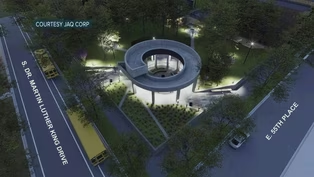
The Chicago City Council in 2015 approved a reparations package that included a permanent memorial. (9m 29s)
Providing Support for PBS.org
Learn Moreabout PBS online sponsorship New Episode
- News and Public Affairs

Top journalists deliver compelling original analysis of the hour's headlines.

- News and Public Affairs

FRONTLINE is investigative journalism that questions, explains and changes our world.



 New Episode
 New Episode
 New Episode


 New Episode
Support for PBS provided by:
Chicago Tonight is a local public television program presented by WTTW
WTTW video streaming support provided by members and sponsors.