
Carolyne Naomi
Clip: Season 17 Episode 11 | 13m 44sVideo has Closed Captions
Carolyne Naomi writes and performs music inspired by her Nigerian heritage.
In the Twin Cities, singer, songwriter, and guitarist Carolyne Naomi writes and performs music inspired by her Nigerian heritage.
Problems playing video? | Closed Captioning Feedback
Problems playing video? | Closed Captioning Feedback
Postcards is a local public television program presented by Pioneer PBS
Production sponsorship is provided by contributions from the voters of Minnesota through a legislative appropriation from the Arts and Cultural Heritage Fund, Explore Alexandria Tourism, Shalom Hill Farm, West Central...
Support provided by:


Carolyne Naomi
Clip: Season 17 Episode 11 | 13m 44sVideo has Closed Captions
In the Twin Cities, singer, songwriter, and guitarist Carolyne Naomi writes and performs music inspired by her Nigerian heritage.
Problems playing video? | Closed Captioning Feedback
How to Watch Postcards
Postcards is available to stream on pbs.org and the free PBS App, available on iPhone, Apple TV, Android TV, Android smartphones, Amazon Fire TV, Amazon Fire Tablet, Roku, Samsung Smart TV, LG TV, and Vizio.
Providing Support for PBS.org
Learn Moreabout PBS online sponsorship- One, two, three, four.
(light rock music) ♪ Na so your matter be oh ♪ ♪ All the things wey you promise me ♪ Ase!
Na lie oh ♪ I gave you all of me oh ♪ Na so your mouth take sweet ♪ Tiff my heart oh!
♪ Just when I started ♪ Opening up to you ♪ So this is kind of like my little space.
It's still bare bones, it's not what it should be yet, but it does the work for now, you know, getting my vocals recorded and sending that to my music producer.
I'm able to create kind of like a demo of my song using my guitar, send that demo to him to tell him this is a new song I'm thinking about.
He goes ahead and then adds more instrumental to it, sends it back to me to then record clean, clear vocals.
Then we send those to the mixing engineer who's in Nigeria.
His name is Santi, Dr.
Santi.
♪ Ah ♪ Then you started acting like a clown ♪ ♪ But it's over now, it's over now ♪ ♪ I no be your mumu again, be your mumu again ♪ ♪ Moti japa, japa, japa ♪ The earliest memory I have of how I started off with music as a kid was when I was about eight or nine years old, and one of the first songs that I wrote was when I was in primary school, I had a math assignment that I had that I didn't like and I didn't want to do.
I wrote about that.
When I was about 12 years old, I joined the choir, kind of like an extracurricular activity to do outside of school.
And then at church, I also joined the choir right around the same time.
And so that was kind of how I developed more of the stage presence, singing in front of people.
♪ But by [indistinct] ♪ And finally I found myself on a West African music reality TV show and competition similar to "The Voice" or "American Idol," but also similar to "Big Brother Africa," "Big Brother America," where you have people living in a house like an academy and performing music every weekend.
15 contestants from different parts of Africa.
It was hosted in my country, which is Nigeria.
I'm on the magazine covers, you know, and I'm just saying hi to all of my friends.
(group laughs) That's it.
- Lovely, very nice, very nice.
- Being on "MTN Project Fame West Africa" kind of opened a door of opportunities for me to perform, to write music, to meet people that made me see that it was possible to in fact be a performer and not be too shy about it, you know?
And so after that, I had the desire to want to teach music and want to perform more.
I had taught a group of kids who were visually impaired.
So it was a school in a place called Surulere in Lagos, Nigeria, where majority of the kids were born blind or a few of them lost their sight as a result of maybe accidents or something else.
And I taught them how to play the guitar, which is very difficult.
Imagine picking up a guitar and trying to show a few kids who have never seen an instrument or seen anything in their lives before and showing them how to play.
And then when I came to Minnesota in 2014, I went to McNally Smith College of Music because I wanted to develop my skills in guitar and singing.
And that's what I did.
And afterwards I started performing here.
And the rest, as they say, is history.
(gentle guitar music) ♪ Who's got it down like ♪ Down like you ♪ Oh, who's in control like ♪ Control like you ♪ You handle everything like a boss ♪ ♪ 'Cos you're the boss ♪ I'm left in awe ♪ You handle everything like a boss ♪ ♪ You have the sauce ♪ Na you be the one ♪ My Oga at the Top ♪ When you speak a word, mic drop!
♪ ♪ Na you be... - A lot of times, the ideas behind the music videos come from the videographer and myself and also the producer that I work with who, when we're writing the song and recording together, we kind of say to ourselves, "Oh, this melody gives us a sense of XYZ, maybe XYZ, you know?"
So like when you're writing, you have this idea of what you want it to look like and then you work that thought process.
♪ Actions speak louder than words ♪ ♪ Deeper than make-believe ♪ ♪ Jowo my sistah ♪ ♪ Toju re e daada ♪ ♪ Ni ife re Pari ja pelu e ♪ ♪ Se gbo gbo eyi ti owo re lese ♪ ♪ Aah And so growing up and listening to Michael Jackson and listening to Brandy, it was like an influence on my style.
And my music producer, whose name is Tolu by the way, shout out to Tolu.
♪ I know that I messed up ♪ But I know that you're ♪ I no be your mumu again And he had initially created a beat already and said, "I have this beat, I think we can work with it."
And then he created like the hook of the song, the japa japa, which means like to run away, to leave a situation sort of.
The theme of the song is being in a relationship or a situationship that is just not beneficial because you realize that the person is wasting your time.
And then you just want to get your things, get yourself, and just run and leave the situation because it's unhealthy.
And so like even the first line of my verse is in Nigerian Pidgin English.
“Na so your matter be” “All the things wey you promise me” “Ase!
Na lie oh” It means, "Oh, so this is how you are.
All the promises you made to me, all the love, all the this and that, everything was completely untrue?"
♪ ...be your mumu again ♪ ♪ Moti japa, japa, japa, mi o lo rara ♪ ♪ I no dey do again oh ♪ (Music fades out) (Music fades in) ♪ A promise ♪ A promise, ooh (soft upbeat music) When I moved in 2014, I definitely experienced culture shock, obviously, but I think the main culture shock for me was the weather.
It was incredibly cold.
So my brother and his family have lived here, I think since 2000, so about 25 years now.
And when I was thinking about moving to Minnesota, the first thing he said was, "Leave all your summer clothes in Nigeria.
Don't bring anything here with you."
I was coming from a weather that's 80 degrees, 90, 100 degrees sometimes, even 100-plus degrees to Minnesota where it was about 40 degrees, and I was freezing in 40 degrees, you know?
And then winter came and it became even worse and I thought I was gonna die literally because I was going to music college and I didn't have a car, so I would have to catch the bus.
I still don't like the winters, but I love Minnesota now.
All right now, I need more people here, come on.
♪ When all us were against you ♪ When it looked like things would fall through ♪ Finding community here in music, dance, cultural activities, connecting with friends and other people who know other people who are either Nigerians or Africans, it started to help me know that I'm far away from home, but in a way, I can make home here as well too in Minnesota.
(audience cheering) Oh my goodness, you guys are amazing.
Thank you, thank you, thank you, thank you so much.
I always dreamed about having my own EP, like a small album of about six songs.
♪ Everybody say (Carolyne singing in foreign language) ♪ One more time, let me hear you say ♪ The events that I play at are music venues like Ice House Minneapolis, I played at Dakota Jazz Club, we played at Afrofest.
So it's just a lot of music festivals, outdoor festivals.
I just love performing, I love being out there.
♪ Ay (group singing in foreign language) - Everything that I experienced inspired the music that I write.
I've written a song about my brother hurting me.
I've written a song about a relationship going bad.
I've written a song about my faith in God, you know, being a Christian and growing up in church and all of that.
So I feel that music speaks to a place in my heart that sometimes words just isn't able to articulate.
When I listen to a song and hear a melody that just strikes something inside of me, I'm like, I don't know, I smile, I respond.
Even at my job, my nine to five, everyone at the company that I work with, they know that I'm a musician, and sometimes they see me working with headphones on and I'm listening to music and my boss would pass by and is like, "Okay, I see you nodding your head.
What are you listening to?"
You know?
So music is just everywhere with me.
There was a time that I would even not go to bed unless I was listening to something to help me sleep at night.
♪ ...grace and mercy ♪ ♪ There is no controversy ♪ ♪ No be me ♪ ♪ Abi na you ♪ ♪ Wey dey give you love Wey dey lift you up ♪ ♪ No be me ♪ ♪ Abi na you ♪ ♪ Wey get your back Through the good and the bad ♪ ♪ No be me ♪ ♪ Abi na you ♪ ♪ Wey stand by your side ♪ When people talk about the Nigerian culture, it's almost as if they assume that it is just one culture, and it is not with that many people, over 200 and something million people.
We have, I believe, over 500 languages if I'm not mistaken.
And those languages are tied to different cultures.
(gentle guitar music) (Carolyne singing in foreign language) I don't have a lot of songs in my own language just because English is the official language in my country.
And in my family, the majority of the times that we conversed, it was mostly in English.
And so I'm not as fluent in my own language, which is terrible.
But I have the song that my mom taught me that I want to sing because I love it.
It just helps me stay connected to my roots.
And I love that a lot.
(Carolyne continues singing in foreign language) (Carolyne continues singing in foreign language) (bright music) - [Host] "Postcards" is made possible by the Minnesota Arts and Cultural Heritage Fund and the citizens of Minnesota.
Additional support provided by Margaret A. Cargill Philanthropies, Mark and Margaret Yakel-Julene on behalf of Shalom Hill Farms, a retreat and conference center in a prairie setting near Windom, Minnesota.
On the web at shalomhillfarm.org.
A better future starts now.
West Central Initiative empowers communities with resources, funding, and support for a thriving region.
More at wcif.org.
(bright music)
 New
NewVideo has Closed Captions
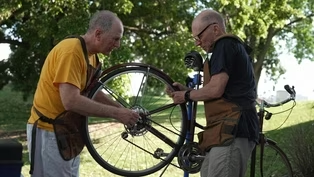
Clip: S17 Ep11 | 14m 23s | We Bike Rochester and Pata de Perro in Rochester with the community to provide bikes for the city. (14m 23s)
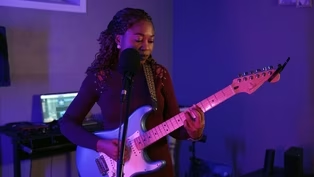
Preview: S17 Ep11 | 40s | We Bike Rochester & Pata de Perro provide bikes and Carolyne Naomi creates Nigerian heritage music. (40s)
Providing Support for PBS.org
Learn Moreabout PBS online sponsorship

- Arts and Music
The Best of the Joy of Painting with Bob Ross
A pop icon, Bob Ross offers soothing words of wisdom as he paints captivating landscapes.










Support for PBS provided by:
Postcards is a local public television program presented by Pioneer PBS
Production sponsorship is provided by contributions from the voters of Minnesota through a legislative appropriation from the Arts and Cultural Heritage Fund, Explore Alexandria Tourism, Shalom Hill Farm, West Central...