WEDU Arts Plus
1501 | Episode
Season 15 Episode 1 | 27m 14sVideo has Closed Captions
PBS is Punk | Pioneering Black Women | Art of Rock Climbing | Plein Air Painting
Local artist Jame brings punk-driven storytelling to chronic and mental health experiences, building empathy and community — plus bold art, trailblazing African American women, indoor rock-climbing design, and plein-air landscapes.
Problems playing video? | Closed Captioning Feedback
Problems playing video? | Closed Captioning Feedback
WEDU Arts Plus is a local public television program presented by WEDU
Major funding for WEDU Arts Plus is provided through the generosity of Charles Rosenblum, The State of Florida and Division of Arts and Culture and the National Endowment for the Arts, and the Hillsborough County Board of County Commissioners.
WEDU Arts Plus
1501 | Episode
Season 15 Episode 1 | 27m 14sVideo has Closed Captions
Local artist Jame brings punk-driven storytelling to chronic and mental health experiences, building empathy and community — plus bold art, trailblazing African American women, indoor rock-climbing design, and plein-air landscapes.
Problems playing video? | Closed Captioning Feedback
How to Watch WEDU Arts Plus
WEDU Arts Plus is available to stream on pbs.org and the free PBS App, available on iPhone, Apple TV, Android TV, Android smartphones, Amazon Fire TV, Amazon Fire Tablet, Roku, Samsung Smart TV, and Vizio.
Providing Support for PBS.org
Learn Moreabout PBS online sponsorship- This is a production of WEDU PBS, Tampa, St.
Petersburg, Sarasota.
[music] - Funding for WEDU Arts Plus is provided by Charles Rosenblum.
Hillsborough County Board of County Commissioners, the State of Florida, and Division of Arts and Culture, and the National Endowment for the Arts.
- In this Season 15 premiere of WEDU Arts Plus, Clothes that tell a story.
- So I like to make those connections and draw people together instead of separating people into their their label of their disease.
- Pioneering African American women.
- The exhibit tells the story of thirty African American women who all had ties to Ohio in some way.
Some were born here, some came here.
- Designing rock climbing routes.
- So route setting is the act of taking holds and putting them on the wall to create a specific route.
- And capturing the outdoors with a paintbrush.
- Being a plein air artist for me means taking my equipment outside and observing light falling on form.
- It's all coming up next on WEDU Arts Plus.
[music] Hello, I'm Gabe Ortiz and this is WEDU Arts Plus.
Two Crow Collective is a small batch clothing brand that blends punk culture and tattoo inspired streetwear with storytelling.
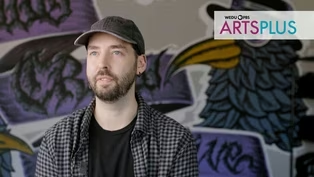
Its founder, Jame, created the PBS Is Punk design and is now using T-shirts to share chronic and mental health stories.
[music] - I think that what we do is a testament to authenticity, transparency and a little bit of dark humor.
[music] Forget Me Not is probably my favorite design I've ever done.
This one was for me.
And so this is kind of like a true testament to like, don't forget about us with chronic illness.
Like we do still want to be invited.
[music] My name is Jame.
I'm the owner of Two Crow Collective.
We make T-shirts for chronic illness, mental health challenges, and disabilities, while we also love just storytelling and helping people express themselves through what we create.
I consider myself to be a jack of all trades, and it took me a very, very long time to fall into the art form of screen printing.
I always loved art.
Growing up, I drew a lot.
I loved creating with Lego.
I loved just making things.
It wasn't until middle school when I met Dave Anderson, my middle school art teacher, who really cemented some core art philosophy in me, and that's just try new things.
- My name is David Anderson and I've been teaching for 30 years now.
I remember Jame as a student, as someone who came into the art room quite often outside of the class time.
He wanted to go around my room and pull out drawers and see what was inside.
Getting students to try new things is really important at this age.
There's a lot of reservation and hesitation for a middle school boy to take chances.
- I grew up with a sister who's 12 years older than me.
She was a goth.
[music] She listened to Nine Inch Nails and Marilyn Manson and Soundgarden and Pearl Jam and Incubus and all these cool grunge bands, and that was my influence at home.
And I became an alternative kid at a preppy, private school.
I was more of a musician more than anything.
I thought I was going to end up being a professional musician full time, and I did for a little bit.
Art wasn't really my main focus at that point in my life, but I still was very inspired to do art and learn more about what bands need.
And it wasn't until college that I found screen printing through our on campus record label, and I screen printed my first T-shirt ever.
I see PTSD, which is complex PTSD.
I lived in a household that was not perfect.
My dad was an alcoholic.
My family didn't deal with that very well.
For my Crohn's disease.
I had a quarter of my colon removed in 2010.
It was my first semester of college.
The cool thing about the band that I was in is everyone knew.
Everyone was super cool with it.
They said, if you need to stop, we'll stop.
And being able to build a community basically around that has been amazing.
[music] My business originally was called Dirty Bourbon Clothing.
We actually were a printing company.
First I was just printing shirts for bands.
I worked a 9 to 5 at a desk, and then I would come home and from 6 to 11 I would print shirts every single night.
I got extremely burnt out.
And then Covid hit.
[music] From there, the printing side, I stopped printing for other people and I started printing for myself.
I started making my own art instead of doing designs specific to chronic illness.
I do designs based on symptoms because somebody with cancer can connect to somebody like me with Crohn's.
So I like to make those connections and draw people together instead of separating people into their their label of their disease.
[music] Eventually, when I realized that the market I was hitting and the community I was building was for chronic and mental health folks, I had to take a step back.
And dealing with alcoholism in my own life and dealing with addiction myself, I had to realize that addiction is a disease too.
And if my friends who were addicts or alcoholics wouldn't wear my shirt because it said bourbon on it, that needed to change.
So we spent a lot of time trying to come up with a new name.
Two Crow is important to me.
My grandmother used to always say and write, "Tutti Two."
She believed that good and bad things always came in twos.
People see one crow and it's supposed to be a bad omen.
But I think like when you see two together, honestly, like I see my grandparents in those grows a little bit.
And I just thought that was a very good representation of the balance between the good and the bad.
[music] We can put purpose behind our pain, and that's what I've done every day since changing the name.
The idea of Two Crow started out there, and it started with my story and seeing that other people connected with it.
And then I realized if other people connect with me, other people can connect with other people.
So the I'm okay collection is an annual little event.
We put it on in the spring each year, and every year we make a new flower that says, "I'm Okay," and they're typically wilting in some regard as a means to say it's okay to not be okay or it's okay to be okay.
[music] The PBS Is Punk design for me is a little out there.
It's not something I typically do as Two Crow Collective.
[music] I got upset when I read the article that PBS was getting defunded because it felt like a part of my childhood was just kind of being ripped away.
I had an image in my head of the PBS logo with a mohawk and piercings.
[music] And I posted it on a whim and then it went viral instantly.
[music] - When I look at his work today, I think it's great and amazing that he is pushing that envelope further and doing it through T-shirt designs and doing it in a really a way where there's this sort of punk rock dynamic of tattoo culture and skateboard culture.
[music] - The biggest message that I want to send to folks with chronic illness or mental health challenges is that you're not alone, and that we're all going through something, everybody's going through something, and you're not alone in that.
[music] - Explore more of James art and his PBS Is Punk design at twocrowcollective.com.
The exhibition, "Queens Of The Heartland," features thirty pioneering African American women who all have connections to Ohio.
Up next, learn how a curator and a visual artist came together to tell the story of these important historical figures.
[music] - I think that it's so important that we know our history, and that this history is American history.
As an American historian, I really want to focus on telling more truths in our historical education.
And so one of the ways that we do that is to include stories that have been either purposefully erased or simply not told.
The exhibit tells the story of thirty African American women who all had ties to Ohio in some way.
Some were born here, some came here.
But all of these women fought for freedom, fought for abolition, access to education, temperance, the right to vote.
So we're telling this story, this long history of activism by these women in Ohio.
[music] I'm Hadley Drodge.
I co-curated the Queens Of The Heartland exhibit alongside artist Nicole Washington, here at the National Afro-American Museum and Cultural Center in Wilberforce, Ohio.
- My name is Nicole Washington.
I'm a visual artist based in New York, and I created the photo illustrations that complement the exhibition.
- It was so exciting to collaborate with someone like Nicole, who comes at this historical project with a completely new and fresh perspective.
And one of the things we tried to do was to breathe life into these women.
You see these black and white photographs, and what you forget is that these women lived their life in color, just like we do today.
And so Nicole was able to bring that to light.
- My inspiration and my goal with the images was to show that these women and their work are still relevant today.
So I really wanted to bring them to life and bring them into the future.
I created this little color grid where I was just like, okay, based on what I've read about these women, these are the colors that are coming to mind.
And so I made a color palette for each woman just so I had like a starting point.
But really when I get the images is when I can get going because I'm like, okay, I can like work off of this person's stance or this person's expression.
A part of it is doing the research, but a part of it is intuitive and kind of thinking, who are these women beyond the words like what were their spirits like?
What were their personalities like?
And trying to bring that to life so that it draws people in.
An image that's coming to mind was Leontyne Price.
When I was creating her image, I thought, ooh, I want to like, have fireworks behind her and really, like create this image that is a celebration of her.
But also she's an opera singer.
And when listening to her, it feels like watching fireworks.
So those are the kinds of things that I would think about during the process.
- One thing we really wanted to do was to make this relevant.
So we translated this history into forms of communication that we're used to seeing today.
For example, each of the panels that features a bio is designed with inspiration from Instagram.
As if this is their Instagram post and their selfie.
Their quotes are hanging from banners from the ceiling, and they're designed with inspiration from Twitter.
So these would be their tweets.
And each of the movements that we use to contextualize the women are designed with icons or like emojis that appear on the bio panel.
So you can kind of see what each woman was involved in, whether it was reform, anti-lynching, black freedom, suffrage, Africana womanism, and so forth.
The objects are also very important part of this exhibit.
In some ways, I feel that their spirits are preserved in these inanimate objects and come to life.
We have several garments on display that help us imagine these women standing there before us in the space.
We have letters and archival documents.
We have signed autobiographies and other material objects that really bring these stories to life.
We also want people who come to see it to be a part of the exhibit, so you can honor your own queens in your life by writing a message to them on the chalkboard.
You can also become the queen you were born to be.
As Nicole says, and pose in front of a beautiful backdrop that she's created to help you feel like one of the queens in the exhibit.
There's not just one role for an African American woman activist.
That activism has to permeate every single aspect of society.
And you see that with these thirty women, that their voices were at the Kennedy Space Center, and they were at the pulpit and the lectern and writing books and creating kindergarten programs.
And that activism can take any role, whatever you feel most driven to do, that, that's where your voice should be heard.
There's no one right way to do it.
One of the things from an historical standpoint that I was surprised by was Edmonia Lewis.
She often spoke about being an outsider to American culture.
She had an Ojibwe and African American heritage.
So I think she was responding to a society that really excluded her, saying she didn't want to be a part of it anyway.
But when you look at newspaper records, you see her and you can kind of trace her involvement in black Power movements, and that was really exciting.
I was also very surprised to see how many women knew each other, and how many women supported each other and were mentored by each other, because it really shows that community and the sisterhood and that support that they had.
- One of the things that really struck me while researching these women and creating these pieces is that so many of these women were at the forefront of movements, while at the same time having to fight through so much violence and atrocious behavior.
And so I thought a lot about what it would mean to like, live during that time.
Those things really showed how much power these women have, and it gave me encouragement that, you know, if these women can live their lives and also fight for justice and freedom.
Then I can have the energy to do the same.
And also, it made me feel I felt really honored to be bringing their stories to even more people, especially during this moment when some of the things that these women were fighting for, we are still fighting for today.
[music] - I hope that this exhibit inspires people to do their own research, to delve deeper, to see the American stories that have been ignored or repressed, and to help us tell a more honest history of America.
I think that history is not about things that happen in the past.
It's about who we are today and how we got to be here.
And if we can understand that better, I think that we could probably come together better as a nation.
[music] - To find out more, go to ohiohistory.org.
When rock climbing indoors, routes are set up to create both a challenging and fun experience for the climber.
They are designed by route setters, dedicated individuals who use their talent, artistry and technical knowledge to produce exhilarating climbs.
See how it's done at Base Camp climbing gym in Reno, Nevada.
[music] - I'd say route setting is a form of art in the sense that, you know, you start with a concept.
You use very specific tools through a process to then produce a product that you then put out into the world outside of the creator.
That's different than saying, oh, here's a wall, I just slapped some holds on it.
Go climb it.
That lacks artistry.
[music] So route setting is the act of taking holds and putting them on the wall to create a specific route.
A route is just a way to get up a wall, so you have a selection of holes that you're able to use, and you use your brain and your muscles to get your body up it.
So in route setting, we start first by taking the old holds down.
You come up with an idea and ultimately you have a concept of what type of movement or challenging technique you want to see on the wall.
Then you'll go select your holds.
We have a huge selection of holes to choose from, and then we put the holds on the wall using drills and bolts and all that fun stuff.
And in that process, we're trying to create movement.
We're trying to force technique.
We're trying to challenge people not just physically, but mentally as well.
Then we'll get together as a crew and then collaboratively use a critical dialog to discuss what's happening with the climbs.
We'll actually try them ourselves.
We have to physically climb them to feel the body position, see what's going on, if it is correct.
So the routes go up independently, but then they ultimately are created as a collaborative product.
[music] Climbing is great in the sense that there is room for your own personal style, so everybody brings their own style and their own biases to the table.
And that's why having what we call athletic empathy is really important.
I, as a 5'9" climber who's been doing this for 20 years, have to envision what it would be like for the five two person who has never tried this before.
How would they feel in these body positions?
Like, how would they feel doing these movements?
So we try to bring that into it and replicate how they might climb.
But we do also bring in our own style and say, hey, what if I was a super expert seven foot person who could just reach past all this?
How would that work?
That's why a diversity in the crew is so important.
I think it's one of our strengths is having such a diverse setting crew and allowing for those different ideas and different approaches towards the climb itself and then amalgamating.
Okay, well, where's the baseline and what does this need to achieve in terms of what a successful gym climb is?
Is it should be fun?
Primarily it should challenge people mentally and physically, and it should be accessible.
You know, the climb that somebody goes back to over and over and over again, that's what you want.
[music] As you go to approach a climb for the first time, you'll walk up.
Generally use chalk to dry your hands.
You'll notice there's a V tape at the bottom.
That's where we start.
That indicates the start of the climb.
You'll put both hands.
That's called a match on that hold.
Hop your feet on the wall and then start to do the moves of the climb, and it usually ends at the top where we have indicated a V as well.
But that's the general approach.
So anytime you see climbers looking at a wall doing this invisible Tai Chi stuff.
We're actually visualizing the root and a specific sequence.
And how to do that is a term we use called beta.
I'm visualizing the beta to get through this section correctly.
If you get twisted up, you're not going to make it through it.
You're probably going to fall.
So you need to think ahead and be like, oh, if I have my left hand here, that'll enable me to get my right hand here, and then I can move my foot here.
And it actually helps to ingrain it mentally.
[music] I really love the process of watching climbers approach the climb.
This is the mark of a really bad route setter.
As you go up and tell people how to do it, like sitting back as an expert and observing what they do with zero guidance is a really wonderful exercise of were you successful even?
And just people come up with some really creative solutions that we didn't even see coming, which can be problematic sometimes, but it's also really cool to see people's ingenuity and like them being challenged and being creative.
I think a lot of people don't even think that they can be creative, and then they'll just figure it out or idea pops in their head and they don't even think about it in the sense of creativity.
It's just, oh, I got through it.
I did what worked.
I hope that people who climb my route don't necessarily see an individual route setter.
They get the sense of the collaborative effort between the whole crew, and they ultimately walk away with just a sense of joy and want to do it again and want to challenge themselves again.
And that brings something more than just an athletic experience to their day.
[music] - Discover more at basecampreno.com.
Meet Ohio artist Debra Joyce Dawson.
Whether abroad or at home, Dawson captures her surroundings with her paintbrush full of color and movement.
Her paintings transport the viewer to a specific time and place.
[music] - Being a plein-air artist for me means taking my equipment outside and observing light falling on form.
First of all, you got to learn your gear and then you got to keep it packed up and ready to go.
And then when the mood strikes, or even if the mood doesn't strike, it's in your car, you go, or you might walk out in your backyard and you get it all out and you observe the light that's falling on form is what it is for me.
That's why I do it.
I'm primarily an oil painter since I was 11 years old, but I love drawing, so all types of drawing in all different drawing media.
Um, I love working from the figure.
I like working from primarily from life.
I hate painting from photos, but I do do it.
It's a necessity at times and I have my sketchbook with me all the time.
I have watercolors in my purse, and when I have a chance, they're out and I'm drawing people in bars or in restaurants.
When I was young, there was a guy on TV named John Nagy.
He was a charcoal artist, and on Saturday mornings you could watch him create a drawing.
And I went to my local Woolworths, saved up my allowance and bought his charcoal set.
And I started to draw on charcoal.
And then when I got to be 11, I asked Santa Claus for oil paints and miraculously they came.
I have some friends that like to travel, and so we get together and we'll go to France, or we'll go to England, or we'll go to other places and paint.
My local landscape has changed so much that I have to go further and further to to find things.
But I do like, um, trying to capture old barns and things that are disappearing and they're rapidly disappearing in my area.
And Wolf Kahn said that was America's cathedral.
And I do believe he is right.
[music] - This is a series of stuff.
- Based on the cliffs of Moher in Ireland.
Um, I've painted there three times.
And these, this these two works were created at the Cliffs of Moher this summer.
I did this eight by ten plein air sketch at 8:00 in the morning.
And then I went to put my equipment away, and I turned around and I saw that and I said, I'm going to try that.
So I tried that and I wasn't that happy with it.
But instead I looked back.
After doing that, I looked back at that and I saw a totally different quality of light falling on the cliffs.
So I'm an avid sketchbook person.
So there's the sketch for that little painting.
And this is the second sketch I did at 10 a.m., so I painted that for about an hour and a half, starting at 8:00.
And then here's the sketch with a different light and sky condition.
And then we probably went away and had coffee and I said, well, I just want to see them one more time before I leave.
And so I came back and the light had dramatically changed.
I started this little sketch at 145 in the afternoon, and now the sun, it's facing west, so the sun was now on the other side and threw everything into darkness.
So I started drawing this at 145 and I ended at 210.
I made some notes, knowing that I was seeing colors that the camera was never going to pick up.
Uh, I just made some field notes here.
And then last night I printed out a photograph of that same quality of light.
The values are pretty much the same as the drawing, but the color is nowhere representative of what I wrote down for my colors.
So this morning I thought, you know, I'm just going to pull out my little watercolors there and see if I can put down some color that I marked and see if what it looks like as a painting before I would ever maybe try to do that in oil, especially on a big painting.
[music] When I work, I just feel better inside.
There must be something in here that's trying to come out that I can express.
Doesn't mean I'm calm when I'm doing it, you know?
But it's making the journey from just getting out there and then deciding what to paint.
[music] - See more at debrajoycedawson.com.
And that wraps it up for this edition of WEDU Arts Plus.
To view more, visit wedu.org/artsplus or follow us on social.
Until next time, I'm Gabe Ortiz.
Thanks for watching.
[music]
Video has Closed Captions
Clip: S15 Ep1 | 6m 36s | Meet Jame, the local artist behind the viral "PBS is Punk" merch line. (6m 36s)
Providing Support for PBS.org
Learn Moreabout PBS online sponsorship

- Arts and Music
The Best of the Joy of Painting with Bob Ross
A pop icon, Bob Ross offers soothing words of wisdom as he paints captivating landscapes.











Support for PBS provided by:
WEDU Arts Plus is a local public television program presented by WEDU
Major funding for WEDU Arts Plus is provided through the generosity of Charles Rosenblum, The State of Florida and Division of Arts and Culture and the National Endowment for the Arts, and the Hillsborough County Board of County Commissioners.