
Detroit Public Theatre’s “The Mountaintop,” sitting down with Dr. Funkenstein, cello performance from Sphinx Competition
Season 54 Episode 7 | 26m 46sVideo has Closed Captions
Conversations with Brian Taylor, Dr. Funkenstein and a performance from the Sphinx Competition.
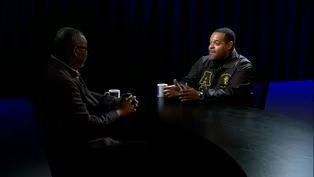
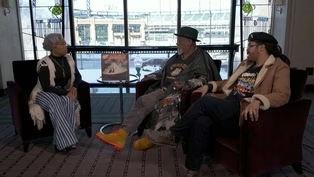
Hear from Brian Taylor on his role as Dr. Martin Luther King, Jr. in Detroit Public Theatre’s “The Mountaintop.” Plus, George Clinton, also known as Dr. Funkenstein, and Maurice “Pirahnahead” Herd talk about creating and recording music at Detroit’s United Sound Systems Recording Studios. Also, listen to a cello performance from Sphinx Competition winner Andres Sanchez.
Problems playing video? | Closed Captioning Feedback
Problems playing video? | Closed Captioning Feedback
American Black Journal is a local public television program presented by Detroit PBS
Detroit Public Theatre’s “The Mountaintop,” sitting down with Dr. Funkenstein, cello performance from Sphinx Competition
Season 54 Episode 7 | 26m 46sVideo has Closed Captions
Hear from Brian Taylor on his role as Dr. Martin Luther King, Jr. in Detroit Public Theatre’s “The Mountaintop.” Plus, George Clinton, also known as Dr. Funkenstein, and Maurice “Pirahnahead” Herd talk about creating and recording music at Detroit’s United Sound Systems Recording Studios. Also, listen to a cello performance from Sphinx Competition winner Andres Sanchez.
Problems playing video? | Closed Captioning Feedback
How to Watch American Black Journal
American Black Journal is available to stream on pbs.org and the free PBS App, available on iPhone, Apple TV, Android TV, Android smartphones, Amazon Fire TV, Amazon Fire Tablet, Roku, Samsung Smart TV, and Vizio.
Providing Support for PBS.org
Learn Moreabout PBS online sponsorship- Just ahead on "American Black Journal," we're gonna talk with a cast member from the Detroit Public Theater's production of "The Mountaintop."
Plus we'll have a conversation with Dr.
Funkenstein himself, George Clinton, and we'll close the show with a performance from this year's Sphinx competition.
Stay right there.
"American Black Journal" starts now.
- [Narrator 1] Across our Masco family of companies, our goal is to deliver better living possibilities and make positive changes in the neighborhoods where we live, work, and do business.
Masco, a Michigan company since 1929.
Support also provided by the Cynthia & Edsel Ford Fund for Journalism at Detroit PBS.
- [Narrator 2] The DTE Foundation is a proud sponsor of Detroit PBS.
Through our giving, we are committed to meeting the needs of the communities we serve statewide to help ensure a bright and thriving future for all.
Learn more at dtefoundation.com.
- [Narrator 1] Also brought to you by Nissan Foundation and viewers like you.
Thank you.
(upbeat music) - Welcome to "American Black Journal."
I'm your host Stephen Henderson.
The award-winning play "The Mountaintop" is currently on stage at Detroit Public Theater.
The two-person show reimagines the events that took place on the night before Dr.
Martin Luther King Jr.
's assassination at the Lorraine Motel in Memphis, Tennessee.
It is written by Pulitzer Prize-winning playwright Katori Hall and it runs through March 8th.
I'm pleased to have cast member Brian Taylor here.
Welcome to "American Black Journal."
- Oh, thank you for having me, Stephen.
- So no burden at all on you playing Martin Luther King on stage, that's gotta be the easiest role you've ever imagined doing.
I mean, it's almost comical to think of how you embody someone who is so recognized, so respected, and just so part of American culture and African American culture.
How do you even begin to think of just in toning even that character?
- Well, you know, and it is the heaviest lift of my career of any role that I've ever undertaken.
What I started with, actually, I worked with a famous legendary Hollywood acting coach, Ivana Chubbuck, on crafting who Dr.
King was as a person.
I think the trap that actors sometimes fall into when you have to portray characters like this, who we all have a imagination of who they are is trying to do the caricature route of it.
And I really focused on the humanity of who he was and the insecurities that he felt and, you know, his personal life, who he was behind closed doors.
So it really helped me grasp it and bring myself to the party, to say.
- Yeah, yeah.
- Yeah.
- This of course is an important moment for him, and it's a moment that I don't know that all of us think about.
We think about what happens the next day all the time.
Sort of walk us through what that story is of that day before.
We know about the speech, but we don't know about what else he was doing or thinking about.
- Yeah.
Well, Katori does an awesome job at demystifying Dr.
King, really bringing him down to size in a way that we can relate to him.
And obviously we don't know what happened the day before aside from him going to the church and giving his last speech, the Mountaintop Speech.
But the way the story is structured in the way I envision it, is that I think he was at a place where he kind of had a feeling that he was going to ascend to the mountaintop 'cause he wasn't originally gonna go to the church, but Ralph Abernathy said, "You gotta come down."
- Right.
"All these people are there."
- Yeah, "All these people are here to see you and be inspired by you."
I think he probably had a feeling of, you know, "I have to leave my final mark here tonight."
So I'm pretty sure there's a feeling of uneasiness or, you know, "Let me make sure everything's in order before that number's called."
And that's kind of how I've structured it in a way when I do this performance of just kind of sitting in that moment of just hearing everything and listening to everything and experiencing everything that you possibly can when you think, and none of us know, but when you think that time may be called for you.
- Yeah, yeah.
It's a two-person play, which is also kind of a burden.
That's a lot.
- It's a lot.
- That's a lot of work, right.
(both laughing) But it seems to me that, you know, in any play, the rapport and the interaction between the characters is really important.
That's doubly or maybe triply important when there's just two people.
- Yes, yes.
- Talk about your co-star.
- My co-star Rebecca Rose Mims is amazing.
She's a brilliant artist.
She probably won't like me to say this, but I'm gonna say it anyway.
She's only 26 years old and she is far beyond her time, not just in life, but as a performer.
And she's such a giving actor.
You don't always get the privilege to work with actors who are giving, and when that happens, it just allows you to settle and not think about other things other than just doing the work.
Because a two-person show is heavy.
- Yeah.
(laughs) - Like, it's a heavy lift.
I was actually watching Angela Bassett talk about her performance when she did with Samuel L. Jackson in 2009 and she was like, "I wish, you know, sometimes somebody else would come on stage to take a break."
- "Come take some of these lines," right?
- Yeah, yeah.
- Yeah.
So, what do you think is the message about Dr.
King that comes out of this play, which is just a, I mean, it's a dialogue, right?
It's conversation between these two people, really.
- Yes.
- What are people supposed to walk out of the theater feeling or thinking?
- I think two major messages: One, Dr.
King was just a man.
He wasn't a superhero, you know?
He wasn't, you know, Black Panther or like, Iron Man.
He was just a man who answered the call of millions and also had to deal with the hatred of millions.
- Yeah.
- And I think when you watch the play, by the end, you'll leave out thinking, "I too, you know, I may not have to do it at the magnitude of Dr.
King, but there is something that I can be doing, especially in the times that we're living in."
- Yeah.
- And I think the second most important message is we all have to pass the baton on; We can't wait for somebody else to do it.
It's gonna take a community initiative for us to see the world of tomorrow.
- Yeah.
- Yeah.
- Yeah.
You've done some other work at Detroit Public Theater.
I always want to take the opportunity to talk about kind of how special of a place that is, how special the work there tends to be, I think, because of the special place but it's different than other theaters.
- Yes.
I will forever be indebted to Detroit Club Theater because they gave me my very first professional star to play in "Skeleton Crew" alongside Ella Joyce, the legendary Ella Joyce, Brian Marable, who actually directed "The Mountaintop," And Shante Delan, another wonderful actress that play, "Detroit 67," where I played both Sly and Link in those shows.
But Courtney, Sarah, and Sarah, they've really taken the initiative- - The founders.
- The founders of Detroit Public Theater, to tell stories that always have a message, you know?
I always joke, I was like, "You guys always tell a message?"
But it just happens and they say, you know, it's not always intentional that way, but the stories that they choose to tell highlight communities who need a voice.
And it's always special when you do work at Detroit Public Theater.
- Yeah.
- Yeah.
- Tell us a little more about you, how did you get the acting bug and how did you get started?
- Well, you know, I always have to give credit to two people: My friend's mother TaRita Darden, who really, I did- My science teacher, she used to always make me like, do work and like, perform.
And TaRita Darden was like, "You should be an actor," before I even knew what it really was.
And my band teacher, Mr.
Randy Scott, who is a world renowned saxophonist, still is a saxophonist now, he would always allow me to host the band concerts.
And it got to a point where he had a script for me.
He was like, "You know what, Brian?
Just do whatever you wanna do.
The crowd loves you."
And then later years, like, I was a part of the Mosaic Youth Theater of Detroit.
- Oh, you were?
Oh, okay, I see you.
- And who really- - What a wonderful organization.
- What a absolutely wonderful organization.
If you are a young actor, you have to go to Mosaic Youth Theater of Detroit.
And they really teach you how to be a professional actor at a very young age.
And then years later, I worked with Ivana Chubbuck, who is actually a Detroit-bred acting coach.
She's major in Hollywood.
She actually is responsible for Halle Berry's and Charlize Theron's Academy Awards for "Monster" and "Monster's Ball."
And she took me under her wing and really just gave me permission to be an actor and to do what I do.
And more so with my work, I'm actually an acting coach as well with my own studio, the Detroit Drama Studio, so this journey has been amazing.
- Yeah, yeah.
- Yeah.
- All right, so after you play King, I don't know, what else can you even do, right?
(both laughing) What's another role that you could even slide into?
It feels like that's like, that's the part, that's the ultimate, right?
- Yeah, it's the ultimate.
Right now, actually, I do- I'm on a series on the Ucult streaming app actually, called "H-Block," where I play a detective, Detective Harvey on that show.
But after you play King... - Yeah, right?
- It's like... - What else is there?
- You know?
It's like, I'm aiming for Denzel and Sidney Poitier now.
So it's like, I want their roles.
- Yeah, yeah.
(Brian laughs) Well, it's great to have you here.
- I appreciate you.
- People should really get out and check out public theater and check out this play.
- Yes, and can I also say, I wore my Alpha Phi Alpha jacket today?
Dr.
King is also a member of Alpha Phi Alpha.
So, I had to represent, you know, my Alpha Brothers and my chapter at Eastern Michigan University, so.
- [Stephen] There you go.
- So thank you for having me.
- Yeah, it was great to have you here.
Thanks for joining us.
- Thank you.
- Detroit played an important role in the groundbreaking career of musician George Clinton and his group, Parliament Funkadelic.
The city's United Sound Systems recording studio was home to Clinton's P-Funk lab for nearly 20 years.
American Black Journal contributor, Cecilia Sharp of 90.9 WRCJ, caught up with Clinton recently at the Detroit Opera House.
She spoke with him and fellow funk artist Maurice "Pirahnahead" Herd about recording at United Sound and producing music that became a cornerstone of African American identity.
- What up, do?
- What up, do?
What attracted you to Detroit?
- Man, Motown records.
- Motown records.
- Motown records.
If you anywhere in this country, from '59 to '69, this was where it was at.
This was Heaven.
For music being made was concerned, this is where everybody wanted to be.
- And how were you a part of Motown?
Where were you in the mix?
- Oh, I bugged 'em to death.
We auditioned at Motown, Martha Reeds auditioned us.
- Wow.
- And she was a secretary, she hadn't even had a record herself yet.
- Wow.
- She auditioned for Mickey Stephenson.
We didn't make it then, you know, we wasn't tall enough.
We wasn't, you know, small.
We was little short ones and, you know, so, but we was from New Jersey, so that wasn't... Well, we weren't from Detroit.
We drove out here to audition.
But I wasn't giving up.
And then I came out here to audition for Mr.
Wingate.
Ed Wingate, he owned Golden World Records.
- Golden World, yeah.
- You know, they had the dramatics in Edwin Star and JJ Barn.
Then that was the second big company in Detroit at the time.
Got a job out there and we ended up doing a record called "I Wanna Testify."
- [Maurice] Revulot.
- Yeah, Revulot for Lebaron Taylor.
And we did a record for him.
and it was "Testifyin'," it was a hit.
We didn't make it to Motown, but by the time we got the hit, Motown was just getting ready to move to California.
So we realized that, "Uh-oh, we late.
We got here, but we late."
We put out "Testifyin'," it was a hit, the next record was "All Your Goodies Are Gone."
You could tell we was influenced by something other than Motown on that one.
We immediately tried to see what The Beatles were doing with "Sgt.
Pepper" and all of that English invasion.
So we started changing right then, right after "Testifyin'," we started changing.
- I wanna shift gears and jump into your time at United Sound Studio.
- Oh, boy.
- Yeah.
(laughs) - That was the fun days.
- Oh, some fun days?
- Yeah.
- You made United Sound your home for about 20 years.
Studio A became the "P-Funk" Lab.
- Yep.
Mm-hmm.
- What made United Sound Studio so special that you stayed there so long?
- I know the sound, I mean, just the sound and the history of people that recorded it prior to us.
I mean, they went back to the forties and stuff.
They did radio commercials so they were pretty much the sound of radio throughout the country.
You didn't know it, but that was the studio did most of the commercials for everything between here and Chicago.
General Motors, Fords, everybody did they commercials there.
- Yeah.
- So it had a relationship to the radio that people didn't even know.
Not only that, Motown recorded there prior to their own studio.
And when they couldn't get into the studio, United was their choice.
And it had the same kind of vibe as Motown had.
It had a little more bottom though, but it had the same vibe.
Especially when we came there.
And with Bootsy, Bootsy had a base that had... (Maurice laughs) Each string on the bass had its own output.
- Yeah.
- He had a track for everything.
United, we had a special sound that no matter what we did, I mean, you can just walk in there not thinking something was anything and when you finish like "Atomic Dog," that was a track being played backwards, I just got on there and started talking.
- Yeah.
- And next thing I know, it had that magic on it that no other place could do.
- Piranha, I wanna get your take.
What was intro into United Sound, then?
- I was, it was around '82, '83.
I was, you know, danking around on the east side, you know, learning to play with cats in the neighborhood.
You know, we was staying out of trouble 'cause it was a lot of trouble that you could get into on the east side of Detroit.
Bootsy had this group called Godmoma.
It was a lady named Cynthia Girty.
- Cynthia... (laughs) - And Tony.
And she grabbed us, it's like, "I'm gonna take you to see a studio."
And she was working for Don Davis at the time.
And we went over there and I think it was Greg Ward or Jim Vitti who said, "George isn't here yet."
So Don was like, "Yeah, just go down there and just check the studio out."
Vitti was showing us around and things like that, I think you and Chong came in after that was just like, "Wait a minute.
I just met this guy who owns a bank and runs the music business and Dr.
Funkenstein, that's what I wanna do."
It became a thing for family, that's always been the P-Funk lab, you know what I mean?
Learn to record with, you know that guy Italian, Jim Vitti, you know.
- [George] Sound.
- Yeah.
Just how to do that, cutting tape.
Dude was slicing tape and doing edits and things like that.
So, you know what I mean?
That's what we saw, all of that.
That and the disc.
- And the disc.
- Yeah.
You realize you could do whatever in a studio.
I mean, like, whatever you want to do.
You know what I mean?
How y'all used to do them claps?
- [George] Oh yeah.
- Live claps.
- Live claps!
They thought it was machine - And we would do it for 10 minutes.
I mean, you didn't- (Maurice laughs) Nowadays you can do two, four bars.
Two bars and then loop it digitally.
No, back then you had to do it, "Flash Light," you had to do it for like, seven minutes and the hands can't get tired.
- (laughs) You gotta maintain the energy - You gotta maintain.
So only certain people could do it, you know?
Again, you can't miss one 'cause it sounds... It's because, and that's what with "Flash Light" was the beginning of it.
- Yeah.
- I wanna jump into showing you an album.
You take it and tell me your United Sound memory.
- Hey, yeah.
- [Cecilia] I noticed that also the hand clappers did get credit on these albums.
- Oh yeah, we gave hand clappers credit.
- Yeah.
- Like I said, people want to get funked up, like, I was imitating Frankie Crocker, the New York disc jockey.
"Good evening, do not attempt to adjust your radio, there's nothing wrong."
You know?
So I was into R&B DJs at the time.
"Mothership Connection," I was trying to do an album with one story line all the way through.
We did it on "Motor Booty Affair" that most of the song relate to the same story.
We got thrown off track on this one because some of the tracks sounded so good we had to put 'em in there anyway.
Then, well, of course, "Tear the Roof Off the Sucker."
And what was good about that, we were able to get it on CKLW here.
If we take off, "Tear the Roof Off the Mothersucker," CKLW said, "We'll put it on if you take the 'Tear the Roof Off the Mothersucker'" and once we did that, it was all over.
- Yeah.
- Biggest memory from this album?
- "Clones of Dr.
Funkenstein."
Wow, this is a good one.
I got on a plane in Dallas, Texas, and then when I got off I had to get on a train.
It was the first day they used the trains to go from one terminal to the next.
When I got on there, there was a book on the seat of the train and it said, "The Clones."
Two faces, one face and the same person.
I thought the book come with the train, you know?
It was the first day of the train, it just makes sense that it... So I opened it up and it was talking about Steve Swanson and this doctor was cloning salamanders, taking one and making hundreds of them.
Then that you'll be able to eventually, one day, be able to clone people and blah, blah, blah, blah.
Then I realized this sound like it's serious.
And so when I got to Portland, Oregon, I went to the library 'cause it, you know, I'm trying to find different concepts now, this sounded interesting.
(Maurice laughs) I go to the library and asked them if there was there anything on cloning.
The lady told me, she said, "Due to the freedom of information, we are not allowed to give out books on those."
It was taboo at the time.
So that, of course, soon as you say taboo, you really got me going now.
- Yes.
- But you know... - She said, "You can actually get a book called 'Charity of the Gods' Or 'The Island of Dr.
Moreau.'"
I got "Charity of the Gods" and the whole album is this.
- Wow.
So the concept was based upon stuff that you read that was science fiction?
- It was science fiction entirely.
- Yeah.
- And, okay, this... Oh, wow, that's deep.
See, now, that's the way we dressed in school when I was in school.
Tailor-made suits.
- [Cecilia] Okay, the tailor-made suits.
- [George] Yeah.
You know, all of that.
- [Cecilia] Just slick.
- A friend of mine, he was trying to show how much he could be deep with us, and he was just getting with us so he just wrote on a note, "Entelechy."
It had a nice ring to it, but what does it mean?
And he said, "Some entity reaching its maximum potential as opposed, you know, to something."
And I said, "As opposed to placebo?"
He said, "Sounds good."
(Cecelia laughs) So that became "Funkentelechy Vs.
The Placebo Syndrome."
"Flash Light" is the weird one because that was... - Oh, man.
- Bernie playing bass on the synthesizer as opposed to Bootsy playing bass.
- That was the first time that happened.
- First time that happened.
- First time it really happened like that.
- And... (vocalizes) - Jewish melody, right?
- That was my friend's Bar Mitzvah.
I remember this Bar Mitzvah.
(vocalizes) He was like... I'm like... - And it just came back to you during that moment.
- I didn't even think of it.
- That's crazy.
- It's just, okay, that fits that and worked.
He lived right down the street, went to school together.
His mother, "George, Myron!
Come in for soup and sandwiches!
Your Bar Mitzvah's happening!"
I didn't know what a Bar Mitzvah was but that was his thing.
I said, "Okay."
So when I finally said it in the magazine, maybe a couple years ago, it went viral.
- Last one.
- Okay, this is, yeah.
This is a good one.
Let's see.
This is 1982 going into '83.
- [Maurice] Wow.
- [George] This was the first one that I did on my own name.
- [Maurice] Oh, man.
- So I did this record under George Clinton.
- The first time you used your name?
- The first time I used my name period on the record.
We put out "Loopzilla" first.
- [Maurice] "Don't touch that radio."
- The people loved it!
- Bad record.
- So immediately we, "Atomic Dog" took off without even saying anything.
- Yes.
- That went crazy.
And it was all over to this day, it's still like that - One of the first people to play that was the Electrifying Mojo and when we heard it, you know, it was like, "Yo, what was that?"
You know?
That whole thing, I mean, it was such a jam because of the backwards drum thing in there.
(George and Maurice inhale) - What was going on with that?
- The tape was on backwards, we was putting effects on it and I'm into my own, I was getting high at the time, didn't know what I was doing.
I'm busting their thoughts, rapping, you know?
Like... Thinking they was trying to record without me.
(laughs) - You wasn't about to miss your spot.
- Wasn't about to miss his spot.
- And once I got in, I didn't know what to talk about.
So you hear me?
"This is his story of famous dogs for the dog that chased his tail will be busy."
I'm trying to think of something to say.
- Yeah.
- "Why must I feel like that?
Why?"
And I did it just like that.
And they left it like that and sang harmony around it.
- Wow.
- But you know what I mean?
It was just like one of these things, man, y'all had such a magic.
- All recorded at United Sound Studio.
- And you can see Cecilia's entire conversation with George Clinton and Maurice Herd at americanblackjournal.org.
Let's turn now to the 29th Annual Sphinx Competition, which celebrates black and Latinx classical string musicians.
The finals took place in Detroit last month, and you can watch it here on Detroit PBS on February 23rd at 9:00 PM.
We're gonna leave you now with a performance by the first place winner in the senior division, cellist Andre Sanchez.
You can find out more about our guests on our website and you can connect with us anytime on social media.
Enjoy and we'll see you next time.
(exciting orchestral music) (exciting orchestral music continues) (exciting orchestral music continues) (exciting orchestral music continues) (exciting orchestral music continues) (exciting orchestral music continues) (exciting orchestral music continues) (exciting orchestral music continues) - [Narrator 1] Across our Masco family of companies, our goal is to deliver better living possibilities and make positive changes in the neighborhoods where we live, work, and do business.
Masco, a Michigan company since 1929.
Support also provided by the Cynthia & Edsel Ford Fund for Journalism at Detroit PBS.
- [Narrator 2] The DTE Foundation is a proud sponsor of Detroit PBS.
Through our giving, we are committed to meeting the needs of the communities we serve statewide to help ensure a bright and thriving future for all.
Learn more at dtefoundation.com.
- [Narrator 1] Also brought to you by Nissan Foundation and viewers like you.
Thank you.
(bright music)
 New
NewVideo has Closed Captions
Clip: S54 Ep7 | 9m 16s | The award-winning play, “The Mountaintop,” is currently on stage at Detroit Public Theatre. (9m 16s)
 New
NewVideo has Closed Captions
Clip: S54 Ep7 | 12m 5s | Funk musician George Clinton reflects on Detroit’s influence on his career. (12m 5s)
Providing Support for PBS.org
Learn Moreabout PBS online sponsorship
- News and Public Affairs

Top journalists deliver compelling original analysis of the hour's headlines.

- News and Public Affairs

FRONTLINE is investigative journalism that questions, explains and changes our world.











Support for PBS provided by:
American Black Journal is a local public television program presented by Detroit PBS