
December 9, 2024 - PBS News Hour full episode
12/9/2024 | 57m 46sVideo has Closed Captions
December 9, 2024 - PBS News Hour full episode
December 9, 2024 - PBS News Hour full episode
Problems playing video? | Closed Captioning Feedback
Problems playing video? | Closed Captioning Feedback
Major corporate funding for the PBS News Hour is provided by BDO, BNSF, Consumer Cellular, American Cruise Lines, and Raymond James. Funding for the PBS NewsHour Weekend is provided by...
December 9, 2024 - PBS News Hour full episode
12/9/2024 | 57m 46sVideo has Closed Captions
December 9, 2024 - PBS News Hour full episode
Problems playing video? | Closed Captioning Feedback
How to Watch PBS News Hour
PBS News Hour is available to stream on pbs.org and the free PBS App, available on iPhone, Apple TV, Android TV, Android smartphones, Amazon Fire TV, Amazon Fire Tablet, Roku, Samsung Smart TV, and Vizio.
Providing Support for PBS.org
Learn Moreabout PBS online sponsorshipGEOFF BENNETT: Good evening.
I'm Geoff Bennett.
AMNA NAWAZ: And I'm Amna Nawaz.
On the "News Hour" tonight: a new day in Syria.
Rebel forces who ousted Bashar al-Assad's regime seek to build a functioning government.
We get the Biden administration's view on the seismic shift.
JON FINER, U.S.
Principal Deputy National Security Adviser: The future of the Syrian people is going to depend on the choices that they make.
GEOFF BENNETT: A person of interest is arrested in the manhunt following the shooting death of UnitedHealthcare's CEO in New York City.
AMNA NAWAZ: And in his first network TV interview since winning the election, president-elect Trump lays out his agenda on the border, tariffs, and potential political retribution.
AMNA NAWAZ: Welcome to the "News Hour."
After 13 brutal years of war, Syrians breathed free today in Damascus and most of the nation after the fall of the autocratic Assad dynasty.
GEOFF BENNETT: Bashar al-Assad and his family are now in Russia, which extended them asylum.
The lightning-fast seizure of the nation by insurgent forces over the last two weeks rocked the region and the world.
But for many Syrians today, the task after the fall of Assad was to take stock of the catastrophic damage done by over five decades of their rule and what the future holds.
Nick Schifrin starts our coverage.
(CHEERING) (CHANTING) NICK SCHIFRIN: In free Damascus today, the foot soldiers of revolution celebrated the birth of a new nation and a new generation that will barely know a ruler named Assad.
Syrians who have known nothing but Assad called today victory and flew the flag of the Syrian republic, now the flag of free Syria.
DR. SAEED KHALIFEH, Pediatrician (through translator): This great and glorious day is the new independence day of Syria.
MOUNIR AL-GHARIB, Damascus Resident (through translator): People are delirious with happiness here.
Yesterday was a great day, and we are waiting for the country's children to return home to enjoy it.
NICK SCHIFRIN: The country that millions fled, now tens of thousands of cars, tens of thousands of families returning to their homes, even if those homes no longer stand.
Yaser Shehadeh and her husband haven't seen their destroyed neighborhood since the war began.
YASER SHEHADEH, Displaced Syrian Refugee (through translator): Now, after 13 years, we are back and the joy is overwhelming.
Thanks to Allah, we are home again.
NICK SCHIFRIN: For nearly a decade, this was Syria's map, the opposition in green cornered in Idlib province in Northwest Syria, the Kurds backed by the U.S. in yellow in the northeast, the regime and its allies in red with pockets of desert controlled by the Islamic State in purple.
It was redrawn in just 10 days, the opposition sweeping through Aleppo, Hama and Homs, and seizing Damascus with barely a shot fired.
U.S. officials say their top concern, keeping those ISIS pockets frozen.
Yesterday, the U.S. launched a large air raid into Syria, bombing 75 different targets described as ISIS meetings and training.
Syria's neighbors are worried about instability, and Israeli officials told "PBS News Hour" that ground forces in blue entered Syria for the first time in more than 50 years to create what they call a buffer zone in what has been demilitarized territory along the Syrian border.
Israel also targeted suspected chemical weapons sites and long-range rockets to prevent them from falling into rebel hands.
Yesterday, Israeli Prime Minister Benjamin Netanyahu visited the Golan Heights and took credit for ousting Assad.
BENJAMIN NETANYAHU, Israeli Prime Minister (through translator): This is a historic day in the history of the Middle East, a direct result of the blows we inflicted on Iran and Hezbollah, the main supporters of the Assad regime.
This created a chain reaction throughout the Middle East of all those who want to be freed from this regime of oppression and tyranny.
NICK SCHIFRIN: Oppression was an Assad family affair.
Hafez al-Assad Assad and his son Bashar ruled the country for 52 years.
He and his wife, Asma, claimed to be Syria's stylish modern future.
But, in 2011, as part of the Arab Spring, pro-democracy protests swept through the country.
Assad unleashed a brutal crackdown that triggered civil war and left cities in ruins.
Half the country, more than six million people, fled their homes, desperately making a dangerous journey by boat because the land was no longer safe.
But so many, including 3-year-old Alan Kurdi, never made it, this image becoming the icon of fear and flight from Syria.
Those who stayed to fight and whom the regime caught disappeared into Sednaya, a notorious military prison outside Damascus.
Some were tortured so severely, the only word he can say today is Arabic for Aleppo, the prison the crucible of Assad's cruelty, the bodies that embody Assad's brutality.
Now Assad stands no longer, his legacy smashed, his stature diminished.
His army retreated, hollowed out by years of corruption and defections, and Assad's previous saviors, Iran and its allied militia Hezbollah and Russia, unwilling and or unable to save him.
Syria's new apparent leader, Ahmed al-Shar'a, better known as Abu Mohammad al-Jolani, met today with the prime minister.
Jolani vows a smooth transition and moderate governance to respect minorities.
But he and his group, Hay'at Tahrir al-Sham, or HTS, are designated by the U.S. as foreign terrorists.
Whether they govern for all Syrians, whether this country's splinters is unknown.
But, for now, these Syrians enjoy a new day of freedom and hope the future brings peace.
For the "PBS News Hour," I'm Nick Schifrin.
GEOFF BENNETT: U.S. officials say they are closely monitoring the situation in Syria, where 900 U.S. troops are still stationed mostly in the country's Northeast.
Jon Finer is the principal deputy national security adviser, and I spoke with him moments ago.
Jon Finer, welcome back to the "News Hour."
President Biden said yesterday that the sudden collapse of the Syrian government under Assad is a fundamental act of justice, but he said it's a moment of risk and uncertainty for the Middle East.
What are those risks, and what is the administration doing to mitigate them?
JON FINER, U.S.
Principal Deputy National Security Adviser: Well, Geoff, let's just not lose track of the opportunity side of this before we get to the risks.
And the opportunity here for the Syrian people is to have their first experience with a government free of oppression in many generations, after 13 years of just an excruciating, violent civil war.
That is the opportunity that presents itself by the fall of Assad.
The risk, of course, is that the groups that toppled Assad, some of them have their own checkered history, history with human rights abuses, with violent extremism, with terrorism.
Now, many of those groups are saying that they have changed, that they have reformed.
Many of them are saying the right things in the current moment, as the president pointed out yesterday.
But we will be judging those groups by their actions, by how they deal with this new moment of responsibility that's been brought about.
And I think the future of the Syrian people is going to depend on the choices that they make.
GEOFF BENNETT: The leader of Syria's rebel offensive, Abu Mohammad al-Jolani, he is said to have evolved from his past as a hard-line jihadi extremist.
What's the current U.S. assessment of him, and are the terrorist designations of him and his group still warranted?
JON FINER: Those designations very much remain in place because those designations are based on actions, not just on words.
And so the United States is going to be assessing in real time the choices that these groups make and that their leaders make.
Again, we have seen some of the comments made by Jolani and others, some of which we found to be constructive.
But it's going to take a lot more than constructive comments to bring about a better future for the Syrian people, a future that includes a government that is inclusive, that's represented by all of the major -- that represents all of the major communities that make up Syria's population.
And they have got a lot of work to get to that point.
The United States will be supportive of that process as it plays out on the side of the Syrian people.
GEOFF BENNETT: On Saturday, as rebels race toward Damascus, president-elect Donald Trump posted on social media: "This is not our fight.
Let it play out.
Do not get involved?"
What is the U.S. interest in Syria, in your view?
JON FINER: Well, the U.S. has a number of interests in Syria.
First of all, the United States fundamentally believes that the people of Syria deserve a better future than they have had to endure over the course of both the recent civil war and generations of tyrannical rule before that.
But fundamentally for the United States, there is still a terrorist threat in Syria.
There is an ISIS threat in Syria that the United States has deployed troops to address, including, by the way, taking strikes just yesterday to continue to suppress that threat, as we have successfully done now across successive U.S. administrations.
The United States has partners and allies inside Syria, Kurdish groups that we have worked with over a period of years.
The United States has partners and allies on the borders of Syria, Israel and Jordan and Iraq and other countries, whose interests we are going to try to work with them to uphold.
So the United States has a number of interests that converge in Syria, and we want to stay engaged.
But where we agree with what President Trump said is that does not mean the United States should be deploying militarily to engage in the conflict that ultimately led to the toppling of Assad.
GEOFF BENNETT: I want to note for our viewers that background noise, the construction happening there at the White House.
It is, of course, a very busy time at the White House.
A follow-up question, though.
Has the Biden national security team been able to convey those views and coordinate, for that matter, with the incoming Trump team, not just on Syria, but on a range of pressing matters from the Middle East?
JON FINER: So, on the national security side, we have been able to engage in conversations with the incoming Trump national security team.
I won't get into the details of those conversations, and I wouldn't say they go as far as coordination, but we are keeping them informed of these situations as they unfold.
GEOFF BENNETT: Assad and his family have been granted asylum in Moscow, as we understand it.
What does accountability for Assad, who was a brutal dictator, autocrat, what does accountability look like right now for him?
JON FINER: Well, we certainly believe that Assad should be held accountable for the crimes that he perpetrated against the Syrian people.
Certainly, there has been, as the president said, a measure of justice delivered already by the sheer fact of his removal from office summarily and the fact that he was forced to get on a plane and fly out of his own country, where he has spent his entire life as part of the ruling family.
So there is a measure of accountability in that.
We'd certainly be supportive of more.
I suspect the Russians will have a different view of what Assad's future should look like, so I'd direct your questions to them.
But we would be all for Assad being held accountable further for his crimes.
GEOFF BENNETT: Finally, this is a rare moment of hope for the family of journalist Austin Tice.
He's been held in Syria since 2012.
Does his family have reason to be optimistic?
I mean, is there an opening here potentially?
JON FINER: Well, I should say, I have known Austin Tice's family, his mom and dad, for now more than 10 years and had the occasion to meet with them recently, as I have a number of times in my current job and previously.
These are good people who have been put through just an extraordinarily terrible set of circumstances.
And, obviously, nobody has suffered more as a result of this than Austin himself, who's now been missing in Syria,held captive in Syria for 12 years.
It is our belief, our assessment that Austin is alive in Syria, and we are going to be doing everything we can to reunite him with his family.
Beyond that, we don't have further information to provide at this point.
But we are very much seeking information about his whereabouts, because he deserves to come home.
GEOFF BENNETT: Jon Finer, principal deputy national security adviser for the Biden administration, thanks again for your time this evening.
JON FINER: Thank you.
AMNA NAWAZ: For more perspective on the collapse of the Assad regime and the opposition that's coming to power, we turn now to Murhaf Jouejati.
He's a distinguished visiting professor at the U.S.
Naval Academy and the former chairman of The Day After.
That's a nonprofit organization that's been working toward building democratic institutions in Syria.
Murhaf, good to see you.
Thanks for being here.
MURHAF JOUEJATI, United States Naval Academy: Thank you.
Thank you.
AMNA NAWAZ: I just want to start with your reaction as we have been watching these scenes unfold in Syria and people cheering in the streets.
What has that been like for you to see?
MURHAF JOUEJATI: I am absolutely elated.
I'm elated, just as the Syrians inside Syria and the Syrians outside of Syria.
This has been a tragic moment for the Syrians for the past 50 to 60 years of martial law, of tyranny, of imprisonment, enslavement, torture.
This has been really a murderous regime that is corrupt and that has put Syrians through a lot.
And so, 60 years later, imagine, suddenly, we are free.
The Syrians are free.
So it's a moment of total elation.
AMNA NAWAZ: Also a moment of great uncertainty, because we don't yet know what comes next.
When you look at the promises made by this leader of HTS, al-Jolani, what do you make of his pledge to build a pluralistic, tolerant society?
MURHAF JOUEJATI: I don't simply go by his pledge.
I go by the history of Hay'at Tahrir al-Sham, the organization that he dominates in the province of Idlib, where they have now an experience in governance, where he has allayed the fears of minorities, where he has not imposed hijab and so on, on women.
So I go by these things, in addition to the fact that very recently he has communicated with the elders of the Alawites, the sectarian minority.
AMNA NAWAZ: That had previously backed the Assad regime.
MURHAF JOUEJATI: That backed the Assad regime.
AMNA NAWAZ: Yes.
MURHAF JOUEJATI: And they are on board with him.
And this is extremely significant.
Recently, he has nominated the cardinal of Aleppo to be mayor of Aleppo.
And the cardinal declined because he doesn't want to be in a political position.
Sunday, the church bells were ringing in Damascus.
So, again, he has been bending over backwards to allay the fears of minorities.
AMNA NAWAZ: At the same time, I should ask -- and you saw Jon Finer mention this -- the fact that there is still a U.S. terrorist designation this group, on HTS.
A precursor group, al-Nusra, did have links to al-Qaida.
And we should also point out that al-Jolani himself was the man against who the U.S. government issued a stop this terrorist effort, offering $10 million in a reward for anyone helping to track him down.
So do you see that designation being lifted?
And are we sure there are no ties to al-Qaida that remain?
MURHAF JOUEJATI: All these accusations are very true.
However, Jolani did break away from al-Qaida.
He even fought al-Qaida and he fought ISIS.
And this is not only words, but there is evidence of this.
So this designation of terrorism is in the past.
Obviously, we should trust and verify.
We shouldn't only take him by his words, but by his actions.
And we will see what will happen in the days and the weeks ahead.
What encourages me very much is that he is now coordinating and cooperating with the former regime prime minister in order to have a transition of all these major files, health care, water, electricity and so on, to be taken to the next transitional administration, so that there would be continuity in Syria's state institutions.
This is very significant, and it tells us about the intentions of not only him and his organization, but the coalition of forces that joined him in liberating Damascus.
AMNA NAWAZ: I want to ask you as well about Israel's decision to move military forces into Syria, seizing territory in a demilitarized zone there that was part of a 1974 cease-fire.
They claim that it's a temporary defensive position.
Some see it as a land grab.
How do you look at that?
MURHAF JOUEJATI: Israel has always expanded and said it would temporarily expand.
I see this as a land grab.
I do not agree with Mr. Netanyahu, who says that all this liberation of Syria was triggered directly by Israeli bombing, because, in 2011, when there was a peaceful, popular uprising of the Syrian people against the Assad regime and it failed, it failed because of the intervention of the Russian air force and of Iranian and Iranian pro-militias that propped up the Assad regime.
So this has little to do with the Israeli adventures in the Middle East.
I think this is a land grab.
I don't think it is temporary.
I think Israel will remain there to stay.
AMNA NAWAZ: Well, time will tell.
We will see.
But I need to ask you as well about the millions of Syrians who have been displaced over these many years of war.
I remember myself being on that Turkish border and visiting with many of them in the camps there.
Children who have been born in the camps had never even set foot back in Syria.
What do you see as their future?
Will they be allowed to return home?
MURHAF JOUEJATI: My dear friend, we have to only look at the footage at the tens of thousands of refugees outside Syria, mainly in Turkey -- there are three million in Turkey -- that are returning home now to reclaim their properties and to reclaim their lives and to be with their families and loved ones.
They want to return to Syria.
and they will, and they are certainly welcome.
AMNA NAWAZ: Murhaf Jouejati, distinguished professor at the U.S.
Naval Academy, thank you so much for being with us here today.
We appreciate your time.
MURHAF JOUEJATI: Thank you.
My pleasure.
Thank you for having me.
GEOFF BENNETT: Now to our other major story.
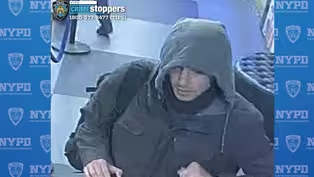
Police say they have detained a man they're calling a strong person of interest in the murder of the CEO of the nation's largest health insurer, who was shot in New York City last week, leading to a nearly weeklong manhunt that widened beyond the city's limits.
Tonight, authorities say they apprehended 26-year-old Luigi Mangione in the brazen and targeted shooting of 50-year-old Brian Thompson, the CEO of UnitedHealthcare.
ERIC ADAMS (D), Mayor of New York: He matches the description of the identification we have been looking for.
He's also in possession of several items that we believe will connect him to this incident.
How did we do it?
Good old-fashioned police work.
GEOFF BENNETT: Mangione was taken into custody after police got a tip that he'd been spotted at a McDonald's in Altoona, Pennsylvania, more than 200 miles West of New York.
ERIC ADAMS: Someone at McDonald's, employee did something we ask every American to do.
If you see something, say something, but, most importantly, do something.
And they did.
GEOFF BENNETT: Police say they found Mangione with a firearm that was consistent with the one used in the murder, complete with a suppressor.
The NYPD said it was a ghost gun, not licensed and not manufactured, but made with parts that could have been printed by a 3-D printer.
Police also found multiple fake I.D.s, a passport and a three-page document full of writings that they said spoke to his motivation and mind-set.
Last week, investigators confirmed they found shell casings at the scene inscribed with the words "Delay," "deny" and "depose," Words often associated with the way insurance companies deny claims.
Police said the document they found today revealed more about Mangione, but they provided few details.
JOSEPH KENNY, NYPD Chief of Detectives: It does seem that he has some ill will toward corporate America.
GEOFF BENNETT: New York police say detectives are on the way to Pennsylvania and are working to bring Mangione back to New York to face charges.
It ends a six-day manhunt that sent police scouring New York City and following a trail of surveillance images looking for the killer, including this one showing a man in a black hooded jacket and surgical mask in the back of a cab that police say headed to the George Washington Bridge bus terminal.
Thompson's murder ignited a wave of public feelings online and elsewhere, including anger and resentment toward insurance companies and in some cases a lack of empathy for his death.
Following Thompson's killing, UnitedHealthcare reinforced their headquarters in Minnesota with new fencing and a heightened police presence.
And several news reports say that handwritten document that Mangione was found carrying criticized health care companies and suggested violence as the answer.
And that part of the story, the connections to the health care industry, has touched a nerve, sometimes with ugly results in the days since his murder.
For more on that, we're joined now by Nicholas Florko, staff writer at "The Atlantic," who covers health care and wrote, the recent piece: "Murder Is an Awful Answer for Health Care Anger."
Thanks for being here.
NICHOLAS FLORKO, Staff Writer, "The Atlantic": Of course.
Thanks for having me.
GEOFF BENNETT: And, first, we want to acknowledge that Brian Thompson was a husband a father, a colleague to many, and so much of the rhetoric online regarding this issue is really just morally corrupt, depraved, abhorrent.
And you write of the wave of public sentiment that we have seen.
You say this: "Americans' zeal for the death of an insurance executive demonstrates both the coarsening of public discourse and the degree of rage many Americans feel over the deficiencies of the U.S. health care system."
So, what do you think this anger reflects about the current state of the system overall?
NICHOLAS FLORKO: Well, first, I want to agree with you that we should all agree that murder is abhorrent and it's not something we should be cheering about.
But I think this anger comes from the fact that our health care system largely results in people paying a huge amount of money out of pocket.
This country has a medical debt problem.
There are statistics that show a significant portion of folks have to forego medical treatment to pay for other bills because of the cost of health care.
And it's those issues that are really, I think, causing people to react really viscerally to this murder.
GEOFF BENNETT: Well, the other thing you write about, you say that denying claims is a feature of the health care industry.
It's not a bug.
Tell me more about that.
NICHOLAS FLORKO: Yes, I mean, we have a for-profit system.
For better or worse, we depend on insurers to make decisions on whether care should be paid for or not paid for.
And we can have a debate over whether insurers are too aggressive in those policies and are denying too many pieces of medical care.
But the reality is, even our most notorious, famous public insurer, Medicare, they deny claims as well.
It is part of the system.
It's just a question of whether insurers are abusing that power.
GEOFF BENNETT: So what are the real-world results for people who experience a denied claim?
NICHOLAS FLORKO: I mean, there's a few different ways that somebody can approach it.
I mean, folks can pay the bill, which could result in you wiping out your entire savings.
You could try to fight that claim and appeal it, maybe go to court.
That again is also going to largely drain your savings if you actually have to go to court.
Or you go into medical debt.
Those are really the only ways out of the system at this point.
And that's why people, I think, feel so powerless.
GEOFF BENNETT: Well, even after major reforms, it's clear that lots of people feel that the health care system isn't working for them.
How does -- how does our system compare to other developed nations?
NICHOLAS FLORKO: Well, most other developed nations do not rely on private health insurers to provide their health care.
They have a single-payer system.
And, I mean, that is the biggest difference is, we depend on companies like UnitedHealthcare to provide our health care.
GEOFF BENNETT: What else is driving up costs for these companies?
NICHOLAS FLORKO: I mean, every part of the system is driving up costs in some ways.
I think a really illustrative way to think about this is, like, a prescription drug.
So say somebody goes to a pharmacy and they're told they have to pay $200.
The insurer is going to tell you, that is the drugmaker's fault because they set that cost for that drug.
And it is true.
They could lower the cost of that drug, you would pay less.
But if somebody with insurance goes into a pharmacy and is told to pay $200 for a drug, that means that they have skimpy insurance.
It means that either they're being told they have to pay a co-insurance, which is a percentage of the drug cost, or maybe they have a deductible where they have to pay the entire amount until their insurance kicks in.
So it's everyone who's at fault.
GEOFF BENNETT: So what are some of the potential fixes that could mean fewer denials, better coverage and cheaper care?
NICHOLAS FLORKO: Well, that's the million-dollar question.
I don't think we have actually gotten there yet.
GEOFF BENNETT: Even after all of the political capital that was expended on Obamacare, still, we haven't figured it out?
NICHOLAS FLORKO: It's important to note that Obamacare did strengthen patients' abilities to appeal these denials.
That was supposed to be a big piece of this.
And, honestly, that is one of the more powerful things that patients can do to fight back against these issues.
There are proposed fixes, like the doctors lobby, the American Medical Association.
They have been pushing for reforms to something called prior authorization, which is one of these tactics that insurers use.
Those arguably could help.
But I don't think we have gotten to a place here where we have fully figured out how to make this private system work and not also create a lot of pain for the folks that have to pay.
GEOFF BENNETT: Were you surprised by the reaction that we witnessed online after the shooting death of the CEO?
NICHOLAS FLORKO: Yes and no.
I don't think I have ever seen anything quite like that.
I think we're sort of used to at this point discourse on X, formerly Twitter, being a bit toxic at times.
Folks seem to be empowered to say what they want to say on those platforms that they wouldn't say in public.
But, I mean, when I wrote this story, the amount even of vitriol that I got just for saying we shouldn't be calling for murder of CEOs was astounding.
People are furious.
I don't think I have ever seen anything like it.
I sort of expected some toxicity around the edges, but it is widespread right now on that platform.
GEOFF BENNETT: It's an indictment of the times in which we live.
Nick Florko, thanks so much.
NICHOLAS FLORKO: Of course.
Thanks for having me.
AMNA NAWAZ: We start the day's other headlines with the latest problems with the military's V-22 Osprey fleet.
The Pentagon is temporarily pausing flights of the aircraft after weakened metal components were found following a near-crash in New Mexico last month.
The latest incident bears similarities to the crash off the coast of Japan in 2023 that killed eight service members.
And it comes amid ongoing concerns over the Osprey, which has been plagued by safety issues during its three decades of flying.
The Biden administration is banning two known carcinogens found in a variety of everyday products and services.
Today's announcement from the Environmental Protection Agency includes a total ban of the highly toxic TCE.
It's primarily used in industrial settings as a metal degreaser, but TCE is also in some household items like cleaning wipes, stain removers and glue.
The agency also restricted consumer and commercial use of what's known as Perc, a common solvent used in dry cleaning.
Both chemicals have been linked to liver, kidney and other types of cancer, as well as damage to the nervous and immune systems.
More than three-quarters of the land on Earth got drier in recent decades.
That's according to a new report released at a U.N. summit in Saudi Arabia where nations are working to address the loss of once-fertile land.
The U.N. calls the shift an existential crisis, which will mean more drought and less land that can grow food and sustain plant and animal life.
The report finds that some five billion people will be impacted by drying land by the end of the century.
Scientists place the blame on emissions from burning fossil fuels.
SERGIO VICENTE-SERRANO, Lead Author, IPPC Assessment Report: From observations, we can see that global warming has been the main factor explaining the aridity trends observed in the last decades.
Precipitation is not changing very much at the global scale.
AMNA NAWAZ: Separately, European climate scientists say that the Earth just experienced its second warmest November on record.
The report from the climate service Copernicus is just the latest evidence that this year will likely be the hottest ever recorded.
That would mean back-to-back years of record heat following the all-time highs set in 2023.
South Korea's Justice Ministry has banned President Yoon Suk Yeol from leaving the country following his attempt to impose martial law last week.
Authorities are investigating Yoon for rebellion and other charges amid allegations that he tried to consolidate power and use the military to block legislators from voting the martial law down.
Protesters have maintained a presence outside of Parliament, calling for Yoon to resign.
South Korea only turned to democracy in the 1980s, and activists say they are committed to defending it.
JEON HYO YOUNG, Protester (through translator): I am well aware democracy in South Korea was not achieved easily.
Our history says so, and it is something that our parents devoted their tears and blood to achieve.
I am here today because I cannot sit idly by while watching it crumble.
AMNA NAWAZ: Yoon survived an impeachment vote on Saturday after his allies boycotted the proceedings.
He has apologized, but refuses to step down and says he will leave it to his party to decide what happens next.
Merriam-Webster has selected polarization as its word of the year.
It refers to a very specific type of division.
In the current landscape, polarization has become nearly synonymous with political discord.
The dictionary itself defines it as -- quote -- "a state in which the opinions, beliefs, or interests of a group or society no longer range along a continuum, but become concentrated at opposing extremes."
The word was first used in 1812 in "The Journal of Natural Philosophy."
More than 200 years later, it is more relevant than ever.
The sports world is buzzing after news that Yankees outfielder Juan Soto has agreed to a record contract with crosstown rivals the New York Mets.
The deal is reported to be worth $765 million over 15 years.
That would work out to more than a million dollars per home run if he's able to keep up his 2024 output for that whole time.
Soto's deal tops the previous record held by Shohei Ohtani, who signed with the L.A. Dodgers last December for $700 million over 10 years.
Soto is a four-time All-Star who hit 41 home runs this year as he helped the Yankees to reach the World Series.
On Wall Street today, tech stocks struggled after China announced an antitrust investigation into American chipmaker Nvidia.
The Dow Jones industrial average lost 240 points, or about half-a-percent.
The Nasdaq dropped more than 100 points, retreating from its recent record.
The S&P 500 also pulled back from its all-time high.
And it is the end of an era for Taylor Swift's two-year blockbuster of a concert tour.
The pop superstar wrapped up her record-breaking Eras Tour with a final show in Vancouver this weekend.
In total, Swift performed 149 shows in over 50 cities across five continents.
More than 10 million people saw her perform.
That is roughly the population of Sweden.
Along the way, she raked in a record 2.2 billion, with a B, dollars in ticket sales.
That is about double the amount Coldplay reportedly took in for a similar stretch of shows for its Music of the Spheres Tour.
And in a touch of class behind all that cash, it's been reported that Swift gave nearly $200 million in bonuses to her tour team.
That includes truck drivers, caterers, security personnel and her dancers, among many others.
Still to come on the "News Hour": a Marine veteran who put a homeless man in a fatal choke hold on the New York City subway is acquitted; and an East Los Angeles arts program works to give addicts and ex-convicts a new life.
Over the weekend, president-elect Donald Trump sat down for his first formal interview since winning a second term in the White House.
Trump spoke to "Meet the Press" about his plans for his new administration, doubling down on campaign promises around mass deportations, threatening political rivals, and praising January 6 insurrectionists.
Laura Barron-Lopez has been following all this and joins us now.
Good to see you.
LAURA BARRON-LOPEZ: Good to be here.
AMNA NAWAZ: So he has made clear that he plans to implement mass deportations early in his next administration.
What did he say about that and other plans for immigration?
LAURA BARRON-LOPEZ: So, when, it comes to mass deportation, Amna, the president-elect said that he would deport entire families.
DONALD TRUMP, Former President of the United States (R) and Current U.S. President-Elect: I don't want to be breaking up families, so the only way you don't break up the family is you keep them together and you have to send them all back.
KRISTEN WELKER, Moderator, "Meet The Press": Even kids who are here legally?
DONALD TRUMP: Well, what you've got to do if they want to stay with their father?
Look, we have to have rules and regulations.
LAURA BARRON-LOPEZ: According to Pew Research, Amna, that action could impact an estimated 4.4 million U.S.-born children under 18 who live with an unauthorized immigrant parent.
Now, Trump also said that he wants to end the 156-year-old right under the 14th Amendment to birthright citizenship.
KRISTEN WELKER: Can you get around the 14th Amendment with an executive action?
DONALD TRUMP: Well, we're going to have to get it changed.
We'll maybe have to go back to the people.
But we have to end it.
We're the only country that has it.
LAURA BARRON-LOPEZ: Now, it's false, Amna, that the U.S. is the only country that has birthright citizenship.
Some three dozen countries have it as well, including Canada and Mexico.
But how would he do this?
Trump has said during the campaign trail and during statements that he could go around Congress with an executive action, directing agencies to require that at least one parent be a U.S. citizen or a lawful permanent resident for a future child to be able to get automatic citizenship.
He would also direct agencies to stop issuing passports and Social Security to people born in the U.S.
Many constitutional scholars, though, have said that this would require a constitutional amendment through Congress.
And that's the only way this could change.
Of course, if he tries to take an executive action he would face lawsuits, which could then lead to the Supreme Court.
Lastly, Amna, just very quickly, Trump also said that he would allow dreamers, those children who were brought here illegally as minors, to stay in the U.S.
But, during his first term, he tried to eliminate that program, and the Supreme Court stopped him.
AMNA NAWAZ: He's also previously said that he would pardon the January 6 rioters, those who violently stormed the Capitol back in 2021.
What did he say about how quickly he would move on this, and also anything on prosecuting his political rivals, which he's mentioned before?
LAURA BARRON-LOPEZ: The president-elect said that, on day one, he would be looking to pardon these January 6 rioters, saying that he would act quickly, Amna.
And he also accused lawmakers who worked on that House January 6 Committee that investigated the insurrection.
He said that he thinks that they should be thrown in jail, and he accused them of committing crimes.
DONALD TRUMP: And Cheney was behind it.
KRISTEN WELKER: Well... DONALD TRUMP: And so was Bennie Thompson and everybody on that committee.
For what they did... KRISTEN WELKER: Yes.
DONALD TRUMP: ... honestly, they should go to jail.
KRISTEN WELKER: So you think Liz Cheney should go to jail?
DONALD TRUMP: For what they did.
KRISTEN WELKER: Everyone on the committee, you think should go to jail?
DONALD TRUMP: I think everybody on the -- anybody that voted in favor.
KRISTEN WELKER: Are you going to direct your FBI director and your attorney general to send them to jail?
DONALD TRUMP: No, no, no, not at all.
I think that they will have to look at that, but I'm not going to -- I'm going to focus on drill, baby, drill.
LAURA BARRON-LOPEZ: President-elect Trump said that he would leave it up to his attorney general nominee, Pam Bondi, as well as his FBI director nominee, Kash Patel, to ultimately decide if they want to investigate the people that he was talking about there or if they want to investigate President Biden or others.
But those nominees have made clear, Amna, that they want to investigate the investigators and go after anyone they consider an enemy of the president-elect.
AMNA NAWAZ: They covered a lot of topics in this interview.
What else stood out to you?
LAURA BARRON-LOPEZ: The president-elect was asked about medication abortion and whether or not he would restrict it.
At first, he said no.
And then, when pressed on if he would fully commit to not restricting it, he said -- quote -- "Things change."
Also, his comments on tariffs, Amna, he -- talking about the broad tariffs that he wants to implement on goods being imported from other countries, he said that he cannot guarantee that Americans will pay more.
AMNA NAWAZ: Laura, we have talked before, a lot of news organizations have reported on the challenges of interviewing president-elect Trump because of the frequency and the volume of many of the lies he puts forward.
It's well-documented during the campaign season as well.
How did NBC handle it in this interview?
LAURA BARRON-LOPEZ: So, NBC initially put out an edited interview that added some context.
They also released a transcript, and then they ultimately released the entire full, unedited interview.
But during the interview itself, Amna, there was very little to no fact-checking, very little to no pushback in real time as Donald Trump was repeating falsehoods that he made during the campaign trail, as well as outright lies.
AMNA NAWAZ: Well, Laura, while we have you, I want to ask you about things on the transition front with the incoming Trump administration.
His embattled pick for defense secretary, Pete Hegseth, was back on Capitol Hill meeting with senators.
What do we know about that?
LAURA BARRON-LOPEZ: Pete Hegseth met with Republican Senator Joni Ernst of Iowa.
She's a veteran.
She also sits on the Senate Armed Services Committee.
She is a key vote here, Amna.
And she said in a statement today that Hegseth -- that she is going to work with Hegseth during this process and that she believes he should have a -- quote -- "fair hearing based on truth, not anonymous sources," referring there to the sexual assault allegation that Hegseth faced in 2017, as well as the multiple reports that detail intoxication across his jobs.
That is the biggest sign to date, Amna, that Senator Ernst is potentially moving closer to supporting Hegseth.
And that's a welcome sign for Trump's team, because they were really looking to her, hoping that she would back him, because they believe other senators will follow her.
AMNA NAWAZ: There's news on another nomination front.
Today, more than 75 Nobel laureates signed a letter urging senators not to confirm Trump's pick to lead the Department of Health and Human Services.
That is Robert F. Kennedy Jr. What should we know about that letter?
LAURA BARRON-LOPEZ: So, the laureates say that Kennedy has -- quote -- "a lack of credentials" across science, medicine, as well as administration.
And they warn in the letter that Kennedy -- quote -- "would put the public's health in jeopardy and undermine America's global leadership in health sciences."
And they specifically cite his opposition to vaccines, like the measles and polio vaccines.
They also cite the conspiracy theories he's promoted on successful treatment for AIDS and other diseases.
Now, the laureates who signed onto this, Amna, include a cancer researcher, Harold Varmus, Eric Kandel, who is a pioneer in cognitive neuroscience, as well as Carol Greider, a famous molecular biologist.
AMNA NAWAZ: All right, that is our White House correspondent, Laura Barron-Lopez, covering it all.
Thank you so much, Laura.
LAURA BARRON-LOPEZ: Thank you.
GEOFF BENNETT: A jury in New York City today found Marine veteran Daniel Penny not guilty in the choke hold death of Jordan Neely.
AMNA NAWAZ: The death, which took place on a subway car last spring, has provoked intense reactions.
Some are painting Penny as a savior who protected people.
Others see him as a reckless vigilante who went too far.
Stephanie Sy has the details on the verdict and the case.
STEPHANIE SY: Jordan Neely was a homeless man who struggled with mental illness.
On the day he died, he entered a crowded subway car, yelling that he was hungry, thirsty, and ready to die or go to jail.
That's when another passenger, Daniel Penny, took him to the ground in a choke hold that lasted for almost six minutes.
When Penny let go, Neely was unresponsive.
He was later pronounced dead at a hospital.
The verdict brings an end to a closely watched trial that touched on questions around public safety, mental health, race, and homelessness.
Neely's father spoke moments after the decision.
ANDRE ZACHARY, Father of Jordan Neely: I just want to say I miss my son.
My son didn't have to go through this.
I didn't have to go through this either.
It hurts.
It really, really hurts.
What are we going to do, people?
What's going to happen to us now?
I had enough of this.
The system is rigged.
STEPHANIE SY: Penny did not speak afterward, but his lawyer later said that he -- quote - - "finally got the justice he deserved."
Joining me to discuss the case is Samantha Max, public safety reporter for New York public radio station WNYC.
And, Samantha, you have been covering this trial.
Thank you so much for joining us now.
Going into this, we knew that New York City's medical examiner had ruled that Penny's six-minute choke hold on Neely caused his death.
Help us understand how the jury could have arrived at this acquittal.
SAMANTHA MAX, Public Safety Reporter, WNYC: So, Penny was charged with two crimes, manslaughter and criminally negligent homicide.
He couldn't have been, in any case, convicted of both.
They kind of spoke to different mind-sets.
But, basically, the prosecution had to prove that Penny not only directly caused Neely's death, but also that he knew or should have known that he could have been putting Neely's life in danger and that he wasn't justified in his actions.
So, ultimately, at least one of those factors, the jury felt enough doubt that they decided they could not find him guilty of those charges.
STEPHANIE SY: Daniel Penny's defense was that he was protecting himself and other riders.
And both sides actually agreed, I understand, that he didn't intend to kill Neely.
The jurors were all regular subway riders, where safety, of course, is never far from mind.
How did that factor into the trial?
SAMANTHA MAX: The subway really was central to this whole case.
During jury selection, everyone was asked how often they ride the subway.
So the people who were deciding this verdict were also regular subway riders.
And throughout the trial, we heard from many different people who were on the subway that day, many who had been riding the subway for years or even decades, often many, many times a week.
And they were saying that they had witnessed outbursts before, but that there was something that was different about this one.
There were several people who were really genuinely afraid and who said that they were relieved when Penny held Neely in a choke hold.
And then there were others who -- especially those who once the train pulled into the station and watched Penny continue to hold Neely for about six minutes, that they felt uncomfortable with how long he was holding on.
And those were the people who tried to intervene unsuccessfully.
STEPHANIE SY: Penny is a former Marine who happens to be white.
Neely was a homeless Black man with a history of mental health hospitalization and a traumatic childhood.
Samantha, how did the histories and identities of these two men add to the weightiness of this trial and the ways in which it was politicized nationally?
SAMANTHA MAX: I mean, I think it just really added a lot of layers.
On Neely's side, this was coming at a time when there was a huge debate already happening in the city about mental illness and homelessness, especially after the pandemic.
And so many people who are struggling with mental illness or who are unhoused have really been in the subway system very visibly.
And then, on the other hand you have Daniel Penny, who's a former Marine, and he really went into the spotlight in his own way.
There was a legal defense fund that was set up that garnered more than $3 million in donations.
You had big conservative names like Vivek Ramaswamy joining into his defense.
And, also, both of his defense attorneys are former military.
So it really became just this very political case on both sides.
STEPHANIE SY: Following up on that, Samantha, after the verdict was read, there were reportedly some cheers in the courtroom.
And there had been some anger when Daniel Penny was charged.
Is there a sense of vindication among his supporters?
And on the flip side, for Penny's critics who said it was vigilantism run amuck, is there concern that this verdict leads to more of that kind of thing?
SAMANTHA MAX: I think that is the unpredictable question.
We actually just were speaking with Penny's defense attorney, who was saying that this is a huge relief for his client and that he thinks that his client was a hero and that he acted with justification.
We have had other instances of self-defense in New York City, some famous cases on the subway.
Some people might think of the name Bernie Goetz.
There was also -- shortly after Jordan Neely was killed, there was another person who was involved in an incident and stabbed someone to death on the subway and was not charged, because pretty quickly prosecutor's felt that he was justified.
So I think, if these things come up in the future, prosecutors will always be evaluating on a case-by-case basis.
But I do think it sends a message to people who were perhaps concerned about what could happen when you step in that perhaps this will make them feel more empowered to do so, for better or for worse.
STEPHANIE SY: Samantha Max with WNYC, thank you so much for your reporting and for joining us.
SAMANTHA MAX: Thank you.
GEOFF BENNETT: Changing lives and creating art.
Special correspondent Mike Cerre looks at a tried-and-true program in East Los Angeles and the forces behind it.
It's part of our arts and culture series, Canvas.
FABIAN DEBORA, Homeboy Art Academy: It's beautiful.
Hi.
MIKE CERRE: One of Fabian Debora's first art commissions was this mural on a neighborhood grocery store in East Los Angeles while a recovering drug addict on probation.
FABIAN DEBORA: There were times when I was sick in my addiction that God will give me a job opportunity, paint my store, paint the letters here, paint some flowers there, just to keep me and the art also away from doing stealing or anything.
MIKE CERRE: Today, he's a celebrated Chicano muralist and this year's recipient of a National Endowment of the Arts Heritage Fellowship.
FABIAN DEBORA: Art is a powerful tool.
It can make you or it could break you.
MIKE CERRE: A survivor of the all-too-familiar East Los Angeles cycle of a challenging childhood due to immigration, drugs, gangs and family incarceration issues, art has been Fabian's escape to a much different life for himself and his family.
FABIAN DEBORA: Every time life will seem hard and dark, or I will feel out of place, I will go under a coffee table and I will begin to create my own worlds to escape my reality.
That's when I found art to be more than just a gift.
It was sort of like a big brother.
MIKE CERRE: He also discovered a guardian angel in his parish priest, Father Greg Boyle, who encouraged him to stick with his art and defended him in juvenile courts.
FABIAN DEBORA: Father Greg just kept accepting and embracing and receiving me regardless of where I was at in my life.
No matter what, he never shut the door.
MIKE CERRE: Father Greg Boyle went on to create Homeboy Industries, where Fabian worked, along with other gang members, addicts and ex-cons, searching and working towards a new life, starting with an industrial bakery and retraining program, a popular cafe that expanded to one at the Los Angeles International Airport, and a free tattoo removal service.
Homeboy Industries has become the country's largest gang intervention and reentry program.
Fabian Debora got father Boyle's blessing and Homeboy Industries' support to fulfill his dream of running his own art academy and support group.
FABIAN DEBORA: Once we do that, think about where you're at in your current life now in this moment, because every day is a new beginning.
You can always turn the page, or we can dwell in the past and suffocate.
So, today, we're turning the page.
MIKE CERRE: The Homeboy Art Academy is Fabian's art studio and vehicle for sharing his passion for art with former gang members and parolees, like he once was.
FABIAN DEBORA: So, if you think about the tradition of arts practices and how art brings people together in creativity and community, it's always been a healing method.
Art has a universal language that can be embraced by anyone.
And, in this, the arts helps drop the defenses.
MIKE CERRE: Shanker Davis, on parole for a hit-and-run charge, is learning how to make and design custom T-shirts.
SHANKER DAVIS, Homeboy Art Academy: Keep Scoring.
My Web is called Keep Scoring Clothes, because you -- in this life, you have got to keep going, keep going.
You just can't stop.
MIKE CERRE: So is Keep Scoring the name of your fashion business now?
SHANKER DAVIS: Yes, that's my business.
(CROSSTALK) MIKE CERRE: OK. Did you ever -- had you had your sewn or silk screen before this?
SHANKER DAVIS: Never.
I never touched a sewing machine.
I never touched a silk screen, never.
FABIAN DEBORA: When growing up, graffiti art, there's the '80s.
Hip-hop culture was at its best.
So graffiti art is what I was attracted to as another form of expression.
Although graffiti art was also considered vandalism.
MIKE CERRE: Father Boyle helped make Fabian's graffiti art street legal by setting him up with an internship with Los Angeles' premier street muralist.
The Getty Museum included Fabian's work in their Black Book exhibit of graffiti artists called the Book of Friends.
FABIAN DEBORA: Chicano art is not just a movement, but it's also a form of activism.
And Chicano art allows us to convey messaging and amplify the voices of our people.
And we don't come with restrictions when it comes to Chicano art.
We don't fall for what is art and what is an art.
We paint, create, and amplify the voice of our people.
And that is the beauty of Chicanismo, of Chicano art.
MIKE CERRE: So, growing up in East Los Angeles, you didn't have any formal training.
You had no reference for the Baroque, Renaissance art.
FABIAN DEBORA: To me, it's important to utilize those things in the Baroque, Renaissance style, because they are elegant, they're glorious, these paintings, but yet the people can relate to it.
MIKE CERRE: His latest exhibition featured his interpretations of the 16th century Italian painter Caravaggio, known for his intense and often violent realism.
FABIAN DEBORA: The way I relate to Caravaggio is because of his lived experience and my lived experience.
There's a lot of commonalities there, being oppressed and suppressed for the person that he has become.
He was considered a thug.
That's me.
So then how do I take Caravaggio imagery or storylines and reground them and connect them back to my community?
And maybe next, I challenge Michelangelo.
That's just the way I'm thinking right now.
MIKE CERRE: Why not?
FABIAN DEBORA: Why not?
And that's my next move.
And if you know, I have all the 16 chapel books and Michelangelo books there.
Already doing my research.
MIKE CERRE: So you're ready to take the Sistine Chapel, bring it to East Los Angeles?
FABIAN DEBORA: You would be surprised, and I hope that you come to see the outcome of this body of work.
MIKE CERRE: Walking the talk is still very much the Homeboy way.
And Fabian Debora's art keeps him climbing for the sky.
For the "PBS News Hour," I'm Mike Cerre in East Los Angeles.
GEOFF BENNETT: And a quick note before we go.
There was a lot of news in tonight's program, and so we did not have time for our usual Politics Monday duo of Amy Walter and Tamara Keith.
AMNA NAWAZ: But fans of that weekly segment should fear not.
They will be back next week.
And, remember, there's always a lot more online, including some tips for giving back and volunteering during the holiday season.
You can see that at PBS.org/NewsHour.
GEOFF BENNETT: And that is the "News Hour" for tonight.
I'm Geoff Bennett.
AMNA NAWAZ: And I'm Amna Nawaz.
On behalf of the entire "News Hour" team, thanks for joining us.
Jury acquits man charged after NYC subway chokehold death
Video has Closed Captions
New York jury acquits former Marine charged after subway chokehold death (7m 1s)

LA arts program gives addicts and ex-cons escape to new life
Video has Closed Captions
East LA arts program gives addicts and ex-cons an escape to a new life (6m)
Syria seeks to build government after fall of Assad
Video has Closed Captions
Syria seeks to build functioning government after fall of autocratic Assad dynasty (5m 31s)
Trump lays out agenda on border, tariffs in interview
Video has Closed Captions
Trump lays out agenda on border, tariffs and potential political retribution in interview (7m 4s)

What to expect from the Syrian opposition coming to power
Video has Closed Captions
What to expect from the Syrian opposition coming to power after toppling Assad (6m 20s)
What we know about man detained in health care CEO killing
Video has Closed Captions
What we know about the person of interest detained in health care CEO killing (8m 3s)

White House: Future of Syria depends on 'choices they make'
Video has Closed Captions
White House says future of Syrian people depends on 'choices they make' (6m 6s)
Providing Support for PBS.org
Learn Moreabout PBS online sponsorship
- News and Public Affairs

FRONTLINE is investigative journalism that questions, explains and changes our world.

- News and Public Affairs

Amanpour and Company features conversations with leaders and decision makers.











Support for PBS provided by:
Major corporate funding for the PBS News Hour is provided by BDO, BNSF, Consumer Cellular, American Cruise Lines, and Raymond James. Funding for the PBS NewsHour Weekend is provided by...