
Could biotech be a key to diversifying Southern Nevada’s economy?
Clip: Season 8 Episode 42 | 18mVideo has Closed Captions
Roseman University has opened a new biotech incubator. How it could help diversify Nevada’s economy
Roseman University has opened a new biotech incubator. How it could help diversify Southern Nevada’s economy
Problems playing video? | Closed Captioning Feedback
Problems playing video? | Closed Captioning Feedback
Nevada Week is a local public television program presented by Vegas PBS
Could biotech be a key to diversifying Southern Nevada’s economy?
Clip: Season 8 Episode 42 | 18mVideo has Closed Captions
Roseman University has opened a new biotech incubator. How it could help diversify Southern Nevada’s economy
Problems playing video? | Closed Captioning Feedback
How to Watch Nevada Week
Nevada Week is available to stream on pbs.org and the free PBS App, available on iPhone, Apple TV, Android TV, Android smartphones, Amazon Fire TV, Amazon Fire Tablet, Roku, Samsung Smart TV, LG TV, and Vizio.
Providing Support for PBS.org
Learn Moreabout PBS online sponsorshipEconomic downturns tend to hit Southern Nevada harder than other parts of the country due to the region's heavy reliance on gaming and tourism.
That's why there's a growing push to diversify the economy and why some local leaders are banking on biotech.
Just last month, in fact, Roseman University of Health Sciences opened Roseman Bioventures, one of the largest dedicated biotech incubators in the Intermountain West.
So what role could it play in building a true biotech ecosystem here in Southern Nevada?
Joining us now are Jeff Talbot, Vice President for Research at Roseman University; Len Jessup, Managing Director of Desert Forge Ventures and former president of UNLV; Jamie Schwartz, Board President of BioTech Vegas; and Ray Liu, CEO of the medical technology company Vena Vitals.
Thank you all for joining Nevada Week.
So when we hear the term "biotech," I think for some people it can be a little abstract.
But some examples of everyday use would be insulin or vaccines.
And it's not just medicine, but it's also products.
And so, Ray, give me an example of what you are doing that fits into this biotech space and the need that it's going to fill.
(Ray Liu) Thank you, Amber, for having us.
So Vena Vitals, we are an early stage startup company.
We do continuous blood pressure monitoring.
So within the broader biotech space, we are med devices specifically, med tech, and we actually are able to track real-time changes in blood pressure.
So instead of a cuff that gives you only a snapshot in time, we're tracking the real-time changes so that we can identify potential biomarkers and also notify clinicians when we need to respond.
-How long have you been in Southern Nevada?
Why did you move here?
-So we moved to Las Vegas about two years ago, and it was really a number of different opportunities that attracted us.
One is the cost of living and the ability to have wet lab space at a very affordable cost.
But also, when we came here we realized that there was the resources that are here in Nevada, in Las Vegas, are really phenomenal.
So just to give you a few examples, Desert Forge Ventures with Len, we were able to be one of their first portfolio companies to receive investment from their VC.
Also now we're starting new clinical collaboration with UNLV and UMC to be able to run clinical studies.
So I think one of the main things that we see in Las Vegas is just there is such a strong motivation to bring biotech and health tech to Las Vegas.
It gives us so many opportunities, and we feel the whole city is behind us.
And that's been just an amazing journey over the past two years, as we've set up shop here in Las Vegas.
-Len, you bring a lot of credibility to this topic.
You were the former president of UNLV.
You moved away.
You came back and you started this venture capital fund, and you're targeting biotech.
Why do you believe in it?
(Len Jessup) Yeah.
This is, for me, unfinished business.
So when I first came to UNLV, we knew we wanted to become a Carnegie R1 research university, and then it would need tech transfer and commercialization.
It would eventually then need a fund aimed back at the spinouts coming out of the university.
And I just never got to finish.
We didn't get quite all the way before I went down and had my adventure down in Claremont.
So when I came back, it was time to finish and to create the fund.
And we knew biotech was a sector that we wanted to look at, and we wanted to help prosper here because they're great companies.
They're products that improve people's lives, and they're great jobs.
-Jeff, from the research perspective and having traveled across the country to other hubs for biotech, you told me you just got back from Utah, why does it make sense for this to happen here?
(Jeff Talbot) Thank you, Amber.
This is an incredible opportunity for Nevada.
There's inflationary pressures that are pushing or drawing biotech and life science companies out of the coastal hubs, where, traditionally, that's the only place they could do business.
But now they can do business here, and they can because of the folks at this table.
Len forming Desert Forge Ventures, just the importance of that can't be overstated for our local environment.
And I think Vena Vitals and Ray's company coming is just one of many examples of how Nevada will reap the benefits, not just from a diversity of economy, but from, as Ray said, having patients that are accessing innovation in their healthcare.
-Jamie, you have a giant task of creating an entire biotech ecosystem here.
What is the strategy?
Where do you start?
And how have you found that you've made progress in this huge task?
(Jamie Schwartz) Well, thankfully, the biotech ecosystem is organically growing on its own, and one of the reasons that we created biotech Vegas, or we've launched it, is to exist as a networking core for those of us that are in Nevada who want to connect with one another.
It's also a way that we can represent who's here and what are our strengths externally to the rest of the world.
We have our Governor's Office of Economic Development or the Las Vegas Global Economic Alliance, even our city economic development offices that go out and try to attract those types of companies here to our community.
And we can serve as an asset map and a resource to them to know who's here, what are our strengths and expertise, and where do we have momentum.
-What kind of government funding is available right now, and was that something that was important to you, Len?
-Yeah, it's a big factor in what we're doing.
I think the chief one that we rely on is through the Governor's Office of Economic Development, and they've got a source of funding from the Federal Treasury, and the program is called the Small State Business Credit Initiative.
And they're able, the Governor's team, is then able to take that and match dollar for dollar anything we do.
So we made the investment into Ray's seed round, a pretty significant investment sort of at the end of his seed round, and then the GOED team matched it dollar for dollar with that federal money.
So it was huge for these guys.
It amplified all of our efforts.
-And, Ray, how important is it to have local funding versus funding, I guess, from a big bank nationally?
-Yeah.
I think the main difference is you have the attention.
So we, when we are in Las Vegas, we feel like rock stars, in a sense, because, just to tell you a story, when we first came here from Orange County, we flew in.
It was, it was middle of summer, really, really hot, and we're a startup, so we're wearing shorts and a T-shirt.
Then we see, at that time it was LVGEA, Mitch Keenan, who showed up with a full suit, picked us up at the airport with a sign.
So we felt like celebrities, and Mitch then introduced us to Jeff Talbot.
And when we got to tour the lab at Roseman University, our minds were just blown, because having state-of-the-art facilities, wet lab facilities, that's really, really difficult to get.
Even in Orange County, where there's a big biotech hub, it's still very cost prohibitive, for especially startups, to be able to grow and scale because of all that infrastructure needs.
So I think it's just the mindset of wanting to bring innovation to Nevada, to Las Vegas.
That goes a long way, because we feel supported throughout.
And I think that's, yeah, that's made all the difference for us.
-Jeff, when I first heard the term "wet lab space" several years ago in terms of diversifying the economy here, I thought, what in the world?
What's wet space?
Can you help explain that to our viewers who are in the same boat as me and why what you're doing at Roseman is significant.
I mean, the sheer size of it, right, is what makes it a big deal?
-It is in part.
It's partly the capacity of this space to meet the needs of life science startup companies, anywhere from biosafety capacity to conduct biosafety-level research here to features of this space that, for example, Vena Vitals, Ray's company, they needed some sophisticated chemistry that goes into their medical device.
They need a place to safely do that.
And then it's just the sheer amount.
It's there's 120,000 square feet of space now that is devoted to this initiative, Roseman Bioventures.
And it is to complement the efforts across Nevada, UNLV and our other academic institutions, our economic development authorities, and, again, Desert Forge Ventures being just a key component.
-What am I missing here?
We talked about a good economic condition to come into and start a business, the amount of space that's available, the connections.
What else, though, is going to make Southern Nevada competitive in biotech?
Jamie?
-One of the things that we all recognize is that the story isn't out there as much as we'd like it to be.
But the more that people find out about it, just as Jeff was talking to us earlier before we came on, there are companies that are clamoring from other states to be here.
It's more advantageous for them, for their business.
And we have to get the word out that this is an environment that has the resources and the capacity to serve those companies and to give them flight to grow.
-How do you do that?
How do you share that?
-Well, I think part of the effort is through the BioTech Vegas, aggregating the community together and making sure that we understand who's here and where are their expertise and what are they working on, and how can we collaborate and help promote what each other are doing.
And then the other thing is to present that as a picture that makes sense to the outside world so that other businesses, other companies that are thinking of investing their dollars into our community, can understand what's the best bet for them.
-Is there a specific sector within biotech that is leading the way, from your perspective, of what's already going on within Southern Nevada?
-We have a few areas of expertise.
We all know about the Lou Ruvo Center, right, and the incredible work they're doing in brain health.
We want to make sure people understand also that UNLV has the Chambers-Grundy Center for Transformative Neuroscience, run by Dr.
Jeff Cummings and Dr.
Jeff Kinney, who are doing outstanding and revolutionary work in their field.
And then, Len, do you want to speak to some of the other things that you're seeing here?
-So we always think of the "Ds," right, when you talk about biotech--drugs, devices, diagnostics, data, and there's some delivery mechanisms that people go after.
We're seeing all of it here, believe it or not.
And you'd think that medical devices would be the easier thing to pull off.
It's a little shorter cycle with the FDA approval, but we're seeing serious drug work in labs at UNLV and the other places that you mentioned.
And at Roseman, Heligenics is a UNLV spinout doing high-level genomics using sort of AI and machine learning applied to the drug discovery.
So the highest level work is happening here, not just San Francisco.
-And I think we could even expand that.
So Heligenics is a company that's at Roseman Bioventures now.
It helped a Nevada-born company stay in Nevada.
And the reach of their, of their work will probably be global, but it will also improve healthcare for Nevadans.
We have a company that is out of New Jersey who brought their R&D to Southern Nevada for skin graft technology for surgeries.
Another company, a startup out of Georgia Tech, has just arrived utilizing immunotherapy to treat solid tumors.
A company just reached out to us from Southern California, another oncology company.
I think what we're seeing is that Nevada has interest and capacity in accepting all of those Ds, as you say, and it's a great time.
-You described-- Somewhere I read you described that Roseman is a great place for early startups and then mid-level, I believe.
But what about when they become high-level?
Can they stay in Southern Nevada?
What will they need?
-Absolutely.
And I think Ray can speak to this.
I think Jamie just has.
That's where Nevada, I think, can be a difference maker.
Not only can we receive the early company and create resources that help nurture those companies to FDA approval and to a marketable product that will influence healthcare, but then we have local development authorities who will incentivize keeping those companies here, where it will continue to be better to do business in Nevada.
-Who will?
You're hoping that they will, or they will?
-They will.
[laughter] -We're going to speak it into existence.
I mean, tell me, for example, when you begin manufacturing, does that change what Southern Nevada provides, what you can do here?
-I think Jeff touched on it in the sense that Vegas, regardless, has a huge advantage, because of the cost of living, because of the resources available and the broader community that we're building.
One of the things, just to give you an example, when we first were looking to come here, we were worried about talent.
We were worried about-- -Workforce?
-Workforce development and local workforce.
And what we found is that there is not only a lot of strong talent here locally through the university, such as UNLV and Roseman, but also we've been able to attract talent from top schools across the country.
And especially given when they start seeing how much their dollar can go here versus in California, it really becomes a no-brainer for them.
And we haven't had any issues attracting talent to be able to relocate, move to Las Vegas.
And we think that's also part of the story to be able to help make Vegas a hub for biotech, is that when we have the workforce here, then there will be more startups that come.
There will be more larger companies.
And we think about when we do-- At some point we will grow out of the Bioventures hub out of Roseman, and-- -Outgrow it?
-We will outgrow it, exactly, and where would we set up a factory?
Well, this is one way we can keep manufacturing in the U.S., in Nevada and Las Vegas, specifically, because of all the advantages here versus trying to set up somewhere else.
Or even compared to going overseas for contract manufacturing, we see this as a really good long-term solution for us to keep our, our IP and all of our manufacturing processes here locally.
-And, Jamie, we talked on the phone, though.
You are in commercial real estate as well.
Is there land available for a large facility like Ray is talking about?
-So putting my other hat on as the executive director for our Commercial Real Estate Developers Association out here, we do have a land shortage for development needs, and our developers do want to see that there are more federal lands that are released for development so that we can continue to have places and spaces to build great companies and provide great jobs.
But there is good news, and when you talk to the folks in the city of Las Vegas, they are looking at their Las Vegas Medical District as a key driver of the activity for development of lab space and medical biotech facilities here.
So I think in this particular space, the City, the State are looking to transform areas that are already kind of merging together and are already a hub of activity.
The medical school is downtown.
We have a lot of clinics and facilities there, so there's space.
-We've got thousands of acres coming online in North Las Vegas, just right next to the VA hospital.
That's federal land coming to UNLV and the other members of the system, and that's going to be a great tech park out there.
-And I think it's worth noting that everyone's success is the success that will help the entire ecosystem.
Each of us together will do more.
And that's also, I think, another asset of Southern Nevada.
They're just really key stakeholders that are all in and providing momentum for us.
-Last question, Len.
Upcoming legislative session, what kind of incentives will you be asking for or would you like to see in this space?
-You know, we've been asked to advise on a number of legislative fronts.
There are a couple of bills being drafted that would aim at this sector and others like it.
So there's one, for example, that's, what if we took the idea from the film industry, the Transferable Tax Credits and applied it to advanced manufacturing and companies like what Ray's doing and aerospace and defense and some of these other areas?
I think that would be a great thing to have happen.
There's some talk about doing some kind of a fund of funds, where the State, like we're doing with the federal money that I mentioned, that the State might try to do that as well.
There are other states in the Mountain West that are taking kind of state money and putting it into venture capital and to help companies like this grow.
So we're advising on a couple of those bill drafts.
I'd love to see any or all of that happen.
-Okay.
And real quick, Ray.
Where is your company?
What stage are you at in developing the Vena Vitals product?
-We're at a very exciting stage right now.
We've submitted to the FDA our device, and now we're waiting for clearance.
So soon we anticipate we'll be a commercial stage company, and we'll be able to see our products at the bedside in hospitals actually helping save patient lives.
-Congratulations on that.
You moved that from Southern California to Southern Nevada, and look where you're at.
Thank you so much for joining Nevada Week.
We'll have you back on to talk more of these developments.
 New
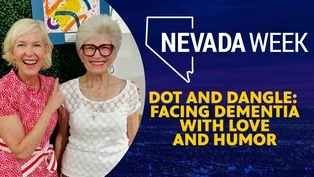
NewDot and Dangle: Facing Dementia with Love and Humor
Video has Closed Captions
Clip: S8 Ep42 | 7m 3s | Two women use YouTube to help dementia patients and caregivers lead with kindness and humor. (7m 3s)
Providing Support for PBS.org
Learn Moreabout PBS online sponsorship
- News and Public Affairs

Top journalists deliver compelling original analysis of the hour's headlines.

- News and Public Affairs

FRONTLINE is investigative journalism that questions, explains and changes our world.











Support for PBS provided by:
Nevada Week is a local public television program presented by Vegas PBS