
Actor Brian Taylor on his role as Dr. Martin Luther King, Jr. in Detroit Public Theatre’s “The Mountaintop”
Clip: Season 54 Episode 7 | 9m 16sVideo has Closed Captions
The award-winning play, “The Mountaintop,” is currently on stage at Detroit Public Theatre.
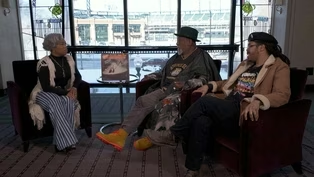
Actor and Detroit-area native Brian Taylor joins host Stephen Henderson to talk about his role as Dr. Martin Luther King, Jr. in the production of "The Mountaintop" currently playing at Detroit Public Theatre through March 8. The award-winning, two-person play reimagines the events that took place on the night before Dr. King's assassination in 1968.
Problems playing video? | Closed Captioning Feedback
Problems playing video? | Closed Captioning Feedback
American Black Journal is a local public television program presented by Detroit PBS
Actor Brian Taylor on his role as Dr. Martin Luther King, Jr. in Detroit Public Theatre’s “The Mountaintop”
Clip: Season 54 Episode 7 | 9m 16sVideo has Closed Captions
Actor and Detroit-area native Brian Taylor joins host Stephen Henderson to talk about his role as Dr. Martin Luther King, Jr. in the production of "The Mountaintop" currently playing at Detroit Public Theatre through March 8. The award-winning, two-person play reimagines the events that took place on the night before Dr. King's assassination in 1968.
Problems playing video? | Closed Captioning Feedback
How to Watch American Black Journal
American Black Journal is available to stream on pbs.org and the free PBS App, available on iPhone, Apple TV, Android TV, Android smartphones, Amazon Fire TV, Amazon Fire Tablet, Roku, Samsung Smart TV, and Vizio.
Providing Support for PBS.org
Learn Moreabout PBS online sponsorship- Welcome to "American Black Journal."
I'm your host Stephen Henderson.
The award-winning play "The Mountaintop" is currently on stage at Detroit Public Theater.
The two-person show reimagines the events that took place on the night before Dr.
Martin Luther King Jr.
's assassination at the Lorraine Motel in Memphis, Tennessee.
It is written by Pulitzer Prize-winning playwright Katori Hall and it runs through March 8th.
I'm pleased to have cast member Brian Taylor here.
Welcome to "American Black Journal."
- Oh, thank you for having me, Stephen.
- So no burden at all on you playing Martin Luther King on stage, that's gotta be the easiest role you've ever imagined doing.
I mean, it's almost comical to think of how you embody someone who is so recognized, so respected, and just so part of American culture and African American culture.
How do you even begin to think of just in toning even that character?
- Well, you know, and it is the heaviest lift of my career of any role that I've ever undertaken.
What I started with, actually, I worked with a famous legendary Hollywood acting coach, Ivana Chubbuck, on crafting who Dr.
King was as a person.
I think the trap that actors sometimes fall into when you have to portray characters like this, who we all have a imagination of who they are is trying to do the caricature route of it.
And I really focused on the humanity of who he was and the insecurities that he felt and, you know, his personal life, who he was behind closed doors.
So it really helped me grasp it and bring myself to the party, to say.
- Yeah, yeah.
- Yeah.
- This of course is an important moment for him, and it's a moment that I don't know that all of us think about.
We think about what happens the next day all the time.
Sort of walk us through what that story is of that day before.
We know about the speech, but we don't know about what else he was doing or thinking about.
- Yeah.
Well, Katori does an awesome job at demystifying Dr.
King, really bringing him down to size in a way that we can relate to him.
And obviously we don't know what happened the day before aside from him going to the church and giving his last speech, the Mountaintop Speech.
But the way the story is structured in the way I envision it, is that I think he was at a place where he kind of had a feeling that he was going to ascend to the mountaintop 'cause he wasn't originally gonna go to the church, but Ralph Abernathy said, "You gotta come down."
- Right.
"All these people are there."
- Yeah, "All these people are here to see you and be inspired by you."
I think he probably had a feeling of, you know, "I have to leave my final mark here tonight."
So I'm pretty sure there's a feeling of uneasiness or, you know, "Let me make sure everything's in order before that number's called."
And that's kind of how I've structured it in a way when I do this performance of just kind of sitting in that moment of just hearing everything and listening to everything and experiencing everything that you possibly can when you think, and none of us know, but when you think that time may be called for you.
- Yeah, yeah.
It's a two-person play, which is also kind of a burden.
That's a lot.
- It's a lot.
- That's a lot of work, right.
(both laughing) But it seems to me that, you know, in any play, the rapport and the interaction between the characters is really important.
That's doubly or maybe triply important when there's just two people.
- Yes, yes.
- Talk about your co-star.
- My co-star Rebecca Rose Mims is amazing.
She's a brilliant artist.
She probably won't like me to say this, but I'm gonna say it anyway.
She's only 26 years old and she is far beyond her time, not just in life, but as a performer.
And she's such a giving actor.
You don't always get the privilege to work with actors who are giving, and when that happens, it just allows you to settle and not think about other things other than just doing the work.
Because a two-person show is heavy.
- Yeah.
(laughs) - Like, it's a heavy lift.
I was actually watching Angela Bassett talk about her performance when she did with Samuel L. Jackson in 2009 and she was like, "I wish, you know, sometimes somebody else would come on stage to take a break."
- "Come take some of these lines," right?
- Yeah, yeah.
- Yeah.
So, what do you think is the message about Dr.
King that comes out of this play, which is just a, I mean, it's a dialogue, right?
It's conversation between these two people, really.
- Yes.
- What are people supposed to walk out of the theater feeling or thinking?
- I think two major messages: One, Dr.
King was just a man.
He wasn't a superhero, you know?
He wasn't, you know, Black Panther or like, Iron Man.
He was just a man who answered the call of millions and also had to deal with the hatred of millions.
- Yeah.
- And I think when you watch the play, by the end, you'll leave out thinking, "I too, you know, I may not have to do it at the magnitude of Dr.
King, but there is something that I can be doing, especially in the times that we're living in."
- Yeah.
- And I think the second most important message is we all have to pass the baton on; We can't wait for somebody else to do it.
It's gonna take a community initiative for us to see the world of tomorrow.
- Yeah.
- Yeah.
- Yeah.
You've done some other work at Detroit Public Theater.
I always want to take the opportunity to talk about kind of how special of a place that is, how special the work there tends to be, I think, because of the special place but it's different than other theaters.
- Yes.
I will forever be indebted to Detroit Club Theater because they gave me my very first professional star to play in "Skeleton Crew" alongside Ella Joyce, the legendary Ella Joyce, Brian Marable, who actually directed "The Mountaintop," And Shante Delan, another wonderful actress that play, "Detroit 67," where I played both Sly and Link in those shows.
But Courtney, Sarah, and Sarah, they've really taken the initiative- - The founders.
- The founders of Detroit Public Theater, to tell stories that always have a message, you know?
I always joke, I was like, "You guys always tell a message?"
But it just happens and they say, you know, it's not always intentional that way, but the stories that they choose to tell highlight communities who need a voice.
And it's always special when you do work at Detroit Public Theater.
- Yeah.
- Yeah.
- Tell us a little more about you, how did you get the acting bug and how did you get started?
- Well, you know, I always have to give credit to two people: My friend's mother TaRita Darden, who really, I did- My science teacher, she used to always make me like, do work and like, perform.
And TaRita Darden was like, "You should be an actor," before I even knew what it really was.
And my band teacher, Mr.
Randy Scott, who is a world renowned saxophonist, still is a saxophonist now, he would always allow me to host the band concerts.
And it got to a point where he had a script for me.
He was like, "You know what, Brian?
Just do whatever you wanna do.
The crowd loves you."
And then later years, like, I was a part of the Mosaic Youth Theater of Detroit.
- Oh, you were?
Oh, okay, I see you.
- And who really- - What a wonderful organization.
- What a absolutely wonderful organization.
If you are a young actor, you have to go to Mosaic Youth Theater of Detroit.
And they really teach you how to be a professional actor at a very young age.
And then years later, I worked with Ivana Chubbuck, who is actually a Detroit-bred acting coach.
She's major in Hollywood.
She actually is responsible for Halle Berry's and Charlize Theron's Academy Awards for "Monster" and "Monster's Ball."
And she took me under her wing and really just gave me permission to be an actor and to do what I do.
And more so with my work, I'm actually an acting coach as well with my own studio, the Detroit Drama Studio, so this journey has been amazing.
- Yeah, yeah.
- Yeah.
- All right, so after you play King, I don't know, what else can you even do, right?
(both laughing) What's another role that you could even slide into?
It feels like that's like, that's the part, that's the ultimate, right?
- Yeah, it's the ultimate.
Right now, actually, I do- I'm on a series on the Ucult streaming app actually, called "H-Block," where I play a detective, Detective Harvey on that show.
But after you play King... - Yeah, right?
- It's like... - What else is there?
- You know?
It's like, I'm aiming for Denzel and Sidney Poitier now.
So it's like, I want their roles.
- Yeah, yeah.
(Brian laughs) Well, it's great to have you here.
- I appreciate you.
- People should really get out and check out public theater and check out this play.
- Yes, and can I also say, I wore my Alpha Phi Alpha jacket today?
Dr.
King is also a member of Alpha Phi Alpha.
So, I had to represent, you know, my Alpha Brothers and my chapter at Eastern Michigan University, so.
- [Stephen] There you go.
- So thank you for having me.
- Yeah, it was great to have you here.
Thanks for joining us.
- Thank you.
 New
NewVideo has Closed Captions
Clip: S54 Ep7 | 12m 5s | Funk musician George Clinton reflects on Detroit’s influence on his career. (12m 5s)
Providing Support for PBS.org
Learn Moreabout PBS online sponsorship
- News and Public Affairs

Top journalists deliver compelling original analysis of the hour's headlines.

- News and Public Affairs

FRONTLINE is investigative journalism that questions, explains and changes our world.












Support for PBS provided by:
American Black Journal is a local public television program presented by Detroit PBS